
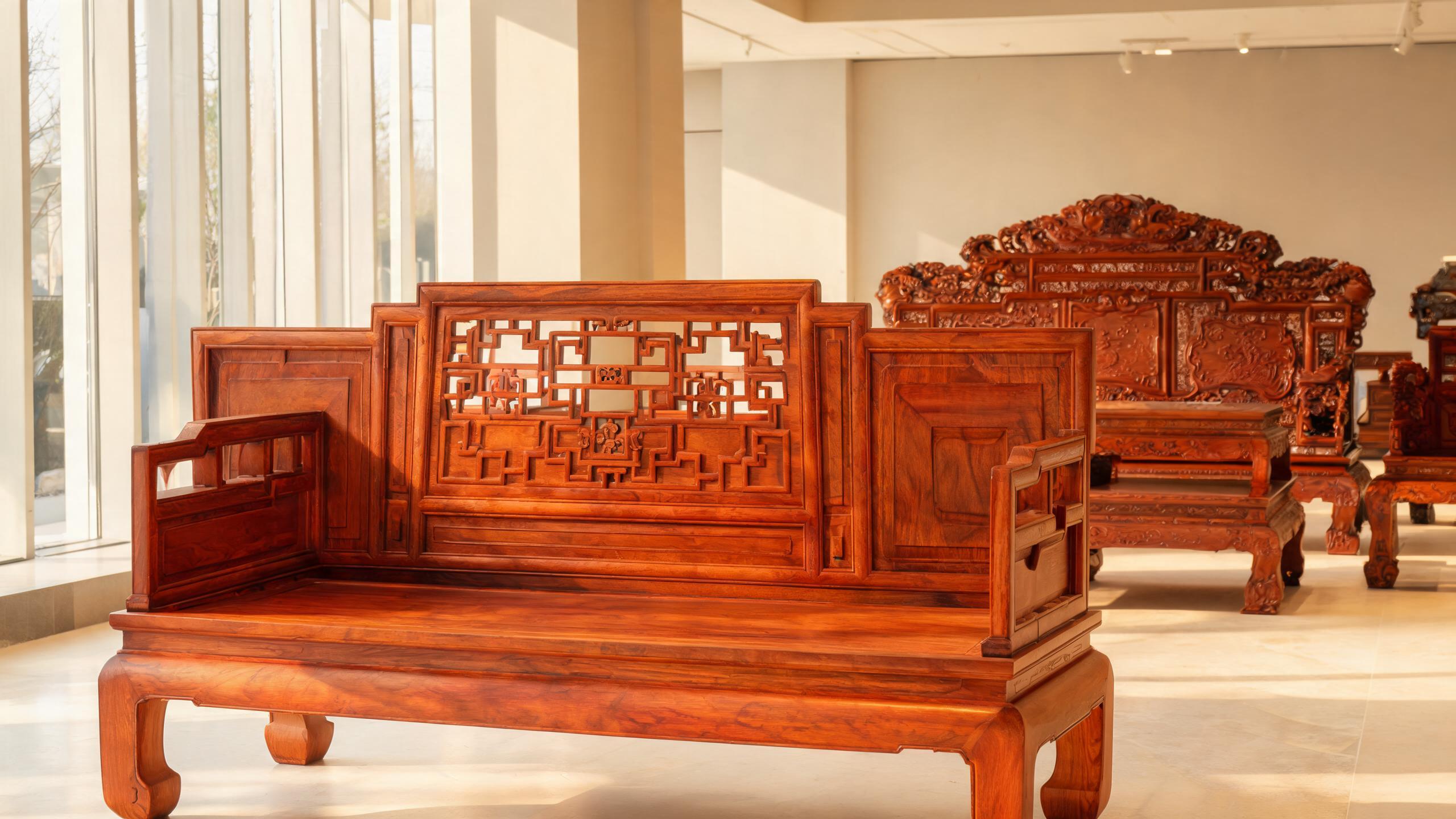
Una comparación práctica de los muebles clásicos de palisandro estilo Ming y Qing para importadores: lenguaje de diseño, mano de obra en tallado, elección de madera y acabados, documentación de cumplimiento, planificación de contenedores y opciones de personalización de un taller en Xianyou fundado en 2008.
Product News · Style Selection Guide · August 15, 2026
When an importer first opens a classical rosewood furniture catalog from China, the earliest and most consequential decision is rarely about timber grades or container volumes. It is about style. Classical Chinese hardwood furniture is written in two broad design languages - Ming and Qing - and the choice between them quietly determines which retailers will stock your pieces, which interiors the furniture will furnish, how many hours of carving labor each unit absorbs, and how the collection photographs in a showroom or a project mood board. Choose well, and the same container that leaves Fujian becomes the anchor of a coherent boutique collection. Choose carelessly, and even well-made furniture can sit in a warehouse because the style does not match the market it was bought for.
This guide is written for wholesalers, hotel project buyers, interior designers and purchasing managers who are deciding what a rosewood program should look like - literally. We will compare the two styles at the level that matters for procurement: geometry and joinery, carving depth and labor, timber selection, moisture control and finishing, compliance paperwork, container planning, and customization paths. Along the way we will ground every workshop claim in what Yunxiao Rosewood Furniture actually does in Xianyou County, Fujian - a 12,000 square meter factory founded in 2008 in one of China's traditional hardwood craft centers - rather than in generic industry talk.
Neither style is "better." They solve different commercial problems. Ming-style furniture rewards buyers who serve contemporary interiors, design-led retail and clients who want craft without ornament. Qing-style furniture rewards buyers who serve ceremonial spaces, hospitality projects and clients who buy furniture as a statement of presence. Most successful import programs we see running today mix both, in deliberate proportions. By the end of this article you should be able to decide your own proportions with confidence, and know exactly which questions to send to your supplier before a deposit is paid.
A note on scope: this is a selection and sourcing guide, not an art-history lecture. Historical context appears only where it changes a buying decision. Where a fact belongs to Yunxiao's own workshop - drying cycles, finishing systems, documentation - we say so plainly. Where something depends on your market, regulations or project, we flag it as a question to confirm with your supplier and customs broker.
What this guide covers
Two design languages, one craft tradition
Ming style: restrained geometry for modern interiors
Qing style: opulent carving and ceremonial presence
Side-by-side comparison table
What each style demands from the workshop
Timber selection across both styles
Moisture control and finishing: the invisible quality
Mapping styles to product lines
Which style fits which market and interior
Compliance and documentation for cross-border shipments
Container planning, lead times and trial orders
OEM and ODM customization paths
Five mistakes buyers make when choosing a style
After delivery: care, display and client handover
Frequently asked questions
Conclusion and next steps
Two Design Languages, One Craft Tradition
Chinese hardwood furniture did not develop as a single continuous style. The forms associated with the Ming dynasty (1368-1644) - clean lines, exposed joinery, restrained decoration - emerged from scholar-official taste and the timber trade of southern China. The forms associated with the Qing dynasty (1644-1912) evolved in imperial and merchant workshops toward larger proportions, deeper relief carving and denser symbolic decoration. Both traditions were carried forward by regional craft lineages, and Xianyou County in Fujian, where Yunxiao's factory stands, is one of the places where those lineages remained unbroken: families of carvers passing chisel techniques, motif conventions and joinery habits from one generation to the next.
For a buyer, the practical meaning is this: Ming and Qing are not quality tiers. They are two coherent systems of proportion, structure and decoration, produced today side by side in the same workshops, often by the same masters. A Qing-style carved sofa set and a Ming-style sofa set from the same factory may share identical timber conditioning, the same mortise-and-tenon frame philosophy and the same finishing line. What differs is how much of the craftsman's time goes into carving, how the silhouette reads in a room, and which client falls in love with it.
That is why style selection deserves to happen before price negotiation. Carving hours are a major component of unit cost; silhouette determines which interiors a piece can serve; and decoration density affects how a piece survives ocean freight and how it is maintained after delivery. A supplier can quote accurately only after the style question is settled, because the same "rosewood sofa" can represent very different amounts of handwork.
It is also why the question "Ming or Qing?" is really a portfolio question. Importers who treat it as a single-order preference tend to end up with fragmented catalogs that photograph inconsistently and appeal to no one sharply. Importers who treat it as a deliberate mix - a core line in one style, an accent line in the other - build collections with a recognizable identity.
Ming Style: Restrained Geometry for Modern Interiors
Ming-style furniture is built on the marriage of a small number of strong lines. Seats sit on gracefully curved or straight members; backs are low and open; aprons and stretchers are shaped but rarely crowded with ornament. Decoration, when it appears, is architectural: lattice panels, subtle cloud-shaped aprons, beaded edges, simple carved struts. The eye reads structure - joint, grain, silhouette - before it reads decoration. The aesthetic vocabulary matured centuries ago, yet it lands remarkably well in contemporary interiors, which is precisely why it has become the default choice for design-led retail in Europe and North America.
For an importer, the first commercial property of Ming style is photographic coherence. Clean-lined pieces share a visual grammar, so a mixed order - sofa set, dining table, display cabinet - reads as one collection in a catalog or on a website. Buyers merchandising online know how expensive it is to make mismatched furniture look like a family. Ming geometry does that work natively.
The second property is labor predictability. Because ornament is restrained, a Ming-style piece concentrates handwork where it matters structurally: joinery fitting, member shaping, surface preparation. There is less relief carving to quote, inspect and protect in transit - which simplifies both cost control and quality control. When carving does appear, it is usually openwork lattice or shallow relief, which an experienced buyer can verify quickly against samples and photos.
The third property is spatial generosity. Open backs and lean silhouettes make Ming-style pieces feel lighter than their mass, and they sit comfortably in apartments, showrooms and hotel lobbies where a fully carved Qing suite would dominate the room. For residential wholesale programs in dense urban markets, that visual lightness translates directly into sell-through.
What Ming style asks of the workshop is precision rather than ornament. Because every line is exposed, there is nowhere to hide: a twisted rail, an uneven joint gap or a poorly shaped leg is immediately visible. Grain selection matters more, since large plain surfaces display the timber itself. Buyers evaluating Ming-style production should therefore look hardest at joinery consistency and surface quality - the same disciplines that classical workshops in Xianyou have practiced for generations, and which we return to in the joinery section below.
Best fit: design-led retail, contemporary interiors, mixed residential programs, boutique hotels.
Commercial strength: coherent catalog photography, predictable labor cost, lighter visual weight per piece.
Watch-outs: precision demands are unforgiving; plain surfaces expose grain and finish quality; undecorated does not mean unskilled.
Qing Style: Opulent Carving and Ceremonial Presence
Qing-style furniture moves the drama from structure to surface. Proportions grow grander, members thicker, backs taller. Decoration deepens into full relief: dragon and phoenix motifs, flowing cloud scrolls, lattice-and-bird backrests, auspicious symbols carved into aprons, arms and stretchers. Historically this vocabulary served imperial and wealthy merchant interiors; today it serves clients who want furniture to carry presence - statement reception suites, ceremonial dining rooms, temple-adjacent hospitality projects, luxury villas where one ensemble anchors the whole floor plan.
The first commercial property of Qing style is unmistakable presence. A carved sofa set photographs as an event. In showrooms it stops foot traffic; in project proposals it gives designers a hero piece to build a scheme around. Buyers serving hospitality and high-end residential projects often find that a small number of carved statement pieces carry more margin and more word-of-mouth than a larger volume of quieter furniture.
The second property is craft visibility. Hand carving is self-evidencing: tool marks, undercutting and the slight asymmetry of the human hand distinguish genuine work from machine-carved imitation in ways an experienced buyer can verify - a topic we treat in detail in our guide on identifying authentic hand-carved redwood furniture. For importers whose clients pay for craft provenance, Qing-style pieces make that provenance legible at first glance.
The third property is symbolic storytelling. Dragon, phoenix, cloud and lattice motifs carry meanings that resonate strongly in Chinese diaspora markets and increasingly among Western clients who want interiors with narrative. Retail staff can sell the story; catalogs can annotate it. Quiet Ming lines demand a more design-literate sales conversation.
What Qing style asks of the workshop is carving depth and consistency. Deep relief must be carved by artisans who understand grain direction - undercut too aggressively and a scroll weakens; too timidly and the motif goes flat. Yunxiao's carving team works in the Xianyou tradition: master artisans hand-chisel dragon, cloud and lattice motifs into solid rosewood using traditional tools and regionally inherited methods. A five-piece Qing-style sofa set in our line, for example, carries a lattice-and-phoenix backrest carving across every seat element, finished with a nine-coat hand-rubbed raw lacquer surface - the kind of specification that only makes sense with a stable, experienced carving bench behind it.
Best fit: hospitality statement pieces, ceremonial and reception rooms, diaspora and gift markets, luxury villas and resorts.
Commercial strength: hero-piece pricing power, visible craft provenance, strong storytelling content for retail.
Watch-outs: carving labor raises unit cost; deep relief needs protective crating; heavy visual weight demands generous interiors.
Side-by-Side Comparison
Use this table as a first-pass filter. It deliberately compares buying-relevant attributes rather than museum categories.
Attribute | Ming Style | Qing Style |
|---|---|---|
Silhouette | Lean, open, horizontally calm | Grand, tall, vertically assertive |
Decoration | Lattice, shallow relief, shaped aprons | Deep relief: dragon, phoenix, cloud scrolls, lattice-and-bird panels |
Where handwork concentrates | Joinery, member shaping, surface | Carving bench, relief depth, motif consistency |
Interior fit | Contemporary, design-led, compact spaces | Ceremonial, hospitality, generous spaces |
Catalog coherence | Very high - pieces share visual grammar | High - strong family resemblance through motifs |
Cost structure | Predictable; less carving labor | Carving hours drive cost; more variance by motif |
Transit protection | Standard crating attention | Relief carving needs bracing and moisture barriers |
Sales conversation | Design and proportion led | Craft, symbolism and presence led |
Read the table as a portfolio prompt rather than a verdict. Most durable import programs we serve choose a primary style for volume lines and a secondary style for statement pieces - for example, a Ming-style dining and living core with one carved Qing reception suite per showroom as the anchor.
What Each Style Demands from the Workshop
Both styles stand on the same structural foundation in a serious workshop: mortise-and-tenon joinery. In classical hardwood furniture the frame is assembled without metal nails - members interlock through precisely fitted tenons, in Yunxiao's production reinforced with bamboo dowel pins, so that no metal fastener sits in the primary frame. This is not nostalgia; it is engineering. Wood moves with humidity. Mechanical fasteners concentrate stress at a point, and in dry heated interiors or air-conditioned hotel environments, that stress splits rails. Interlocked joinery distributes the movement and lets the frame breathe as a system - which is the classical answer to the classical failure mode of export furniture: cracking and deformation in foreign climates.
For Ming-style pieces, the workshop's discipline shows in fit and finish. Joint gaps measured in fractions of a millimeter, legs shaped consistently across a set, surfaces prepared so grain can speak. Because there is little ornament to admire, every structural detail is on display. A buyer inspecting Ming-style production should request close-up photos of joints from previous shipments and, ideally, a sample piece to disassemble mentally: feel the rail shoulders, sight along the members, check that stretchers sit flush.
For Qing-style pieces, the discipline shows on the carving bench. Consistency across a set matters most: when a lattice-and-phoenix motif appears on multiple chairs, the motifs should match in depth and rhythm, not drift between units. Depth should be genuinely three-dimensional - undercut scrolls and shadow-catching relief - rather than flattened pattern work. And carving must respect structure: decoration that cuts through load-bearing members weakens the piece no matter how beautiful it looks.
The styles also differ in inspection economics. Ming-style quality is verified largely by measurement and surface standards, which travel well in photos and spec sheets. Qing-style quality verification needs macro photography of carving detail and, for first orders, a physical sample. Importers should budget inspection time accordingly: one hour with calipers and a light source covers a Ming chair; a carved backrest deserves a slow walk with the camera.
Timber Selection Across Both Styles
Style and timber are separate decisions, but they interact. Yunxiao builds from legally certified timber: Siamese rosewood (Dalbergia cochinchinensis), Machilus nanmu, aged red wood and Grade-A tropical hardwood, sourced with legality documentation. Each species brings properties that suit different roles in a collection.
Siamese rosewood is the premium classical material - dense, deeply colored, with the strength to hold fine relief carving and the grain character to reward large plain surfaces. It is the timber behind our carved Qing-style statement pieces, and also behind refined Ming-style lines where the wood itself is the decoration. Note that Dalbergia species fall under CITES Appendix II, so shipments travel with export permits - more on compliance below.
Machilus nanmu and aged red wood offer excellent stability and warm tone, well suited to larger case pieces and programs where buyers want classical character at a different price point. Grade-A tropical hardwood rounds out structural roles in mixed programs. The buyer's decision is less "which species is best" than "which species carries which role": show surfaces and carved hero pieces in the premium rosewood; stable case goods and secondary lines in complementary certified timbers.
Statement carved pieces - Siamese rosewood with CITES Appendix II permits.
Design-led Ming lines - Siamese rosewood where grain is the ornament, or certified alternatives for volume programs.
Case goods, cabinets, wardrobes - Machilus nanmu and aged red wood for stability at scale.
Ask any supplier three timber questions before ordering: What exactly is this piece made from, species and grade? What legality documents accompany it? What is the moisture content at packing? A workshop that answers those three crisply is one that has already internalized export discipline. We publish our Siamese rosewood product specifications openly for exactly this reason - buyers should never have to guess what is under the finish.
Moisture Control and Finishing: The Invisible Quality
The failure that ends import relationships is rarely visible in showroom photos: a shipped container of furniture that cracks in a dry Northern European winter or a humid tropical summer. The defense is unglamorous and happens weeks before carving is even discussed - moisture control. Yunxiao conditions timber through a 36-day constant-humidity drying cycle, bringing stock to below 14% moisture content before it enters production, the threshold our workshop treats as the stability line for cross-climate export. Timber that leaves the drying room at a controlled, uniform moisture level moves far less after arrival, and joinery fitted around stable timber stays tight for years.
For buyers, this turns into a concrete supplier question: what is your drying process, and what moisture content do you certify at packing? A workshop that cannot answer with a number and a process is asking you to underwrite its risk. Our article on kiln drying and moisture control covers what the numbers mean and why they differ between species and thicknesses.
Finishing is the second invisible quality. Yunxiao finishes with an eco-friendly beeswax and lacquer system that meets EU REACH and US CARB requirements, and carved premium pieces receive a nine-coat hand-rubbed raw lacquer finish - a breathable, penetrating formula that protects the surface while allowing the timber to exchange moisture gently rather than trapping it under a plastic film. For export programs, finish chemistry is also a compliance question: REACH and CARB conformance is what keeps a container clearing customs without chemical-content surprises.
Maintenance expectations differ by style and finish, and retail buyers should be told at purchase. Hand-rubbed lacquer surfaces reward simple care - dry or barely damp dusting, avoidance of prolonged direct heat, periodic wax - while deep carved relief benefits from occasional soft-brush cleaning to keep dust out of the undercuts. Importers who include a one-page care card with each set report fewer after-sales complaints and better reviews.
Mapping Styles to Product Lines
Style strategy becomes real when it maps onto actual stock. A workable pattern many importers use with our catalog: build the living-room anchor and dining core in one style, then pull accent pieces from the other tradition to add range without breaking coherence.
For a Ming-led program, the natural core is a Ming-style living room set such as our nine-piece grand living room sofa suite, paired with a Ming-style round dining table for eight, and a lattice-door display cabinet that bridges living and dining zones. The display cabinet deserves special mention: lattice doors carry just enough classical vocabulary to sit happily beside Ming lines while adding storage retail clients always ask for. A Qing accent - one carved armchair or a small carved tea table - then gives the floor a focal point without converting the whole program.
For a Qing-led program, the anchor is a carved reception suite - our five-piece Qing-dynasty-style sofa set is the archetype: solid Siamese rosewood, lattice-and-phoenix backrests, nine-coat lacquer, mortise-and-tenon with bamboo dowels, CITES Appendix II paperwork included per shipment. Around it, quieter Ming-style dining and bedroom lines keep the program livable: the grandeur reads intentional rather than relentless. A canopy bed can serve either program - classical silhouette with moderate carving, equally at home beside Ming case goods or Qing statements.
Living anchor, Ming-led: Ming Style Siamese Rosewood Sofa 9-Piece Grand Living Room Set.
Living anchor, Qing-led: Qing Dynasty Style Carved Redwood Sofa 5-Piece Set.
Dining core: Ming Style Round Redwood Dining Table 8-Seat Set.
Bridge piece: Classical Siamese Rosewood Display Cabinet with Carved Lattice Doors.
Proportion guidance from our project experience: in mixed programs, keep roughly two-thirds of floor presence in the lead style. Below that, the collection loses identity; above it, the accent pieces stop reading as intentional. These ratios are a planning aid, not a rule - showrooms with strong lighting and generous spacing can carry more Qing presence than compact urban retail floors.
Which Style Fits Which Market and Interior
Yunxiao ships to Europe, North America, Southeast Asia and Australia, and each region leans differently. In Europe, design-led retail and interior studios gravitate to Ming-style lines: they sit comfortably beside contemporary and mid-century programs, and restrained ornament passes the region's interior photography culture, which favors calm backgrounds. Qing-style pieces in Europe tend to sell as singular statements - one carved suite anchoring a hotel lobby or a collector's reception room - rather than as volume lines.
In North America, both styles perform, but through different channels. Design showrooms and hospitality procurement favor Ming-led programs for the same reasons as Europe, while diaspora communities and luxury residential projects sustain steady demand for carved Qing-style ensembles, particularly dining suites for ceremonial family occasions and reception sofas for statement interiors.
Southeast Asia and Australia present humid-climate considerations that matter more than taste geography. Stable joinery and controlled moisture content - the disciplines described above - carry extra weight; a workshop that dries to below 14% and assembles without metal fasteners is exactly what these climates reward. Stylistically, Southeast Asian buyers often share the classical vocabulary natively, so carved programs travel well; Australian projects tend to mix classical statement pieces into contemporary coastal and modern interiors, favoring the Ming-led-plus-Qing-accent pattern.
Whatever the region, match style to the room the piece will actually occupy. Low, open Ming backs suit standard ceiling heights and compact apartments; tall carved Qing backs need space to breathe. A useful showroom test: photograph the piece against a plain wall at the ceiling height of your target market. If the silhouette crowds the frame, it belongs in a grander interior - or a grander room in your client's project.
Compliance and Documentation for Cross-Border Shipments
Rosewood sits at the intersection of beauty and regulation. Dalbergia species, including Siamese rosewood, are listed on CITES Appendix II, which means every legitimate cross-border shipment travels with export permits issued by the exporting authority. Yunxiao's internal team prepares full export documentation, and CITES Appendix II export permits accompany each Siamese rosewood shipment as a matter of course. Buyers importing into the EU additionally navigate the EU Timber Regulation framework and its evolution toward due-diligence expectations; US importers work within the Lacey Act declaration system. Our compliance guide for EU and US imports walks through the practical paperwork both regimes expect.
For style selection, compliance mostly reduces to one asymmetry: premium carved statement pieces concentrate value and regulated timber in single units, so their paperwork must be flawless - a hero suite seized or delayed over documentation is a catastrophic single point of failure. Volume Ming-led programs spread the same compliance effort across many units. Neither path avoids compliance; one simply punishes sloppiness faster.
Beyond timber paperwork, two more documents matter. FSC chain-of-custody certification covers the flow of certified material through the factory - Yunxiao maintains FSC certification for this purpose. And ISPM 15 heat-treatment certification applies to the wooden crates and pallets themselves; our export packaging is ISPM 15 heat-treated and engineered with bracing and moisture barriers specifically to protect relief carving in ocean freight.
Buyer's documentation checklist before deposit: species confirmation per piece; CITES permit scope if any Dalbergia is involved; FSC chain-of-custody reference; ISPM 15 certificate for packaging; finish chemistry statement for REACH/CARB; and the invoice-description wording your customs broker prefers. A supplier that produces this pack quickly has done it before.
None of this is decorative. Importers who retail classical rosewood successfully are, without exception, the ones whose paperwork is boring - same pack, every shipment, no surprises at the border.
Container Planning, Lead Times and Trial Orders
Classical rosewood furniture is dense and irregularly shaped; container planning rewards early attention. Carved Qing suites crate larger than their seat counts suggest because deep relief demands clearance and bracing; Ming-style flat-panel pieces pack more densely. A practical approach: request your supplier's packing list from a recent comparable shipment - pieces per crate, crate dimensions, total cubic meters - and model two or three style mixes in a container before finalizing orders. Yunxiao's team prepares packing layouts for project orders, and free layout drawings are available for project work, which removes most of the guesswork from this stage.
Production timing is straightforward when planned honestly: container orders complete in 45-60 working days after deposit. Add ocean transit, customs and inland delivery to build a realistic retail calendar - importers who plan product launches around this full chain, not the factory date alone, avoid the classic mistake of promising showroom dates the logistics cannot support. For long-term partners, partial shipments are available, which lets a new program launch with a first container while later volumes are still in production.
First-time buyers should not skip the trial step. Yunxiao offers trial single sets and refundable samples precisely because style decisions deserve physical verification: a Ming chair's proportions and a carved backrest's depth are experiences, not photographs. The trial set answers the two questions photos cannot - how the piece feels in a real room, and how your clients react to it - before a full container is committed. The modest cost of a trial is the cheapest insurance in this trade.
Plan after-sales support into the program too. Remote installation guidance is available for delivered sets, which matters for canopy beds and multi-piece suites whose assembly sequence is not obvious to every client's team. Retailers who can promise guided assembly close projects that pure e-commerce competitors cannot.
OEM and ODM Customization Paths
Style selection does not end at the catalog. Most serious import programs eventually customize, and classical furniture accommodates two distinct paths. OEM keeps a Yunxiao design and adapts it: dimensions adjusted to a market's room sizes, motifs swapped, configurations re-cut - a nine-piece living suite re-planned as seven, a dining set extended from eight to twelve seats. ODM starts from the buyer's concept: your proportions, your motif language, your finish specification, developed with our carving and joinery benches. Both paths draw on the same underlying disciplines - certified timber, controlled drying, nail-free joinery, REACH/CARB-conformant finishing - so customization changes the design, never the quality floor.
Customization is also where style strategy earns money. A Ming-led retailer that wants exclusive product differentiates most efficiently through dimension and configuration changes - visibly tailored, structurally conservative. A Qing-led program differentiates through motif development: a proprietary lattice pattern or a signature cloud scroll becomes a house style competitors cannot photograph into their own catalogs. Yunxiao accepts flexible OEM and ODM custom sizes and patterns for villas and resort projects, and free layout drawings support project customization.
Approach customization with the same evidence discipline as base orders: request dimension drawings before production, motif carvings sampled on the actual timber species, and finish swatches matched to your market's lighting. The most common customization failure is not ambition but ambiguity - a motif described in words and carved to a different image in the artisan's mind. Drawings and physical samples close that gap.
Five Mistakes Buyers Make When Choosing a Style
Choosing by taste instead of by market. The buyer's personal preference is a data point, not a strategy. Order the style your clients' interiors and retail channels can absorb.
Equating ornament with quality. A heavily carved piece from an undisciplined workshop is still badly made. Judge joinery, moisture discipline and finish first; decoration second.
Mixing styles without proportion. A fifty-fifty split usually reads as indecision. Lead with one style; use the other as deliberate accent.
Skipping the trial set. Photographs flatten proportion and depth. One physical sample prevents a container-scale misjudgment.
Treating compliance as the supplier's problem alone. Permits, FSC references and Lacey/EUTR declarations are a shared workflow; importers who engage their customs broker before the deposit move fastest when the container sails.
Each mistake is avoidable with a process, and the process is short: settle the market logic, verify the workshop, trial the physical piece, and paper the shipment properly.
After Delivery: Care, Display and Client Handover
The style decision follows the furniture home, and how a piece is handed over shapes how it ages. When container sets arrive, advise clients to let pieces acclimatize before final placement - a day or two out of direct heat and sunlight lets the timber settle into local humidity after weeks in a crate. Position carved Qing statement pieces away from radiators and strong afternoon sun, where repeated heat cycles stress both lacquer and relief; Ming-style pieces tolerate more placement freedom but still reward stable conditions and felt pads under legs on hard floors.
Handover materials matter commercially as much as physically. A short care card in the client's language, a placement note for carved pieces, and clear assembly guidance - Yunxiao provides remote installation guidance for delivered sets - turn a furniture delivery into a service experience. Retailers report that handover quality drives repeat orders more reliably than discounting, because the client's first month with the furniture is when judgments about the whole program are formed.
Display guidance differs by style once furniture reaches the showroom floor. Ming-led displays photograph best with negative space: keep two-thirds of the frame empty and let the silhouette carry the composition. Qing-led displays reward lighting that rakes across carved relief to produce shadow depth - a single warm accent light transforms a lattice-and-phoenix backrest between morning and evening viewing. Neither approach costs much; both measurably improve how long visitors stop at each vignette.
Frequently Asked Questions
Which style holds its value better?
Value retention tracks material, construction and condition more than style. Solid certified rosewood, nail-free mortise-and-tenon construction, controlled moisture content and intact hand carving are the value carriers in both traditions. A well-made Ming piece outperforms a poorly carved Qing piece, and vice versa.
Is Qing-style carving always more expensive?
Carving hours are a major cost driver, so deep-relief pieces generally carry higher labor content than restrained ones. But species, set configuration and dimensions move price too. Request itemized quotations - timber, structure, carving, finishing - and the comparison becomes transparent.
Can I mix Ming and Qing pieces in one container?
Yes, and most experienced buyers do. Plan the mix around the two-thirds proportion guidance above, keep documentation organized per timber species, and let the packing layout account for the carved pieces' bracing needs.
How does humidity affect my choice?
Climate affects construction discipline more than style. The protections - 36-day constant-humidity drying, below-14% moisture content, breathable hand-rubbed lacquer, nail-free joinery - apply to both styles and matter most in very dry heated interiors and humid tropical markets.
What customization minimums should I expect?
Customization feasibility depends on the change: dimension adjustments and configuration changes are routine; bespoke motif development needs sampling time. Confirm specifics with the supplier early, including drawing approval steps and sample lead times, so the 45-60 working-day container rhythm stays realistic.
Do you provide documentation for every shipment?
Yes. Yunxiao's internal team prepares full export documents; Siamese rosewood shipments include CITES Appendix II export permits, the factory maintains FSC chain-of-custody certification, and export crates are ISPM 15 heat-treated. Finish chemistry statements for REACH and CARB conformance are available on request.
How should we brief interior designers on the two styles?
Lead with room program, not labels. Give designers the silhouette heights, seat depths and motif vocabulary of each style, plus photographs of pieces in finished rooms. A designer who understands that Ming lines read as calm structure and Qing carving reads as ceremonial presence will place both correctly without needing the historical vocabulary.
What after-sales support can we promise our clients?
For delivered sets, remote installation guidance is available, and care guidance for lacquer and carved surfaces is straightforward to include in handover materials. Confirming these services at the point of sale, rather than after a problem arises, is what distinguishes a program from a one-off transaction.
Conclusion and Next Steps
Ming or Qing is a portfolio decision disguised as an aesthetic one. Ming-led programs buy coherence, contemporary fit and predictable labor economics; Qing-led programs buy presence, craft visibility and storytelling power. The strongest import programs we serve choose deliberately, verify the workshop underneath the style - certified timber, 36-day drying to below 14% moisture, nail-free mortise-and-tenon joinery, REACH/CARB-conformant finishing, complete shipment documentation - and let a physical trial set settle the question no photograph can.
Yunxiao Rosewood Furniture has built classical redwood suites in Xianyou since 2008, shipping to wholesalers, hotels and designers across Europe, North America, Southeast Asia and Australia. If you are deciding your program's style direction, tell us your target market and interior context; we will propose a style mix, confirm timber and compliance specifics, and prepare a trial set so the decision rests on evidence. Related reading: our guides on mortise-and-tenon joinery, Siamese rosewood as a material, kiln drying and moisture control, identifying hand carving and 2026 CITES developments cover each technical layer in depth.
Ready to specify your program? Send your target market, room dimensions and preferred style direction, and our team will respond with a proposed set configuration, timber and finish specification, compliance document pack overview, and trial-set arrangement - the evidence you need before committing a container.