
マホガニーは家具調達で最も検索される木材名の一つですが、多くの買手は真正マホガニーとローズウッドや商業的な「レッドウッド」を区別できません。本ガイドはB2B買手に植物学的事実、性能比較…
You type "what is mahogany wood" into a search bar because someone in your supply chain just used the word — a catalog, a quote sheet, a hotel fit-out schedule — and the term seems to mean different things to different people. One supplier prices "mahogany" at a premium. Another offers it at a fraction of that. A third tells you the piece you are looking at is not mahogany at all, but rosewood. Meanwhile the specification you received simply says "solid mahogany, dark finish," as if that settles everything.
For consumers, this confusion is an annoyance. For B2B buyers — importers, wholesalers, contract furniture procurement teams, hospitality project managers — it is a commercial risk. The word "mahogany" sits at the center of a web of botanical names, regional trade names, historical market habits, and, in Asia, a long-standing naming collision with rosewood and what English-language trade documents sometimes call "redwood." Ordering the wrong one means disputes at inspection, container loads of furniture that do not match the approved sample, or species claims that fail customs scrutiny.
This guide answers the question properly, from a furniture sourcing perspective. It covers what mahogany wood actually is in botanical terms, what mahogany wood is used for, how its properties compare with rosewood and redwood, where the naming confusions come from, and — most practically — how a B2B buyer should write wood species into purchase orders so that what arrives matches what was specified. Throughout, we will draw on the perspective of a manufacturer working daily in classical solid-wood furniture, where species identity, joinery, and finishing are the whole business.
What Is Mahogany Wood? The Botanical Answer
Mahogany is the common name for timber from trees in the genus Swietenia, a small group of tropical hardwoods in the mahogany family, Meliaceae. Botanists recognize three principal species, and the differences among them matter when you are buying at container scale.
The Three Genuine Mahoganies
Swietenia macrophylla — commonly called Honduran mahogany, big-leaf mahogany, or Brazilian mahogany — is the species the international furniture trade historically meant when it said "mahogany." Native range stretches from southern Mexico through Central America and into the Amazon basin. It is the wood of Chippendale-era commission books, of nineteenth-century ship cabin fittings, and of the classic "cabinet mahogany" reference samples still held by major timber institutes. Because decades of heavy harvesting reduced natural stands, S. macrophylla has been listed on CITES Appendix II since 2003, which means international trade requires permits and documented legal origin.
Swietenia mahagoni — West Indian or Cuban mahogany — is the original mahogany of European cabinetmaking, harvested heavily from the 1700s onward until commercially viable stands were largely exhausted. The wood is typically denser and often shows a finer, deeper figure than big-leaf mahogany. Today it is rare in trade; plantings exist across the Caribbean and southern Florida, but supply is negligible.
Swietenia humilis — Pacific Coast mahogany — grows in the dry forests along Mexico's Pacific slope and Central America. It is smaller, slower-growing, and rarely enters international trade in volume; when it does, it is usually mixed with big-leaf material from the same region.
The Plantation Mahoganies and Their Hybrids
As natural Swietenia stocks tightened, plantation forestry moved the genus across the tropics. Fiji, Indonesia, India, Bangladesh, the Philippines, and parts of Africa and Latin America now grow big-leaf mahogany and its hybrid with S. humilis. Plantation-grown wood tends to grow faster and therefore shows wider growth rings and somewhat lower average density than old-growth material, but well-managed plantations produce sound, stable, entirely serviceable furniture timber. For a B2B buyer, the meaningful distinction is not plantation versus natural in the abstract; it is whether the seller can document the species and origin at all.
African Mahogany: A Different Genus, a Long Market History
Here the definition widens. The timber trade has, for more than a century, applied the name "African mahogany" to species of the genus Khaya — chiefly Khaya ivorensis and Khaya anthotheca — which belong to the same family, Meliaceae, but a different genus. Khaya resembles Swietenia in color, in working properties, and in the ribbon-striped figure it shows on quarter-sawn faces, and it filled the supply gap as American mahogany became restricted. In practice, most "mahogany" furniture sold in Europe and North America in recent decades has been Khaya, not Swietenia. A careful buyer treats "African mahogany" as an accepted trade name for Khaya and requires the botanical name on documents — not because Khaya is inferior, but because the two command different prices and behave slightly differently in finishing.
The working definition: "Genuine mahogany" in the strict trade sense means Swietenia species. "African mahogany" means Khaya. Everything else that travels under the mahogany name in the market is, botanically, something else — and much of it is not even in the same family.
A Short History: Why Mahogany Became the Benchmark Cabinetwood
Understanding the market weight of the word "mahogany" helps a buyer understand why it is so often borrowed — honestly and dishonestly — for other woods. Mahogany entered European cabinetmaking in the early eighteenth century, arriving with trade from the Caribbean. It displaced walnut as the fashionable cabinetwood within a generation, and the reasons were practical, not merely fashionable.
Mahogany combined qualities that few timbers offer together: it is moderately hard yet works cleanly in every direction; it holds crisp carved detail — which suited the rococo and neoclassical carving fashion of the period; it resists splitting when screws are driven close to edges; it swells and shrinks less across the grain than many comparably hard woods; and its natural color deepens with age and polishing into the deep reddish-brown that still defines the "mahogany look." London cabinetmakers of the Chippendale era carved it into openwork fretwork and acanthus scrollwork; shipbuilders prized it for cabin joinery because it resisted rot in humid conditions.
That three-century record built the reputation the name now carries. It also explains the fraud problem: because "mahogany" sells furniture, plenty of timber that is not mahogany has been dressed in the name. A B2B buyer who understands what genuine mahogany actually is can specify it with precision — and can spot the substitutions.
What Is Mahogany Wood Used For?
The supporting question buyers type almost as often as the main one is "what is mahogany wood used for," and the answer is broad, because few timbers have such a wide service record.
Furniture and Cabinetry
This remains the flagship use. Mahogany takes fine detail from moulding planes and carving gouges, holds screws without splitting, and finishes to a glass-smooth surface, which makes it a first-choice timber for bedroom suites, dining sets, display and storage cabinets, desks, and veneered panels. In reproduction and classical furniture — the segment our own workshop works in — close-grained cabinetwoods in the mahogany color range are used for carved armoires, sideboards, tea tables, and chair frames, where the wood must accept both hand carving and multi-coat finishing.
Doors, Windows, and Architectural Joinery
Mahogany-family timbers have excellent dimensional stability and moderate natural durability, and they machine to sharp arrises without fuzzy grain. That combination made them a standard for exterior doors, window frames, and boat trim — applications where movement and moisture would punish a less stable wood.
Musical Instruments and Specialty Trades
Guitar makers value mahogany for acoustic guitar backs, sides, and necks because it is light relative to its stiffness and dampens vibration in a musically pleasing way. Pattern shops historically used it for foundry patterns for the same stability reasons.
Panelling, Mouldings, and Interior Fit-Out
In hospitality and institutional interiors, mahogany-color joinery — wall panelling, reception desks, banisters, library shelving — carries the visual language of formality. Much of this work uses mahogany-family solid wood or veneer over stable substrates, chosen for finish quality and consistency across large runs.
For a procurement team, the practical point is this: mahogany's service record spans high-wear furniture, exterior exposure, and precision specialty work. When a project brief says "mahogany look, contract-grade durability," the specification conversation should be about which mahogany-family species, what documentation, and what finish system — not about whether the name is real.
Mahogany Wood Properties: What a Buyer Should Actually Test
Marketing copy will tell you mahogany is "durable," "stable," and "beautiful." Those words are true but empty until they are tied to measurable properties and to the use case. Here is how the wood behaves, and what each behavior means at order time.
Color and Figure
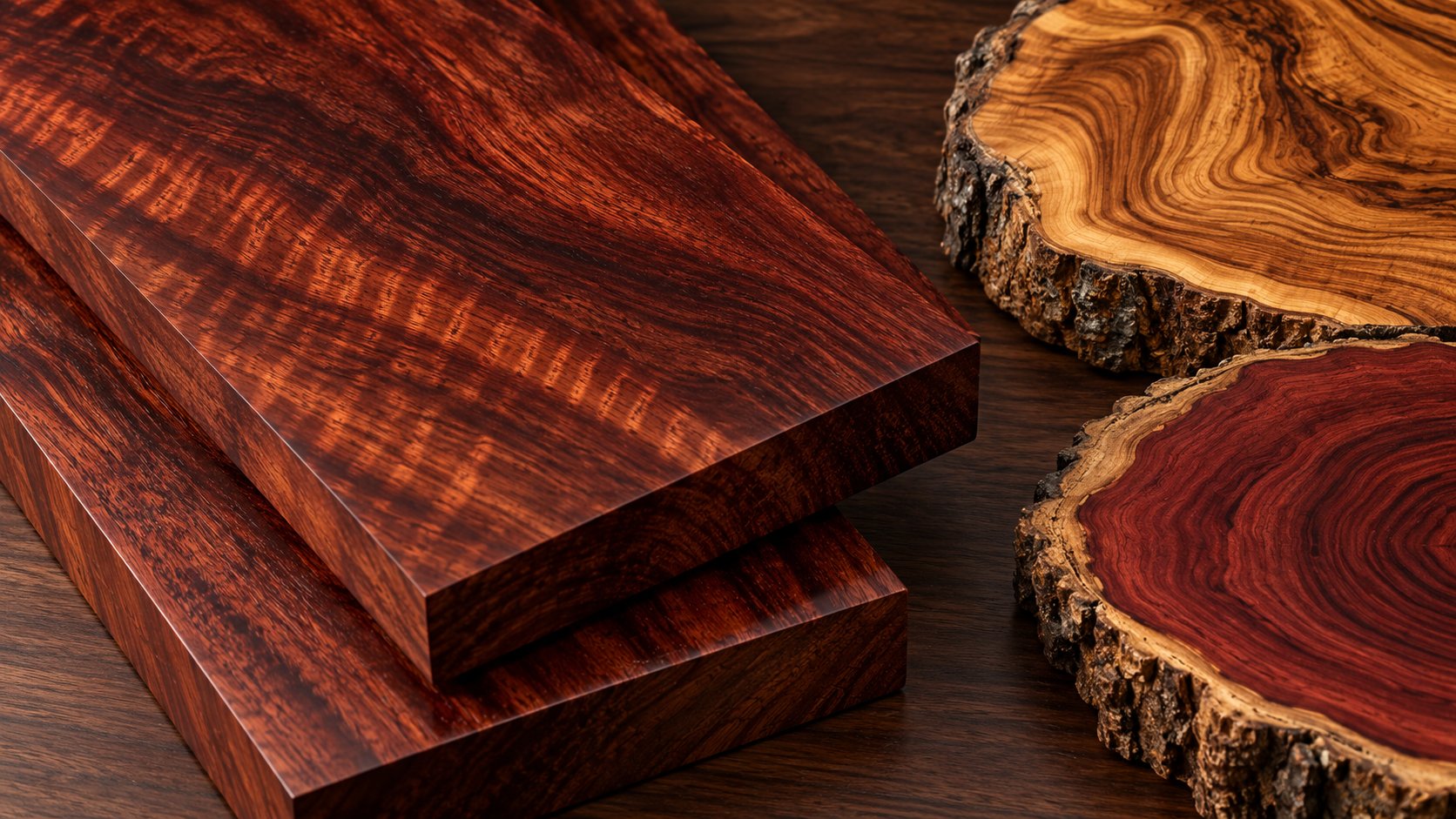
Freshly cut mahogany is pinkish to salmon; it deepens over months of light exposure to the characteristic reddish brown. Quarter-sawn faces show ribbon or stripe figure — alternating light and dark bands caused by interlocked grain — which is prized on panels and veneers. Flat-sawn faces show a plainer, cathedral grain. For furniture buyers this matters in grading: premium work specifies ribbon-stripe consistency on visible faces; volume work accepts mixed grain.
Density and Hardness
Genuine mahogany sits in the middle of the hardwood density range — roughly 500 to 650 kilograms per cubic meter at 12 percent moisture content for big-leaf material, with African mahogany similar or slightly lighter. On the Janka scale it lands around 800 to 900 pounds-force depending on species and origin. Those numbers place it well below the dense rosewoods and the heavy tropical "ironwoods," and far above pines and other softwoods. In plain terms: mahogany is comfortable to carve and kind to cutting tools, resists everyday dents in normal furniture service, but is not the right choice where a specification demands extreme surface hardness — think heavily used bar tops or high-traffic thresholds.
Dimensional Stability
Mahogany's shrinkage coefficients are low for its density class, and the wood is famous for staying flat. Wide boards and wide veneer panels hold their shape; doors built in mahogany-family timber resist warping in humid climates. This stability is the technical reason the wood conquered boat and door trades, and it is a strong argument in furniture destined for Southeast Asian, coastal Australian, or Gulf-state humidity.
Workability and Finishing
The wood cuts cleanly in every grain direction — the interlocked grain occasionally tears on aggressive planing, but sharp tools and moderate feed rates solve it. It glues reliably, holds screws near edges without splitting, steam-bends acceptably, and — critically for classical furniture — accepts both hand carving and lacquer finishing superbly. Its open-to-medium pore structure takes oil, shellac, and lacquer into a deep, lustrous surface; multi-coat finishing schedules build exceptional depth on mahogany-family timber.
Natural Durability
Heartwood of genuine mahogany has moderate natural resistance to decay fungi and to termites — better than most temperate hardwoods, not in the class of the most durable tropical species. For interior furniture this is more than adequate; for exterior use in harsh climates, protective finishing and design detailing carry the load, as with any furniture timber.
Hardwood or Softwood?
A common side-question: is mahogany a hardwood? Yes — botanically it is an angiosperm, a broadleaf, and in trade terms a tropical hardwood. The hardwood/softwood split is botanical, not a hardness rating, but mahogany passes on both counts for most furniture purposes: it is a true hardwood with respectable surface hardness.
| Property | Genuine mahogany (Swietenia) | African mahogany (Khaya) |
|---|---|---|
| Average density (12% MC) | ≈ 500–650 kg/m³ | ≈ 450–600 kg/m³ |
| Janka hardness | ≈ 800–900 lbf | ≈ 750–850 lbf |
| Color when finished | Deep reddish brown | Medium reddish brown, more pink cast |
| Figure | Ribbon stripe, interlocked | Ribbon stripe, often bolder |
| Stability | Excellent | Very good |
| CITES status | Appendix II (S. macrophylla) | Not CITES-listed |
Treat these figures as class guides rather than guarantees — timber varies tree to tree, and a responsible supplier confirms against the actual batch and the applicable standard.
Mahogany vs Rosewood: The Comparison Buyers Actually Need
The single most common sourcing confusion in Asian furniture trade is between mahogany and rosewood. The two names get mixed in quotations, in hotel fit-out schedules, and in buyer inquiries, so it is worth separating them completely — botanically, visually, mechanically, and commercially.
They Are Not Even Relatives
Mahogany belongs to the family Meliaceae, genus Swietenia (or Khaya in the African case). Rosewood belongs to the family Fabaceae — the legumes — genus Dalbergia, a large genus whose timbers trade under regional names: Indian rosewood (Dalbergia latifolia), Brazilian rosewood (D. nigra, now CITES Appendix I), East African and African blackwood relatives, and in Southeast Asia the group the Chinese trade calls hongmu — including Dalbergia cochinchinensis, known in English as Siamese rosewood or Thai rosewood.
They also differ in the trade regime that governs them. Virtually the entire Dalbergia genus was placed on CITES Appendix II in 2017, with Brazilian rosewood on Appendix I. Genuine big-leaf mahogany has been Appendix II since 2003. Practically, this means both families of timber can move in international commerce only with documentation — but the paperwork, quotas, and enforcement pressure differ, and a buyer who cannot name the species on documents will eventually meet a customs officer who insists on knowing.
Color, Figure, and Surface Behavior
Mahogany is a uniform reddish brown that deepens evenly with age; its drama comes from ribbon figure on quartered faces. Rosewoods are more varied and more dramatic: dark chocolate to violet-brown to near-black backgrounds streaked with darker grain lines, sometimes with golden or red sapwood contrast. Siamese rosewood in particular shows dense, oily grain with striking dark figuring that polishes to a depth mahogany cannot match.
Surface chemistry explains part of the aesthetic difference. Rosewoods are rich in natural oils and aromatic compounds — the same compounds that give rosewood its distinctive scent — which give the finished surface a waxy, self-lubricating feel. That oiliness complicates gluing and some finish systems (solvent wiping before gluing is standard practice), but it rewards hand-rubbed finishing and means the furniture improves with handling. Mahogany is comparatively "dry" and finish-agnostic: it takes lacquer, oil, shellac, and polish systems without chemistry fights, which is why European polished furniture traditions built on it.
Density, Hardness, and Feel in the Hand
This is where the two woods separate decisively. Siamese rosewood runs roughly 1,000 to 1,200 kilograms per cubic meter — nearly double the density of mahogany — and its Janka hardness is far above mahogany's. A rosewood chair back feels dense, heavy, and cool in the hand; the same chair in mahogany feels notably lighter. Neither is better; they are different tools. Rosewood's mass gives classical Chinese furniture its planted, grounded presence and its scratch-and-wear resistance. Mahogany's lighter weight and mid-range hardness make it easier to move, easier on hardware, and comfortable for large case pieces.
Carving Detail and Joinery Behavior
Mahogany carves crisply and cleanly — it was the eighteenth century's carving wood of choice — and holds fine moulding detail with minimal grain tear. Siamese rosewood carves beautifully too, but its density and interlocked grain demand sharper tools, slower work, and more tool maintenance; deep openwork carving in rosewood is slow, expert work. In joinery, mahogany glues and screws more forgivingly; rosewood's oiliness demands surface preparation before gluing, though its strength in mortise-and-tenon construction is superb. Traditional Chinese cabinetmaking solved rosewood's gluing challenges centuries ago by building furniture almost entirely on mortise-and-tenon joinery with hand-cut dovetails — no glue dependence — a method our own production continues today.
Price and Market Position
Genuine Swietenia mahogany commands high prices and restricted supply; African mahogany trades at a moderate premium over general utility hardwoods; both sit below the best rosewoods. Collectible hongmu — Siamese rosewood foremost — has appreciated steeply as supplies tighten under CITES pressure and Chinese classical furniture demand grows. For a B2B buyer, the price conversation should be reframed as a value conversation: what does the project need — mahogany's stability and finish depth at a working price, or rosewood's density, collectible character, and heritage story at a premium?
| Attribute | Mahogany (Swietenia / Khaya) | Rosewood / Siamese rosewood (Dalbergia) |
|---|---|---|
| Botanical family | Meliaceae | Fabaceae |
| Density (12% MC) | ≈ 450–650 kg/m³ | ≈ 1,000–1,200 kg/m³ |
| Surface feel | Smooth, finish-dependent | Oily, waxy, self-lubricating |
| Carving behavior | Crisp, easy detail | Superb but slow, expert-level |
| Gluing | Straightforward | Requires oil removal/prep |
| Weight in furniture | Moderate, movable | Heavy, planted presence |
| CITES | Appendix II (S. macrophylla) | Appendix II (genus-wide) |
| Market role | Contract & classic furniture workhorse | Premium classical & collectible |
Mahogany vs "Redwood": Untangling the Asian Trade-Name Collision
If mahogany-versus-rosewood is a botanical confusion, mahogany-versus-redwood is a translation accident with real money attached to it.
Where the Word "Redwood" Goes Wrong
In North American timber trade, "redwood" means Sequoia sempervirens — the coast redwood of California, a softwood used for decking and outdoor structures. That is one meaning. But in Asian furniture trade, the English word "redwood" often appears as a direct translation of the Chinese term hongmu (红木) — literally "red wood" — which is not a botanical category at all but a Chinese national standard (GB/T 18107) covering five genera and roughly twenty-nine species of dense tropical hardwoods used in classical Chinese furniture. Siamese rosewood is a hongmu species. So is a group of Pterocarpus timbers, various Dalbergia species, and others.
The result is a three-way collision. An American buyer reading "redwood furniture" may picture a softwood deck chair. A European buyer may picture mahogany's color. A Chinese-market-facing supplier means: dense tropical hardwood in the classical Chinese furniture tradition — overwhelmingly Dalbergia rosewoods and their relatives. Contracts that say "redwood" without a botanical name inherit all of this ambiguity.
The Practical Rule for Buyers
The rule that resolves every one of these collisions is the same rule: the botanical name governs, trade names decorate. A specification that reads "Dalbergia cochinchinensis (Siamese rosewood), solid wood, air-dried to 12% ± 2% moisture content" cannot be misunderstood. A specification that reads "redwood, mahogany color" can be filled with almost anything the market offers that week.
Buyers sourcing classical furniture from China should also understand how the hongmu standard functions as a quality benchmark. Under GB/T 18107, furniture sold as hongmu in the Chinese domestic market must use the listed species in specified forms (heartwood, no sapwood on visible faces under the strict reading), which gives buyers a enforceable reference point. When your supplier certifies Siamese rosewood against that standard, you are not buying a marketing phrase; you are buying into a codified species list.
Grading and the "Mahogany" Impostors
Because the mahogany name sells, several unrelated timbers have historically traveled under it. A B2B buyer evaluating a "mahogany" quotation should know the main ones.
Philippine Mahogany Is Not Mahogany
The most widespread impostor is "Philippine mahogany" — a trade name applied to several Shorea species (lauan, meranti groups) from Southeast Asia. These are dipterocarps, unrelated to Meliaceae, lighter and paler, and priced far below genuine mahogany. The United States formally restricted the use of the name on labelling decades ago for precisely this reason, yet the term persists in quotes and catalogs. If a "mahogany" price looks too good, check whether the species is Shorea.
Stained Softwoods and "Mahogany Finish"
Lower-tier market goods sometimes use plantation softwoods or cheap hardwoods stained to mahogany color and sold with the phrase "mahogany finish." That phrase — "finish" — is doing heavy lifting. A "mahogany-finish" piece is finished in mahogany's color; it is not made of mahogany. Neither statement is fraudulent on its own, but a purchase order must say which one the buyer intends.
Santos Mahogany and Other Borrowed Names
Myroxylon balsamum trades as Santos mahogany — a dense, reddish South American timber, unrelated to Swietenia, harder than true mahogany and used mainly for flooring. Eucalyptus plantations are sometimes marketed with mahogany-associated names. None of these are dishonest products; they are simply not the wood the word historically means, and contracts should not pretend otherwise.
Specification checklist for "mahogany": 1) Botanical genus and species on documents (Swietenia macrophylla, Khaya ivorensis, etc.). 2) Origin (country and, where available, forest or plantation). 3) CITES paperwork status for Appendix II species. 4) Moisture content at shipment. 5) Grading of visible faces (ribbon stripe, color consistency). 6) Whether "finish" items are solid or veneered. Any quotation missing these lines is asking you to buy a name.
How B2B Buyers Should Write Wood Species Into Furniture Orders
Everything above converges on one operational question: what exactly goes in the purchase order so the container that arrives matches the sample you approved? After years of working with overseas buyers on classical solid-wood furniture, we recommend a specification structure that has prevented every species dispute we have seen.
1. Name the Species Botanically, Then the Trade Name
Write the scientific name first and the trade name in parentheses: "Dalbergia cochinchinensis (Siamese rosewood)." This ordering forces the conversation onto the plant, not the label. If your market legally requires a specific trade term, add it as a third element, not a substitute.
2. Specify Solid Versus Veneered, Component by Component
"Solid mahogany" often means "solid where visible, veneered elsewhere." For classical furniture that claim would be unusual — our own production is solid wood throughout, with hand-carved elements cut from the same timber — but volume contract furniture commonly veneers panels. Both approaches are legitimate; ambiguity is not. List which components must be solid (carved aprons, legs, frames) and which may be veneered (large flat panels), and state the substrate if veneer is allowed.
3. Bind Moisture Content to Shipment, Not to Promise
Air-dried or kiln-dried to a stated moisture content — 12% ± 2% is the working norm for furniture destined for temperate markets; buyers in equatorial markets may agree different targets with their supplier. State that moisture content is measured at packing, with a meter check permitted at inspection. This single line prevents the majority of "my furniture cracked" disputes, which are usually movement in improperly dried wood, not species failure.
4. Require Documentation as a Condition of Payment
For CITES-listed timbers, make the export permit and species documentation a condition tied to the shipping documents. Reputable manufacturers maintain this paperwork as routine — orders in CITES-listed Siamese rosewood ship with CITES documentation, and FSC-certified supply is available on the corresponding chain-of-custody terms where claimed. Buyers should not treat documentation as a favor; it is part of the goods.
5. Approve Color and Figure on Physical Standards
Wood varies. Approve a physical sample or a photographed standard batch for color, and specify ribbon-stripe or plain-sawn expectations per face class. Digital color references fail; timber under different lighting shifts dramatically.
6. Put Joinery and Finish on the Same Page as the Species
Species choice and construction method are one decision, not two. Dense, oily rosewood rewards mortise-and-tenon and dovetail construction with minimal glue dependence; mahogany-family timber performs beautifully under either traditional or glued construction. State the joinery (mortise-and-tenon frames, dovetailed drawers), the finish system (for example, multi-coat raw lacquer, hand-rubbed), and the hardware class in the same specification block as the species. A classical Siamese rosewood sideboard with hand-cut dovetail drawers, for instance, is specified correctly only when timber, joinery, and finish appear together — the dovetail drawers are as much a quality claim as the wood itself.
A Model Specification Block
- Species: Dalbergia cochinchinensis (Siamese rosewood), solid wood throughout; or Swietenia macrophylla (genuine mahogany) / Khaya ivorensis (African mahogany) for mahogany-spec lines.
- Moisture content: 12% ± 2% at packing, meter verification at inspection.
- Construction: mortise-and-tenon frames; dovetailed drawers; floating panels in door and panel work.
- Carving: hand-carved decoration per approved drawings.
- Finish: six- to seven-coat natural raw lacquer, hand-rubbed.
- Documentation: CITES export permit where applicable; FSC chain-of-custody on request for FSC-claimed orders.
- Inspection: pre-shipment inspection with right to species verification.
A specification in this shape can be quoted accurately by any serious factory in Asia, and it cannot be quietly substituted. It is, in effect, the practical answer to "what is mahogany wood" for a professional buyer: the name plus the numbers plus the papers.
Where Rosewood Wins, Where Mahogany Wins: Choosing for the Order
B2B buyers rarely need a debate; they need a decision framework. Here is the one we walk through with procurement teams choosing between mahogany-family timbers and rosewoods for a furniture program.
Choose Rosewood (Especially Siamese Rosewood) When:
- The program is classical Chinese or heritage-style furniture where density, depth of polish, and collectible character are the value proposition.
- End use demands maximum surface hardness — hotel lounges, executive suites, high-end residential statement pieces.
- The market reads hongmu as a quality mark — Southeast Asia, Chinese-speaking markets, and collectors worldwide.
- The client wants furniture that appreciates as material, not just serves as product; tightening Siamese rosewood supply has historically supported its value.
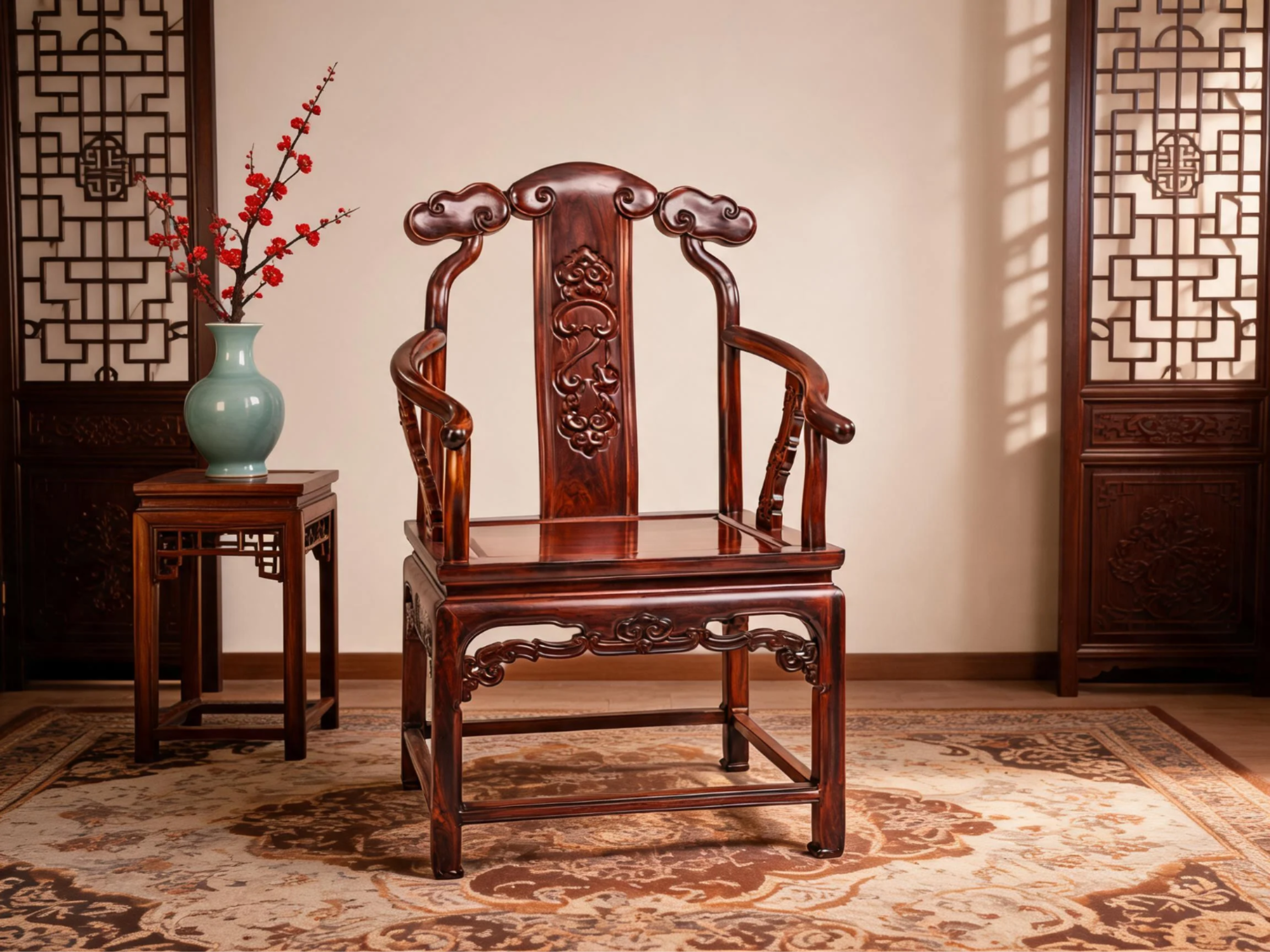
A hand-carved rosewood tea table with bamboo apron or a Ming-style ruyi-back armchair demonstrates the case: dense grain, crisp hand carving, and a lacquer depth that light hardwoods cannot reproduce.
Choose Mahogany-Family Timber When:
- The program is European or American classical furniture where the polished mahogany tradition is the design language.
- Weight matters — large case goods, furniture that will be moved frequently, upper-floor residential delivery constraints.
- Budget requires a premium look at a working price; African mahogany delivers ribbon figure and finish depth below rosewood cost.
- Complex glued construction or extensive carved moulding benefits from mahogany's forgiving working properties.
Choose Both, Separated by Product Line:
Many importers run a two-tier program: rosewood for the classical heritage line and mahogany-family timbers for the European-polish contract line. This is exactly how the furniture market has structured itself for two centuries, and it lets one supplier relationship serve both aesthetics. What must never happen is the two names sharing one line of a quotation with no botanical names — that is the seed of every dispute this article is designed to prevent.
Sustainability, Legality, and the Paper Trail
No contemporary B2B specification is complete without the legality and sustainability dimension, and both mahogany and rosewood sit squarely inside it.
CITES in Daily Practice
Both big-leaf mahogany and the rosewood genus travel under CITES Appendix II, meaning international trade is legal but documented. In daily buying terms this means: your supplier must hold or obtain export permits; your broker clears the shipment against them; and the species named on the permit must match the species in the container. Buyers sometimes discover, at customs, that a shipment documented as one Dalbergia species was another — a costly mismatch that proper pre-shipment species verification prevents. Working with manufacturers who document CITES paperwork as a routine part of the shipment, as we do for every Siamese rosewood order, removes most of this risk before the container is stuffed.
FSC and Chain of Custody
For buyers serving government contracts, green-building programs, or sustainability-audited retail, FSC chain-of-custody certification matters. Ask prospective suppliers whether certified supply is available for your species and volumes, and on what terms — certified material typically carries a premium and minimum-quantity conditions. Where certification is not available for a species or volume, ask instead for documented legal origin: harvest permits, transport documents, and supplier declarations. The combination of CITES (where applicable), FSC (where claimed), and legal-origin documentation (always) covers the audit surface for nearly every B2B program.
Plantation Supply as the Long-Term Base
The supply future for both timber families is plantation-based. Mahogany plantations across the tropical Pacific and Latin America, and Dalbergia and Pterocarpus plantations across Southeast Asia, are steadily replacing natural-forest harvest. For buyers, this shifts due diligence toward species verification and plantation legality — areas where a manufacturer's documentation discipline matters more than the forest's location on a map.
Frequently Asked Questions from Furniture Buyers
Is mahogany the same as rosewood?
No. They are different botanical families: mahogany is Swietenia (or African Khaya) in the Meliaceae family; rosewood is Dalbergia in the legume family. Rosewood is roughly twice as dense, oilier to the touch, darker and more dramatically figured, and carries a different market position — collectible classical furniture versus the polished cabinetwood tradition. Both are genuine hardwoods and both can be CITES-listed depending on species.
Why do some suppliers' "mahogany" prices differ so much?
Because the word covers different timbers. Genuine Swietenia mahogany, African Khaya mahogany, and "Philippine mahogany" (actually Shorea, an unrelated and much cheaper wood) can all appear in quotes under one name. The botanical name on the quotation is the only reliable price comparator.
Is mahogany a good choice for hotel and contract furniture?
Mahogany-family timbers are a proven contract choice where the design language calls for polished classical furniture: they are stable in humidity, moderate in weight, and finish beautifully at scale. Where the specification demands maximum surface hardness and a heritage-material story, dense rosewoods are the stronger match. Many hotel programs use both, assigned by product line.
What documentation should I require when ordering CITES-listed timbers?
Require the CITES export permit (and corresponding import paperwork for your market), with the botanical species named, tied to your shipping documents. Add FSC chain-of-custody certificates where certification is claimed, legal-origin documentation for non-listed species, and a pre-shipment inspection clause that includes the right to species verification.
How do I stop a supplier substituting a cheaper wood?
Write the botanical name, origin, moisture content, and grading into the purchase order; approve physical color and figure samples; and make species verification part of pre-shipment inspection with payment conditioned on documents. Suppliers who intend to substitute rarely accept these terms; that reaction is itself useful information.
Does Yunxiao manufacture in mahogany?
Our workshop specializes in classical furniture in Siamese rosewood (Dalbergia cochinchinensis) and related dense tropical hardwoods in the Chinese classical tradition — the hongmu segment, not Swietenia mahogany. Buyers comparing the two for a program can use this guide's framework to assign each timber to the product lines where it performs best, and we are glad to advise on species-to-application fit for specific projects.
Conclusion: The Name Is the Start of the Specification, Not the End
The question "what is mahogany wood" looks like vocabulary; for a furniture buyer it is contract language. Mahogany, rosewood, and redwood are three names that overlap in color, in marketing, and in everyday speech — and diverge completely in botany, performance, price, and paperwork. Genuine mahogany is the stable, finish-friendly cabinetwood of the Western polished tradition. Rosewood — above all Siamese rosewood — is the dense, oily, collectible timber of Chinese classical furniture. "Redwood" is whatever the writer meant, which is why it does not belong in a purchase order without a botanical name beside it.
The buyers who source well are not the ones with the best memory for wood lore; they are the ones whose documents carry botanical names, moisture numbers, joinery and finish requirements, and species-verifiable inspection rights. That specification discipline converts three centuries of timber naming confusion into a clean, enforceable order — and it is the difference between furniture that matches the sample and a container of expensive surprises.
If your current program is weighing mahogany-family timbers against Siamese rosewood — or if you simply want a second pair of expert eyes on the species lines in your next specification — our team works with these questions daily. Explore how classical rosewood furniture is built, from a carved-lattice display cabinet to a stone-top square tea table or a carved-back lounge chair, and see the material-and-craft decisions in finished form.
Discuss Your Wood Specification With Our Team
Tell us your target market, product mix, and timber questions — species documentation, moisture targets, joinery and finish standards — and our production team will review your requirement and prepare a selection and quotation response. Whether your program calls for classical Siamese rosewood pieces or another direction in solid-wood furniture, start the conversation with the specification, not the guesswork.
Request Wood & Product Consultation