Australia applies a biosecurity-first import regime on top of standard customs. This B2B guide covers HS classification, the 5% vs ChAFTA 0% duty decision, DAFF biosecurity documentation, FSC and CITES paperwork, GST and landed-cost planning, packing and container loading, lead times and pre-shipment inspection for classical rosewood furniture containers.
Importing Rosewood Furniture from China into Australia: What This Guide Covers
This guide is written for Australian buyers who source classical solid wood furniture from China: furniture wholesalers building retail ranges, distributors supplying antique-reproduction dealers, and hotel, resort and villa project buyers specifying carved sofa sets, dining sets and bedroom suites for fitted interiors. It is also useful for first-time importers who have bought Chinese furniture before but have never shipped solid rosewood into Australia, where the rules differ from those in Europe or North America in ways that catch new buyers by surprise.
The difference comes down to one word: biosecurity. Australia runs a biosecurity-first import regime administered by the Department of Agriculture, Fisheries and Forestry (DAFF), and those biosecurity conditions sit on top of the normal customs processes — duty, GST and declaration accuracy — handled with the Australian Border Force. A shipment of classical rosewood furniture is, from DAFF's perspective, a container full of processed timber: a material that can carry wood-boring insects, fungal stains and quarantine pests that Australia's agricultural and forestry industries have spent decades keeping out. That makes solid wood furniture a higher-scrutiny category than most consumer goods, and it means the factory you choose matters as much as the broker you hire.
This article walks through the first five steps of the process in practical detail:
- Confirming product classification and HS codes before you sign a purchase contract, so your duty rate and ChAFTA eligibility are locked in from day one.
- Australian furniture import duty and ChAFTA preferences — how the 5% MFN rate drops to 0% with a valid Certificate of Origin, and what that certificate is worth on a real shipment.
- DAFF biosecurity requirements for solid wood furniture under the BICON system, and exactly what documentation a factory should supply to keep your container moving.
- Timber legality and sustainability documentation, including Australia's illegal logging due diligence obligations, FSC chain-of-custody paperwork and CITES Appendix II export permits.
- GST and landed-cost planning, with a worked example showing how one missing document costs AUD 3,300 on a single container.
Further sections of the full guide cover packing and container loading, payment terms, and project logistics for hotel programs. For the complete picture in one place, start with our complete guide to importing rosewood furniture from China, then use the step-by-step articles here as working references during procurement.
The advice throughout comes from the factory floor rather than from a freight forwarder's brochure. Yunxiao Rosewood Furniture Co., Ltd has manufactured classical redwood furniture in Xianyou County, Putian City, Fujian — the hometown of traditional hardwood craft in China — since 2008, and exports to Europe, North America, Southeast Asia and Australia. Every document type described below is one we prepare in-house for our own shipments.
Why Australia Is a Different Import Market for Classical Solid Wood Furniture
Most import markets treat a finished piece of furniture like any other consumer product: classify it, value it, apply the tariff, release it. Australia does not. Because the continent is geographically isolated and its agricultural sector is worth tens of billions of dollars a year, the federal government treats every shipment of timber and wooden articles as a potential pathway for quarantine pests — borers, termites, wood wasps, fungal pathogens — that could establish in Australian forests, plantations or urban trees. That is why the very first legal checkpoint for your container is not the tariff schedule but the BICON (Biosecurity Import Conditions) system administered by DAFF.
Under BICON, all imported timber, wooden articles and related products — commercial or personal — must comply with published import conditions. Furniture and manufactured wooden articles fall under the BICON timber and timber products cases. DAFF verifies that biosecurity risk has been mitigated in two ways: by assessing evidence of compliance in documentation, and/or by physically inspecting goods on arrival. The manufacturing process itself can serve as the risk mitigation — a properly dried, machined and finished product with heat-treated packaging presents a very different risk profile than green or insufficiently dried timber — but only if the importer can evidence it with the right paperwork.
Here is the point that catches new buyers: the Australian importer is legally responsible for ensuring products meet BICON conditions. If a container fails to meet import conditions, the consequences can include delays and treatment costs at the port, and in serious cases re-export or destruction of the goods at the importer's expense. On a container of carved classical furniture, re-export or destruction is a catastrophic outcome — the goods are often one-off pieces that cannot simply be reordered. This is why the documentation chain from the factory is not a nice-to-have; it is the importer's legal shield.
On top of the DAFF layer sits the customs layer handled by the Australian Border Force: accurate classification, valuation, duty, GST and lodgement of preference documents such as a ChAFTA Certificate of Origin. The two layers are administered by different agencies and assessed differently, so a shipment can be perfectly correct on the customs side and still be held on the biosecurity side — or vice versa. A buyer who plans for only one layer has only half a plan.
Classical solid wood furniture also attracts more scrutiny than flat-pack or upholstered goods for practical reasons. Carved surfaces, relief work, joints and unfinished internal surfaces can shelter insect life stages if the timber was not properly dried. Raw timber components, bark remnants and unsealed interior panels are flagged more readily than sealed, finished surfaces. Non-commodity conditions also apply to the packaging and container itself — ISPM-15 compliant wood packaging and container cleanliness are checked, not just the furniture.
The good news is that a factory which manufactures specifically for export climates already addresses most of these risks structurally: kiln or constant-humidity drying to a moisture content matched to the destination, complete surface finishing, bark-free machined timber, and heat-treated export crating. In the sections below we show you how to verify each of those claims before money changes hands. For the full end-to-end process, our complete guide to importing rosewood furniture from China maps every step from factory selection to final delivery, and the remaining articles in this series drill into each checkpoint.
Step 1: Confirm Product Classification and HS Codes Before You Order
Every import decision downstream — duty rate, ChAFTA preference, GST calculation, declaration accuracy — hangs on one detail that most buyers leave to the last minute: the HS classification of the goods. Get the classification right at the quotation stage and everything else lines up. Get it wrong and you can face duty shortfalls, declaration amendments, penalties, or a preference claim that is rejected because the certificate does not match the declared code.
Classical solid wood furniture almost always falls under Chapter 94 of the Harmonized System — furniture, bedding and similar furnishings. Within that chapter, headings distinguish seat furniture (carved sofa sets, armchairs, dining chairs), other furniture types (dining tables, sideboards, display cabinets, wardrobes, beds) and parts of furniture. At the six-digit international level the categories are straightforward; the split into eight- and ten-digit codes happens at the Australian tariff level, and that is where your customs broker adds value. This guide deliberately keeps the specifics generic — do not accept an HS code copied from a previous shipment of a different product without checking it.
Why does the code matter so much?
- The duty rate follows the code. Chapter 94 furniture carries a general MFN duty rate of 5% into Australia, but the rate can vary between tariff lines, and preference eligibility under ChAFTA is assessed per code.
- The ChAFTA Certificate of Origin must match the declared code. If your Certificate of Origin shows one classification and your import declaration shows another, Australian Border Force can deny the preference claim — which means paying the 5% MFN rate you were trying to avoid. The certificate should be requested from the Chinese side using the same code your broker will declare.
- Declaration accuracy is a legal obligation. Systematic misclassification, even unintentional, exposes the importer to penalties and retrospective duty assessments.
Our practical advice, learned from watching buyers across Australia, Europe and Southeast Asia manage this step: confirm the codes with your licensed customs broker before you sign the purchase contract. Send your broker the product specification — material (for example Siamese rosewood, aged red wood or Machilus Nanmu), construction, whether the goods are assembled or knocked-down, and a clear description of each item in the order. Ask the broker to return the correct tariff classification in writing, then require that classification to appear consistently on the commercial invoice, the packing list and the Certificate of Origin.
One trap worth naming: a mixed container of a carved sofa set with tea tables, a six to twelve seat dining set and a bedroom suite may not all land on the same tariff line. Classify the shipment item by item, not as one line described as "wooden furniture." Item-level classification also makes the ChAFTA claim cleaner, because each line's origin is declared against its own code.
Another practical step: agree with the supplier on the description wording. A description like "classical Siamese rosewood sideboard with dovetail drawers" gives your broker far more to work with than "wooden cabinet," and it aligns the commercial documents with the biosecurity documentation DAFF will later assess. Consistency across every document in the shipment file is the single most effective way to avoid border queries.
Yunxiao prepares full export documents in-house — commercial invoice, packing list, CITES Appendix II export permits where the species requires them, FSC chain-of-custody documentation, and the ChAFTA Certificate of Origin arranged with authorised issuing bodies in China. When a buyer supplies their broker's confirmed classification, we mirror it across the document set before the container is booked, so the customs file and the biosecurity file tell the same story. For a deeper treatment of rates and certificate mechanics, the next section covers duty and ChAFTA preferences in detail.
Step 2: Australian Furniture Import Duty and ChAFTA Tariff Preferences
Once your classification is confirmed, the duty calculation is mechanical — but the difference between the right and wrong paperwork is not small, and it compounds across an annual import program.
The general rate. Under Australia's most favoured nation (MFN) tariff, furniture in Chapter 94 attracts a general duty rate of 5% of the customs value. This is the rate that applies when no preferential agreement covers the shipment.
The preferential rate. Under the China-Australia Free Trade Agreement (ChAFTA), the duty rate on Chinese-origin furniture drops to 0%, provided two conditions are met: the goods must originate in China under the agreement's rules of origin, and a valid Certificate of Origin must accompany the import declaration lodged with the Australian Border Force. In practice, for goods manufactured in China by a Chinese factory, the origin rules are usually straightforward — the furniture is wholly obtained or sufficiently processed in China — but the certificate itself is non-negotiable. No certificate, no preference; the 5% applies.
Who issues the certificate. ChAFTA Certificates of Origin are typically issued in China by authorised bodies such as CCPIT (the China Council for the Promotion of International Trade) or CIQ. The exporter applies for the certificate against the shipment's commercial invoice, using the tariff classification your broker confirmed in Step 1. The certificate is then transmitted to you (or lodged directly via your broker) and presented with the import declaration. Note that the certificate must be valid and correctly completed — discrepancies in values, descriptions or codes are the usual reasons preference claims get knocked back.
Check the rate for your exact code. Tariff schedules are maintained line by line, and the authoritative source for ChAFTA rates per HS code is the DFAT FTA Portal. Your broker will do this as a matter of routine, but as a buyer it costs you nothing to ask the broker to show the portal entry for your code — it takes minutes and confirms the 0% rate actually applies to your specific tariff line before you price your retail margin or project bid.
What the certificate is worth. Consider a single container with a customs value of AUD 60,000 and freight plus insurance of AUD 8,000. With a ChAFTA Certificate of Origin, duty is AUD 0 and GST is 10% of (60,000 + 0 + 8,000) = AUD 6,800 — a total border tax of AUD 6,800. Without the certificate, duty is 5% × 60,000 = AUD 3,000, and GST rises to 10% × (60,000 + 3,000 + 8,000) = AUD 7,100 — a total of AUD 10,100. The missing certificate costs AUD 3,300 on that one shipment. Scale it up: a buyer running a AUD 200,000 annual import program without valid certificates is giving away more than AUD 10,000 a year on paperwork alone. We break the arithmetic down fully in Step 5, and our import duties and tariffs overview covers the rate structure, certificate handling and common claim errors in depth.
Practical checklist for the duty step:
- Obtain your broker's written tariff classification before contract signature.
- Require the ChAFTA Certificate of Origin in the commercial terms — at Yunxiao it is included per shipment and prepared in-house, applied for through CCPIT or CIQ with the final invoice values.
- Check that invoice values, item descriptions and HS codes match the certificate exactly.
- Confirm the 0% rate for your code on the DFAT FTA Portal via your broker.
- Lodge the certificate with the import declaration at the time of import — retrospective claims are possible but slower and more error-prone.
One more note for project buyers: if you are phasing a hotel or villa program across several containers, the certificate discipline has to hold on every shipment. A single missing certificate on one container erases the savings the other containers generated, and the audit trail becomes harder to reconstruct months later. Make certificate lodgement a named deliverable in each shipment's document checklist, the same way you treat the bill of lading.
Step 3: DAFF Biosecurity Requirements for Solid Wood Furniture
This is the step where Australian imports genuinely differ from every other market, and where the factory's manufacturing discipline either protects you or exposes you.
The legal frame. The Department of Agriculture, Fisheries and Forestry (DAFF) manages Australia's biosecurity import system. All imported timber, wooden articles and related products — commercial or personal — must comply with the import conditions published in DAFF's BICON (Biosecurity Import Conditions) system. Furniture and manufactured wooden articles are covered by the BICON timber and timber products cases. Before you order, and again before each shipment, your broker or you should check the current BICON case for your goods — conditions are periodically updated, and the version in force at the time of import is the one that applies.
Who carries the responsibility. As the importer, the Australian buyer is legally responsible for ensuring products meet BICON conditions. This is worth underlining for buyers used to supplier-side compliance in other markets: in Australia, the biosecurity obligation lands on the importer of record. If the goods fail to meet import conditions, the consequences can include delays, additional costs, and in some cases re-export or destruction of the goods at the importer's expense. For a container of carved classical furniture — often bespoke or limited-production pieces — destruction is not a calculable cost; it is the loss of goods that cannot be reproduced quickly at any price. The importer's protection is therefore documentary: evidence that the manufacturing process and packaging have mitigated the pest risk.
How DAFF verifies compliance. DAFF verifies biosecurity risk mitigation by assessing evidence of compliance in documentation and/or by inspecting goods on arrival. Approved treatments — fumigation, heat treatment — or the manufacturing process itself can demonstrate pest risk mitigation. In practice this means the stronger and more specific your factory's process documentation, the smoother the shipment. Containers are occasionally selected for inspection on arrival; when that happens, the goods are checked against the documented process, and clean, finished, properly crated furniture passes without drama.
What evidence a factory can supply. When you evaluate a supplier for the Australian market, ask specifically for:
- Drying records. Timbers dried under controlled humidity to a defined moisture content, with audit records showing the target was met. Dry timber is not a hospitable environment for wood-boring insects or fungal development, and documented drying is the manufacturing-process mitigation DAFF recognises.
- Moisture-content audits. Batch-level readings, not just a claim that "the wood is dried."
- ISPM-15 heat-treated export crating. All wood packaging entering Australia must comply with ISPM-15 — heat-treated and stamped — as part of the non-commodity conditions that apply to all packaging, containers and transport methods.
- Treatment declarations and material declarations identifying the timber species and any treatments applied.
- Container cleanliness practices — the container itself must be free of soil, plant material, insects and contamination on arrival.
How this maps onto Yunxiao's process. Our production system was built around exporting dried, finished hardwood furniture to distant markets, and the parameters are specific rather than aspirational. Every timber batch — Machilus Nanmu, aged red wood and Grade-A tropical hardwood such as Siamese rosewood — goes through 36-day constant humidity drying before production, a cycle long enough to bring moisture down evenly through thick carved panels, not just the surfaces. Finished timber is audited to 8–14% moisture content and then conditioned to the destination climate before shipment — an important distinction for Australia, where interior climates vary sharply between, say, humid coastal Queensland and dry inland or southern heating seasons. Timber conditioned for the destination is far less likely to crack, move or open joints in transit and after installation.
Construction also plays a role in biosecurity robustness. Our frames use classic mortise-and-tenon joinery with bamboo dowel pins and zero metal fasteners in the primary frame — an assembly engineered to resist cracking and deformation in overseas climates. Closed, stable joints leave fewer crevices and less exposed raw timber than loose or shrunk joints, which is exactly what a biosecurity inspector looks for on a selected container: sound, finished, pest-free wood.
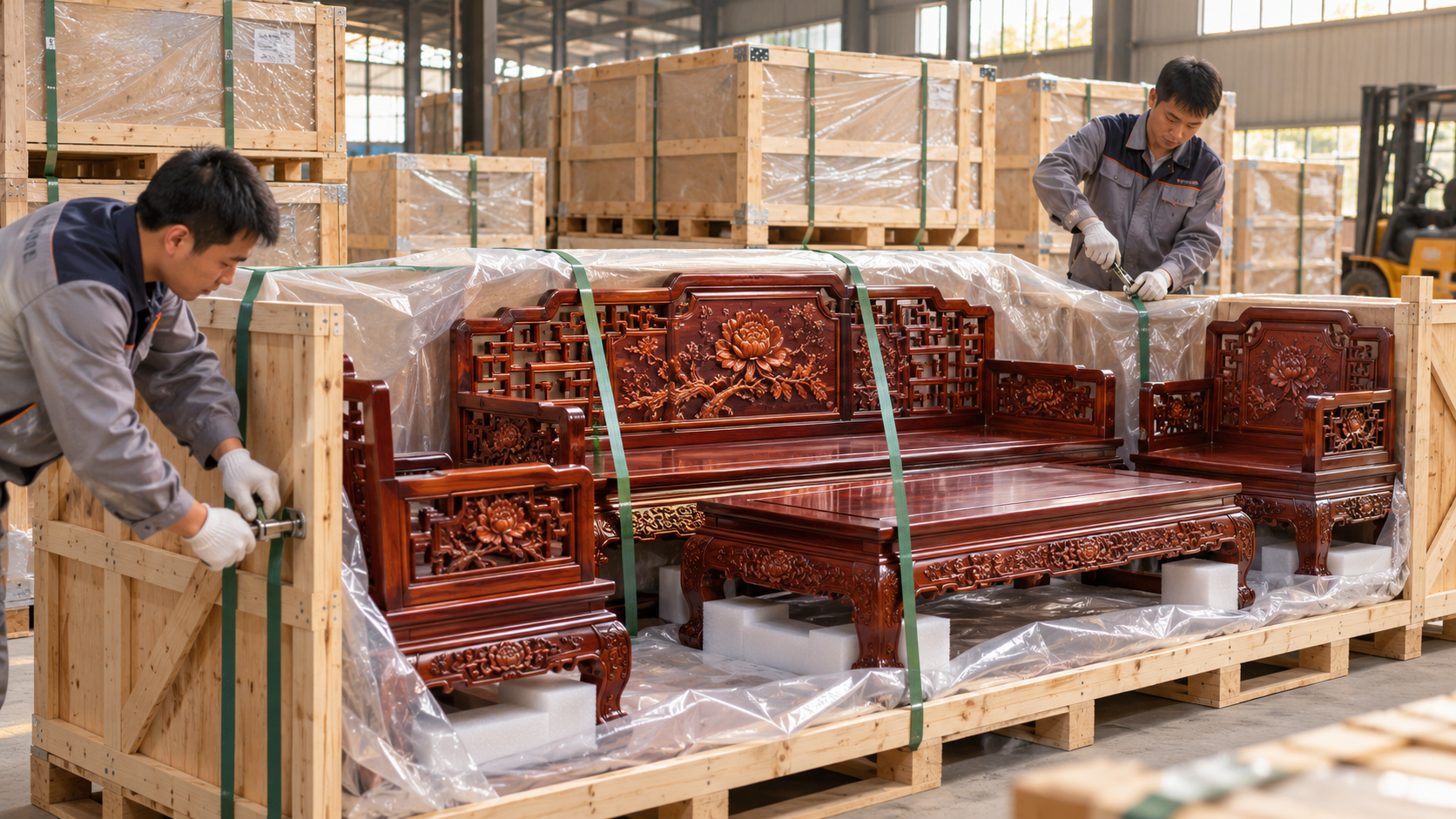
Packaging completes the chain. Every shipment is crated in ISPM-15 heat-treated export crates, with custom crating, moisture barriers and internal bracing engineered for relief-carved pieces, and our crates are validated in-house against a 1-metre six-face drop test. Heat-treated stamped packaging satisfies the wood-packaging condition on arrival; the bracing protects the carved surfaces through inspection handling as well as transport.
Buyer's biosecurity checklist:
- Check the current BICON case for furniture/manufactured wooden articles with your broker before ordering.
- Require written drying process and moisture-content audit documentation from the factory — ask for the actual target figures, not assurances.
- Confirm ISPM-15 heat treatment and stamping of all wood packaging, and request the treatment declaration.
- Confirm species declarations match the timber in the goods and the CITES/export paperwork (Step 4).
- Agree who monitors the container on arrival and responds to any DAFF query — usually your customs broker, with factory documentation on standby.
For the technical background on why heat treatment works and when fumigation is relevant, read our detailed article on fumigation and ISPM 15 heat treatment, and for the crating specifics see our guide to export packaging for carved rosewood furniture.
Step 4: Timber Legality and Sustainability Documentation (FSC and CITES)
Biosecurity is about what might be living in the wood. Legality documentation is about where the wood came from — and Australia enforces that question too.
Illegal logging due diligence. Australian importers of timber products must meet illegal logging due diligence requirements under Australian law. In practical terms, this means the importer must be able to show that they took reasonable steps to confirm the regulated timber in their goods was harvested legally in the source country. For a buyer ordering carved solid hardwood furniture, the due diligence burden is discharged largely through documentation from the supplier: identification of the species used, evidence of the supply chain, and supporting legality or certification paperwork. The key word is documented — a verbal assurance from a salesperson does not constitute due diligence. Build the document request into your procurement process before the first order, not after your first audit.
FSC chain of custody. The most widely recognised way to support due diligence is Forest Stewardship Council (FSC) certification, which traces timber through the supply chain from forest to finished product under chain-of-custody rules. A factory holding FSC chain-of-custody documentation can supply paperwork with each shipment tying the goods back to certified material. Yunxiao includes FSC chain-of-custody documentation per shipment — it is part of our standard export document set, prepared in-house alongside the commercial documents. When comparing suppliers, ask each candidate to send a sample of their FSC documentation from a real previous shipment before you order. The document's completeness tells you instantly whether the factory runs a genuine certified chain or treats the certificate as a marketing badge. Our detailed article on FSC-certified timber compliance explains what the paperwork should contain and how it interacts with your Australian due diligence records.
CITES and rosewood species. The second layer is species-based. Many of the rosewood-family species used in classical furniture — including the Siamese rosewood (a Dalbergia species) used in our Grade-A tropical hardwood range — are listed on CITES Appendix II, which regulates international trade to ensure it does not threaten the species' survival. Commercial export of CITES-listed timber requires an export permit issued by the country of export's CITES management authority. Yunxiao includes CITES Appendix II export permits per shipment where the species requires them, prepared in-house as part of the full export document set. The buyer's counterpart on the Australian side is confirming with their broker whether any import-side formalities apply to the declared species, and keeping the permit with the shipment file as part of both the customs and due diligence records.
Why ask for document samples before ordering. There are three reasons this step pays for itself. First, it screens suppliers: a factory that produces coherent, shipment-specific FSC and CITES paperwork on request has functioning compliance processes; one that stalls or offers generic templates has not shipped regulated timber recently — or at all. Second, it shortens your own due diligence file assembly, because the documents you receive become the evidence base for your Australian obligations. Third, it prevents border friction: document mismatches between species declarations, invoices and permits are a classic cause of holds, and they are entirely avoidable at the contract stage.
If you also supply or ship into other markets, note that the document stack overlaps heavily: our article on how EU and US timber rules compare shows how the same FSC and species documentation serves the EU Timber Regulation-era requirements and US Lacey Act declarations, meaning one well-run document chain serves your whole export program.
Documentation checklist for this step:
- Species declaration naming the timber in the goods (e.g. Siamese rosewood, aged red wood, Machilus Nanmu).
- FSC chain-of-custody documentation included per shipment.
- CITES Appendix II export permits where the species is listed.
- Retain all documents in your due diligence file against each import declaration.
Step 5: GST and Landed-Cost Planning for Your First Container
With duty resolved and biosecurity documentation in place, the last border cost is GST — and it is where a small planning habit saves real money, because the GST base is larger than most new importers expect.
How the GST base is built. Australia charges 10% Goods and Services Tax on import, calculated not on the goods value alone but on customs value plus duty plus international transport and insurance costs. Freight and insurance are inside the tax base, so the GST figure moves with your shipping terms and freight rates — which means landed-cost planning should treat GST as a variable, not a fixed percentage of the invoice.
The worked example. Take a container with a customs value of AUD 60,000 and freight plus insurance of AUD 8,000, in the two scenarios that differ by one document — a valid ChAFTA Certificate of Origin:
| Scenario | Duty | GST | Total tax at the border |
|---|---|---|---|
| With ChAFTA Certificate of Origin (0% duty) | AUD 0 | 10% × (60,000 + 0 + 8,000) = AUD 6,800 | AUD 6,800 |
| Without certificate (5% MFN duty) | 5% × 60,000 = AUD 3,000 | 10% × (60,000 + 3,000 + 8,000) = AUD 7,100 | AUD 10,100 |
The missing certificate costs AUD 3,300 on this one shipment — and the damage compounds: across a AUD 200,000 annual import program, running without valid certificates costs more than AUD 10,000, purely in avoidable tax. The certificate costs the exporter an administrative fee; the return on that fee is several thousand dollars per container. There is no scenario in which skipping it is rational, so the only real risk is process failure — a certificate not applied for, not transmitted in time, or issued with mismatched values or codes. That is a checklist problem, and you should manage it as one.
Landed-cost planning advice for your first container:
- Model the full border cost, not the invoice. Customs value + duty + freight and insurance + 10% GST on that sum, plus port and clearance charges your broker quotes. Price your retail margin or project bid on that landed figure.
- Fix freight terms early. Because freight and insurance enter the GST base, agreeing shipping terms and booking freight early makes your landed cost predictable rather than an estimate that shifts after arrival.
- Put document deliverables in the contract. ChAFTA Certificate of Origin, CITES permits where applicable, FSC documentation, drying and moisture records, ISPM-15 treatment declaration — all named, all due with the shipment file.
- Start small, then scale. A first container is a live test of every process above. Yunxiao offers trial single sets and refundable samples precisely so buyers can validate product, documentation and finish quality — including our nine-coat hand-rubbed raw lacquer flagship pieces and GB 18584 emissions testing, with current test reports provided with quotations — before committing to container volumes.
- Match payment terms to the compliance timeline. Container orders take 45–60 working days after deposit, and the certificate and permit paperwork is finalised against shipped values near the end of that cycle. Structure deposits and balances so the final payment is not released until the document set — including the ChAFTA certificate — is in your hands. Our article on payment terms for Chinese furniture orders sets out structures that align payment milestones with document delivery, and long-term partners can also arrange partial shipments to smooth cash flow across a program.
Get these five steps right — classification, duty and ChAFTA, biosecurity, legality documentation, and GST — and a container of classical rosewood furniture clears the Australian border the way it should: predictably, fully documented, and at the lowest lawful cost. When you are ready to move from planning to a trial order or a project quotation, contact Yunxiao Rosewood Furniture with your product list and destination, and our export team will return a quotation with the current compliance document set attached.
Step 6: Export Packing, ISPM-15 Compliance and Container Loading
Packing is where carved rosewood furniture most often goes wrong in transit, and it is also the step Australian buyers have the least visibility into until the container doors open. DAFF's non-commodity conditions apply to all wood packaging and containers entering Australia, which means your crates and dunnage must meet ISPM-15 heat treatment standards and the container itself must be clean and free of soil, plant material and insect evidence. A shipment can pass every documentation check and still be directed for treatment, re-export or destruction because the packaging failed. As covered earlier in this guide, the biosecurity conditions are published in DAFF's BICON system, and the importer of record carries the legal responsibility for compliance.
Before placing an order, ask any prospective supplier exactly how their export crates are built and verified. At Yunxiao, every shipment leaves in ISPM-15 heat-treated export crates, and each crate design has passed our in-house 1-metre six-face drop test — a controlled test in which the packed crate is dropped on all six faces from one metre to confirm the internal bracing holds the furniture without shifting or contact damage. That test matters because sea freight subjects crates to repeated shock loads from swell, container handling and road transport on both ends; a crate that survives a single vertical drop may still fail when tipped or rolled.
Relief-carved pieces need a different packing discipline than flat-panel furniture. Deeply carved surfaces — the aprons, seat rails and back splats on a classical sofa set, or the crown rails on a canopy bed — cannot be protected by a single layer of wrap, because any foam or film pressed directly against the carving can abrade the finish and snap fragile detail during vibration. Our method for relief-carved pieces combines custom crating, moisture barriers and dedicated bracing: the carved surfaces are spaced away from contact materials, the pieces are immobilised inside the crate, and a moisture barrier lines the crate interior so condensation during an ocean crossing never reaches the wood. This pairs with the timber-side controls described earlier: our wood is audited to 8-14% moisture content and conditioned to the destination climate before shipment, so the furniture enters the crate already stabilised for the humidity range it will meet in Australia.
Container loading is the second half of the risk. A 40-foot container loaded with a full carved sofa set, a 12-seat dining set and a bedroom suite is a stacking problem: weight distribution, upright orientation, load-bearing points and inter-crate bracing all determine whether pieces arrive as shipped or arrive with fractured arms and split rails. Heavier solid-wood pieces such as sideboards and display cabinets go on the floor with load spread above; lighter chairs and folding stools are braced rather than simply stacked; nothing is loaded on top of a crate containing a carved set unless the crate is engineered for it. We plan the loading sequence around disassembly as well — most classical sets ship partially disassembled to reduce collision exposure, with hardware-free mortise-and-tenon joints reassembled on site.
If you want the full detail on crate construction, barrier materials and bracing methods, see our article on export packaging for carved rosewood furniture, and for the loading sequence itself, our guide to container loading planning walks through how we build a mixed-set load piece by piece. Ask any supplier for packing photos and crate test evidence as part of your pre-order due diligence — a manufacturer that cannot show you a drop-test record or loading plan is asking you to absorb the transit risk yourself.
Step 7: Shipping Routes, Lead Times and Production Scheduling
For full furniture sets moving from Fujian to Australia, sea freight in a full container is the standard route and, for anything beyond a small sample order, the only economically sensible one. Solid rosewood furniture is dense and heavy; air freight costs quickly become irrational, and the pieces are robust enough to handle an ocean crossing when crated correctly. Main port pairs run from Chinese ports such as Xiamen — the practical gateway for Xianyou-produced furniture — to Sydney, Melbourne, Brisbane and Fremantle, with transit typically taking several weeks depending on the port pair and the sailing schedule. Book with a forwarder experienced in furniture and biosecurity-sensitive cargo; when DAFF raises a query on the container or the packaging, a forwarder who knows the process saves you days.
Production timing is the number you should schedule around. At Yunxiao, container orders take 45-60 working days after deposit. That window is not padding — it reflects the real sequence a classical piece must pass through: timber selection, the 36-day constant humidity drying cycle for wood entering production, cutting and grading, mortise-and-tenon joinery, carving, and the finishing layers, including the nine-coat hand-rubbed raw lacquer process on flagship pieces. Each stage is sequential, and compressing it shows up later as joints that move or finishes that cure improperly in transit. When you compare quotes, treat a dramatically shorter lead time as a question about process, not a bargain.
For repeat buyers, scheduling gets easier: we offer partial shipments for long-term partners, so a rolling order book can be drawn down container by container instead of waiting for the full program to finish. This suits Australian wholesalers running seasonal retail — ordering ahead of the spring furniture season means placing the deposit roughly four months out, counting production plus transit plus clearance.
Project buyers face a harder constraint: a hotel opening date does not move. Work backwards from installation. If a hotel project needs furniture installed by a fixed date, allow production time, several weeks of sea transit, clearance time at the border, and buffer for reassembly and placement. Our free layout drawings and remote installation guidance exist precisely for this: project teams can plan room-by-room placement and staff the reassembly before the container arrives. If payment structure is part of your schedule negotiation — matching deposit and balance milestones to production stages — our article on payment terms for Chinese furniture orders covers how buyers typically structure this. The core rule for both retail and project buyers: confirm the lead time in working days, in writing, against the deposit date, and add your own buffer for port congestion and seasonal sailing schedules.
Step 8: Pre-Shipment Inspection for Carved Rosewood Furniture
Once a container is sealed, your leverage drops to near zero. Everything you want to verify about carved rosewood furniture must be verified before the crates close — which is why a structured pre-shipment inspection is the step most first-time importers skip and most experienced ones never do without. Whether you fly in, appoint a third-party inspection agency, or rely on the factory's documented quality records, inspect against a fixed checklist rather than a general impression.
Start with joint fit. Classical redwood furniture is built with mortise-and-tenon joinery — at Yunxiao with bamboo dowel pins and zero metal fasteners in the primary frame — so joint quality is the whole structure. Check that joints seat fully with no visible gaps, that assembled frames are square and do not rack under light pressure, and that disassembled joints reassemble cleanly. A mortise-and-tenon joint with a visible daylight gap at the shoulder will open further in a dry Australian summer.
Next, carving detail consistency. On a matched sofa set, compare the same carved motif across every piece: depth of relief, sharpness of edges, and completeness of the pattern. Hand carving varies slightly between pieces — that variation is part of the craft — but a motif that is noticeably shallower or coarser on one chair signals a rushed section. Check corners and underside edges, where shortcuts show first.
Then finish. For beeswax and lacquer finishing, look for even coverage, no pooling in carved recesses, no dust nibs on flat surfaces, and consistent sheen across the set. On flagship pieces carrying the nine-coat hand-rubbed raw lacquer finish, expect depth and a matte-to-satin warmth rather than a sprayed gloss; each coat should be cured, not tacky.
Request the moisture records. The timber should be audited to 8-14% moisture content and conditioned to the destination climate before shipment — ask for the drying and audit records for the wood in your order, not a generic certificate. Verify color and grain matching across a set: timber from the same batch should read consistently, and deliberate grain sequencing on table tops and sideboard fronts should run logically.
Finally, inspect the packing itself: crate condition, ISPM-15 marks on the timber, moisture barriers in place, bracing installed, and a full set of packing photos and video showing each piece wrapped, crated and loaded. This documentation is what you compare against on arrival, and it is your evidence in any transit-damage claim. Third-party inspection is straightforward to arrange in Fujian; agencies will follow a checklist you supply, so write your checklist from the points above and require photo evidence per item, per piece.
Common Mistakes First-Time Australian Importers Make
- Ordering before confirming BICON conditions. Some buyers deposit funds, then discover the timber species or product category has conditions they did not anticipate. All imported timber and wooden articles must meet the import conditions published in DAFF's BICON system, and it takes minutes to check the relevant timber and timber products case before you commit. Confirm the species, the treatment pathway and the documentation your broker will need — before the deposit, not after.
- Treating biosecurity as the broker's problem. Your customs broker lodges the declaration, but as the importer, you are legally responsible for ensuring the goods meet BICON conditions. Non-compliance can mean delays, extra costs, or re-export and destruction at your expense. The broker cannot manufacture evidence — if the factory cannot supply treatment records, manufacturing-process declarations or clean packing documentation, no amount of brokerage fixes it. Vet the factory's compliance capability directly.
- Missing the ChAFTA certificate of origin. The Chapter 94 general duty on furniture is 5% of customs value; under ChAFTA it is 0% provided the goods originate in China and a valid Certificate of Origin accompanies the import declaration. Certificates are typically issued by authorised bodies such as CCPIT or CIQ in China. On a AUD 60,000 container, a missing certificate costs AUD 3,300 in extra duty and GST — more than AUD 10,000 across a AUD 200,000 annual program. Confirm the certificate is issued and in the document pack before the vessel sails.
- Underestimating lead time. A 45-60 working day production window after deposit, plus several weeks of sea transit, plus clearance, means a container ordered casually in spring may arrive after the selling season or after the hotel opening. Work backwards from the fixed dates in your calendar and add buffer for peak-season sailing schedules.
- Buying on price alone without moisture and drying evidence. Rosewood furniture cracks in Australia when the timber was never properly dried. Ask for the drying process and moisture audit records — at Yunxiao, timber passes 36-day constant humidity drying, is audited to 8-14% moisture content, and is conditioned to the destination climate before shipment. A supplier who cannot document this is selling you a warranty claim.
- Ignoring container loading for carved pieces. Relief-carved furniture fails in transit when it is wrapped against the carving, stacked without bracing, or loaded under other crates. Ask how the supplier crates and loads: custom crating, moisture barriers, dedicated bracing and a drop-test record are reasonable demands, and packing photos plus video of loading should be standard deliverables.
- Skipping pre-shipment inspection. Once the container is sealed and shipped, defects become a negotiation instead of a correction. A structured inspection of joint fit, carving consistency, finish, moisture records and crate condition — by you or a third party — costs a fraction of what one damaged or unsaleable container costs.
How Yunxiao Supports Australian B2B Buyers
Yunxiao Rosewood Furniture Co., Ltd was founded in 2008 and operates a 12,000 sqm factory in Xianyou County, Putian City, Fujian — the hometown of traditional hardwood craft in China. That location is not marketing: the county's craft ecosystem supplies the carvers, joiners and finishing specialists a classical workshop needs, and it is why a full carved sofa set, a 12-seat dining set and a complete bedroom suite can all be produced in-house under one roof rather than scattered across subcontractors.
Construction is built for overseas climates. Every piece uses classic mortise-and-tenon joinery with bamboo dowel pins and zero metal fasteners in the primary frame, assembled specifically to resist cracking and deformation when the furniture moves from Fujian's humidity into drier Australian conditions. On the timber side, the process is documented at every stage: 36-day constant humidity drying before production, moisture audited to 8-14%, and conditioning to the destination climate before shipment. For buyers who want to see the process rather than read about it, our article inside the workshop follows a piece from raw timber to finished furniture.
Compliance paperwork is handled per shipment, not on request. FSC chain-of-custody documentation and CITES Appendix II export permits accompany every shipment, and our full export documents are prepared in-house — the ChAFTA certificate, packing lists and invoices arrive in your document pack ready for your broker's lodgement with Australian Border Force. If you want the detail on how the FSC documentation chain works for Australian due diligence, see our guide to FSC-certified timber compliance. Crating is equally standardised: ISPM-15 heat-treated export crates, custom crating with moisture barriers and bracing for relief-carved pieces, and crate designs verified through the in-house 1-metre six-face drop test.
Commercially, we work the way B2B buyers need. Container orders run 45-60 working days after deposit, with partial shipments available for long-term partners. New buyers can start with trial single sets and refundable samples before committing to a full container. In practice, most Australian buyers container-mix full sets with statement pieces: a Qing Dynasty style carved redwood 5-piece sofa set for the showroom floor, a Ming style round 8-seat redwood dining set for volume retail, and a classical redwood canopy bed 3-piece bedroom suite as the luxury anchor — with sideboards, display cabinets and folding stools filling the remaining cube.
For hotel and villa projects, we provide free layout drawings so placement is planned before the container arrives, plus remote installation guidance for your on-site team during reassembly. Finishing compliance is documented too: eco-friendly beeswax and lacquer finishes meeting EU REACH and US CARB standards, with emissions tested against GB 18584 requirements and current test reports supplied with quotations.
Frequently Asked Questions
Do I need a licence to import furniture into Australia?
There is no general import licence for furniture as such, but imported timber and wooden articles are regulated: all such goods, commercial or personal, must comply with the import conditions published in DAFF's BICON system, and importers must also meet illegal logging due diligence requirements under Australian law. As the importer, you are legally responsible for ensuring the goods meet BICON conditions, and your declaration is lodged with the Australian Border Force. In practice, the requirements are met through documentation — evidence of treatment or of the manufacturing process — supplied by the exporter and assessed by DAFF. Verify the specific BICON case for your product and species before ordering.
Will DAFF inspect my container?
DAFF verifies biosecurity risk mitigation by assessing evidence of compliance in documentation and/or by inspecting goods on arrival. Not every container is physically inspected, but any container can be — and the outcome depends on the paperwork and the condition of the goods and packaging. If documentation is incomplete, or if the container or timber packaging shows soil, plant material, insect evidence or non-compliant wood packaging, DAFF may direct treatment, and in some cases re-export or destruction of the goods at the importer's expense. The practical answer is to make inspection irrelevant: compliant ISPM-15 packaging, clean containers, and complete documentation mean an inspection simply confirms what the paperwork already shows.
Who issues the ChAFTA Certificate of Origin?
ChAFTA Certificates of Origin are typically issued in China by authorised bodies such as CCPIT or CIQ. The certificate confirms the goods originate in China, which is what entitles Chapter 94 furniture to the 0% ChAFTA duty rate instead of the 5% MFN general rate. The certificate must accompany the import declaration lodged with Australian Border Force to claim the preference — it is not something that can be added later without cost and difficulty. Confirm per HS code on the DFAT FTA Portal, and as the buyer, make sure the certificate is issued, correct and in your document pack before the goods ship. Yunxiao prepares full export documents in-house, including this certificate.
Does kiln-dried furniture still need biosecurity treatment?
Drying and biosecurity treatment address different risks, so do not assume one covers the other. Kiln drying — in our process, 36-day constant humidity drying with moisture audited to 8-14% — stabilises the timber against cracking and deformation in the destination climate. Biosecurity conditions target live pests, and DAFF assesses compliance by reviewing evidence of approved treatments and/or the manufacturing process itself, as set out in the relevant BICON case. The specific requirement depends on the timber species and product category, which is why you check the BICON conditions for your exact goods before ordering. Our related article on fumigation and ISPM 15 heat treatment explains how treatment and packaging requirements interact for furniture exports.
How is import GST calculated?
Import GST of 10% applies on the customs value plus duty plus international transport and insurance costs. Using the worked example from earlier in this guide: a container with a customs value of AUD 60,000 and freight plus insurance of AUD 8,000. With a ChAFTA Certificate of Origin, duty is AUD 0 and GST is 10% x (60,000 + 0 + 8,000) = AUD 6,800. Without the certificate, duty is 5% x 60,000 = AUD 3,000 and GST is 10% x (60,000 + 3,000 + 8,000) = AUD 7,100. Total tax is AUD 6,800 versus AUD 10,100 — the missing certificate costs AUD 3,300 on that single shipment. For a fuller breakdown of rates and thresholds, see our import duties and tariffs overview.
What is the production lead time for a container?
At Yunxiao, container orders take 45-60 working days after deposit. The window reflects the actual production sequence: timber selection and the 36-day constant humidity drying cycle, cutting and grading, mortise-and-tenon joinery, carving, and finishing — including the nine-coat hand-rubbed raw lacquer process on flagship pieces. Working days, not calendar days, so convert carefully when you plan: roughly two to three calendar months for production alone, before adding several weeks of sea transit to Australia and clearance time at the border. For long-term partners, partial shipments are available, so a rolling program can ship in stages rather than waiting for the entire order to complete. Confirm the lead time in writing against the deposit date.
Can I order a trial set or a mixed container?
Yes. We offer trial single sets and refundable samples so new buyers can verify construction, carving and finish quality before committing to container volumes — a sensible path for a product category where the joint fit and finish must be seen to be judged. For container orders, buyers typically mix full sets with statement pieces: carved sofa sets with tea tables, 6-12 seat dining sets and complete bedroom suites alongside single pieces such as armchairs, tea tables, sideboards, display cabinets, wardrobes and folding stools. Product range spans legally certified Machilus Nanmu, aged red wood and Grade-A tropical hardwood (Siamese rosewood), so a mixed container can also test market response across material grades. Partial shipments are available for long-term partners as the program grows.
What documents should I collect before the goods ship?
Assemble the pack before the container closes, because post-shipment fixes are slow and costly. At minimum: the commercial invoice and packing list; the bill of lading; the ChAFTA Certificate of Origin (issued by an authorised body such as CCPIT or CIQ) so your broker can claim the 0% duty rate on the import declaration; the FSC chain-of-custody documentation and CITES Appendix II export permits supporting your illegal logging due diligence; evidence for the relevant BICON conditions, such as treatment records or manufacturing-process declarations; moisture-content records for the timber; and the packing documentation — ISPM-15 marks, packing photos and loading video. Yunxiao prepares full export documents in-house and supplies current GB 18584 emissions test reports with quotations, so most of the pack arrives ready-made.
Conclusion: Plan the Paperwork Before the Container
Importing rosewood furniture from China into Australia is a sequence of eight steps, and every one of them is cheapest to get right before the goods ship. Verify the HS classification and the ChAFTA duty entitlement. Check the BICON conditions for your species and product. Confirm the FSC chain-of-custody and CITES documentation that your illegal logging due diligence requires. Structure the payment terms against production milestones. Plan the packing and container loading around carved pieces. Schedule production — 45-60 working days after deposit at Yunxiao — against your real deadlines. Inspect before shipment. And collect the full document pack before the crates close.
The arithmetic makes the case by itself. On an AUD 60,000 container with AUD 8,000 in freight and insurance, a valid ChAFTA Certificate of Origin means AUD 6,800 in total tax; a missing one means AUD 10,100. That AUD 3,300 gap — more than AUD 10,000 across a AUD 200,000 annual program — is decided by one document prepared before departure, not by anything you can do after arrival. The same logic runs through the whole process: biosecurity conditions confirmed up front, moisture and drying records requested in advance, packing and loading evidence required as deliverables. For a step-by-step walkthrough of the entire sequence, our complete guide to importing rosewood furniture from China consolidates every stage in one place.
If you are building an import program for Australian retail or a hotel project, start with the document pack, not the deposit. Yunxiao prepares full export documentation in-house — ChAFTA certificates, FSC chain-of-custody, CITES Appendix II permits and current GB 18584 emissions test reports — alongside ISPM-15 crating, climate conditioning and free layout drawings for projects. Request a quotation and document pack through Yunxiao Rosewood Furniture, and start your first shipment with the paperwork already in order.