
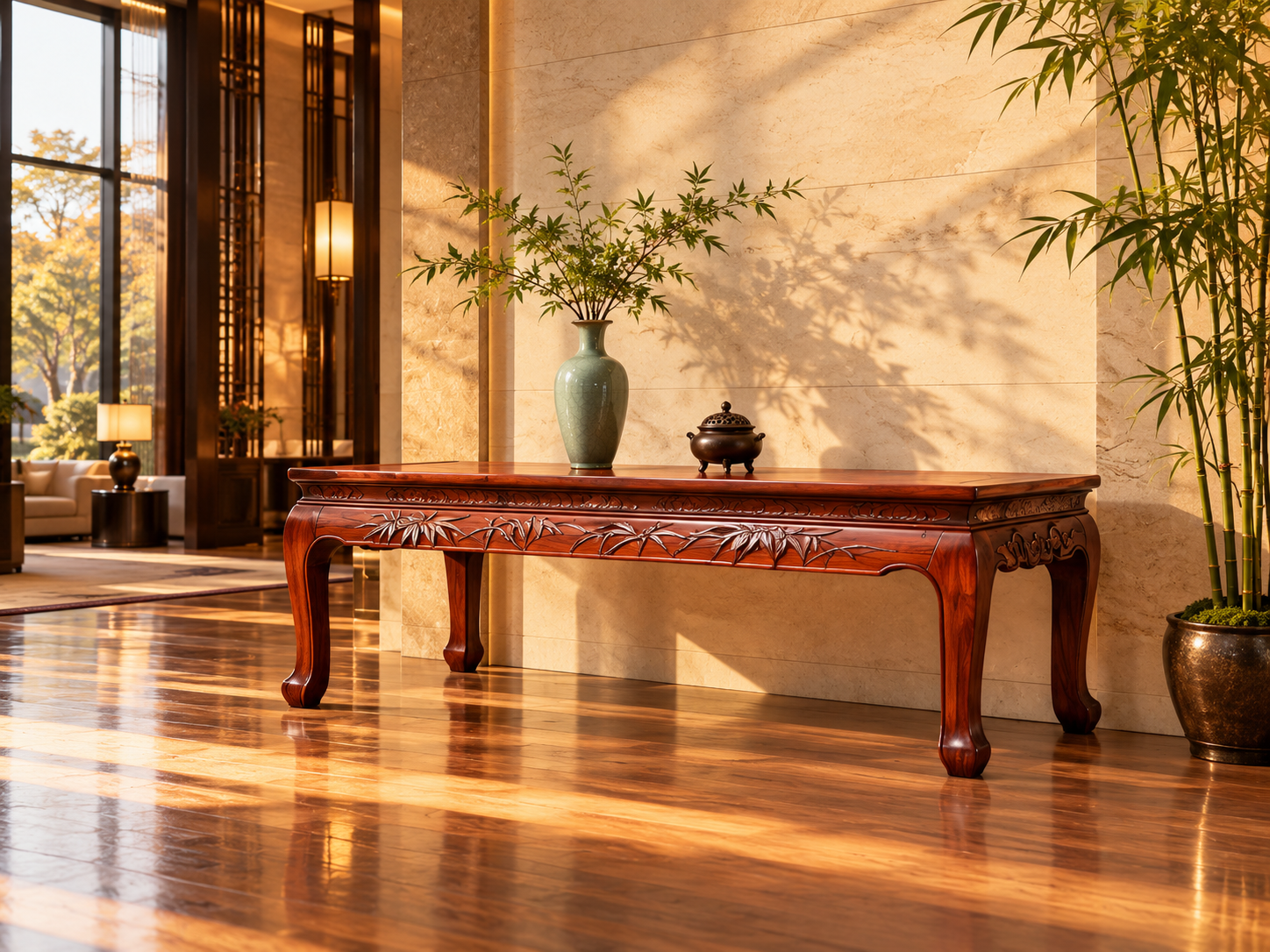
A practical B2B guide to the Chinese altar table: what it is, why luxury hotels and villas specify one, how Yunxiao builds it in Siamese rosewood with mortise-and-tenon joinery, and what importers should check before ordering an OEM altar table from China.
Walk into a well-designed luxury hotel lobby in Singapore, a private villa in Melbourne, or a boutique resort in Bali, and sooner or later you will meet a piece of furniture that looks like a long, slim, dignified table set against a wall: a chinese altar table. For centuries this form anchored family rituals in China; in the last decade it has quietly become one of the most requested statement pieces in high-end hospitality and residential projects across Southeast Asia, Australia, Europe and North America. For a B2B buyer — an importer, a furniture wholesaler, a hotel procurement manager, an interior designer sourcing for a villa project — the altar table raises a very practical set of questions. What exactly is it, and how is it different from a console table or a sideboard? Why are designers specifying it? What does it take to manufacture one in solid rosewood that will survive an ocean crossing and a very different climate? And how do you audit a supplier before you wire a deposit?
This guide answers those questions in the order a buyer actually meets them, based on how we build classical rosewood furniture at Yunxiao Rosewood Furniture Co., Ltd — a factory founded in 2008 in Xianyou County, Putian City, Fujian, one of the recognized hometowns of traditional hardwood craft in China. Whether you are researching the category for the first time or comparing suppliers for a full container order, the sections below are written to help you make a sourcing decision, not just admire the furniture.
What Is a Chinese Altar Table? Definition, Anatomy and Proportions
A Chinese altar table — in Chinese, tiaozhuo (tiao table) or, in its most ceremonial form, qiaotou'an (upturned-end altar table) — is a long, narrow, high table traditionally placed against a wall in halls, temples and family courtyards. Three proportions define the type. First, length: a typical altar table runs from roughly 150 to over 250 centimeters, far longer than it is deep, with a depth commonly between 40 and 60 centimeters. Second, height: at 80 to 100 centimeters, it stands taller than a dining table or a coffee table, which is precisely what makes it read as a ceremonial or display surface rather than a working one. Third, orientation: it is designed to be seen from the front, standing against a wall or acting as a freestanding divider, never floating in the middle of a room like a dining table.
The anatomy rewards a closer look, because each element carries both a function and a classical furniture vocabulary your customers will recognize. The top is a single thick panel, often framed with tongue-and-groove edge boards in an edge-and-center-panel construction. On the most collectible Ming-style forms, both ends of the top rise into small, upturned everted flanges — the qiaotou, or "upturned head" — which visually lift the piece and, practically, kept ritual objects from rolling off. Below the top sits the apron: a shaped rail that can be plain and architectural on scholarly Ming pieces, or deeply carved with bamboo, clouds, dragons, phoenixes or lattice motifs on later Qing-influenced work. The legs are usually round or square columns that splay slightly outward — the famous "horse-hoof" feet terminate in a flat pad, while cabriole legs end in curled claw-and-ball or ruyi feet on more ornate examples. Many altar tables also feature a recessed waist between the top and the apron, a detail prized in classical Chinese furniture for the shadow line it creates.
Two clarifications matter for buyers. First, the term overlaps but does not coincide with the modern "console table": a chinese altar console table is essentially the same form interpreted for contemporary entryways, often slightly scaled down. Second, the market distinguishes sharply between a genuine antique chinese altar — a Ming or Qing dynasty survivor sold through auction houses and specialist dealers — and a newly made classical altar table built with traditional methods. New work is what furniture importers actually procure: the visual language of the antique form, produced in legal, documented timber, at factory scale, with the structural reliability of modern joinery standards. This guide is about the new-build category, which is where our factory works.
From Ancestral Hall to Hotel Lobby: What the Altar Table Means
To sell the piece confidently to hoteliers and designers, your sales team should be able to tell its story accurately. In traditional Chinese homes, the altar table stood in the central hall — the tangwu — against the north wall, the most honored position in the house. It carried the family's most significant objects: ancestral tablets, incense burners, vases, a clock and a mirror in later periods, arranged according to custom. The table was therefore never just furniture; it was the axis of family ceremony, the place where the household marked festivals, honored elders and remembered ancestors. Its elevated height and long, horizontal profile gave it a naturally monumental quality — a piece of furniture that behaves like architecture.
The decorative vocabulary carved into altar tables is a language of auspicious meaning, and it is worth knowing at least the main motifs when you select carving for a project. Bamboo stands for integrity and resilience because it bends without breaking. Cloud scrolls (the xiangyun motif) signify good fortune descending from heaven. The dragon represents authority and protection; the phoenix, grace and renewal; together they mark the highest ceremonial grade of carving. Lattice patterns derived from window screens suggest order and scholarship. Ruyi — the S-shaped ceremonial scepter motif — means "may everything go as you wish." These are not arbitrary decorations: on a well-made classical piece the motif is chosen to match the room's purpose, which is exactly why designers specify different carving programs for a hotel spa, a villa entryway and a corporate reception.
What changed in the last decade is context, not form. As Chinese classical furniture gained visibility through design media, museum exhibitions and the broader appreciation of craft-made interiors, Western and Southeast Asian designers began to read the altar table's dignity as a universal design asset rather than a culturally specific one. The piece keeps its ceremonial posture — long, slim, elevated, wall-facing — but now carries vases of branches, sculpture, table lamps or nothing at all. Buyers who understand both readings — the original ritual meaning and the contemporary styling — are in a much stronger position to advise their own customers, and this is a real sales advantage when you are presenting a rosewood altar table to a hotel group's design committee.
Why Luxury Hotels, Villas and Design Projects Specify an Altar Table
Ask a hotel interior designer why they keep specifying altar tables and the answers cluster around four practical properties.
First, it solves the long-wall problem. Almost every lobby, corridor junction, spa reception and private dining room has a long wall that needs furniture without blocking circulation. A 2.2-meter altar table occupies barely 50 centimeters of depth, so it furnishes the wall while preserving walkways — a combination that bulky sideboards and cabinets cannot match. In villa projects the same logic applies to entryways: the piece greets guests at the door with a strong horizontal line, holds a lamp and a vase, and leaves the floor visible.
Second, it reads as craft. High-end projects increasingly compete on the perception of authenticity. A machine-laminate console looks flat under lobby lighting; a solid rosewood altar table with hand-carved apron and visible grain reads as investment-grade even to guests who cannot name the wood. This is why the category appears in five-star lobbies, hot-spring resorts, members' clubs and tea houses rather than in mid-market chains — it is a signature-piece decision, and buyers sourcing for such projects are usually given a signature-piece budget.
Third, it is culturally flexible. In properties targeting Chinese outbound travelers — a significant segment for Southeast Asian and Australian hospitality — the altar table signals cultural fluency and respect. In properties with no Chinese reference at all, the same piece works as sculptural, museum-like furniture. Few categories carry this double reading, and it materially widens the addressable customer base for an importer stocking the form.
Fourth, it photographs. Hotel marketing lives on imagery, and a well-styled altar table against a stone or plaster wall is one of the most reliable interior shots a property can produce. Procurement teams know this; some of our project clients specify the piece partly for its role in opening photography.
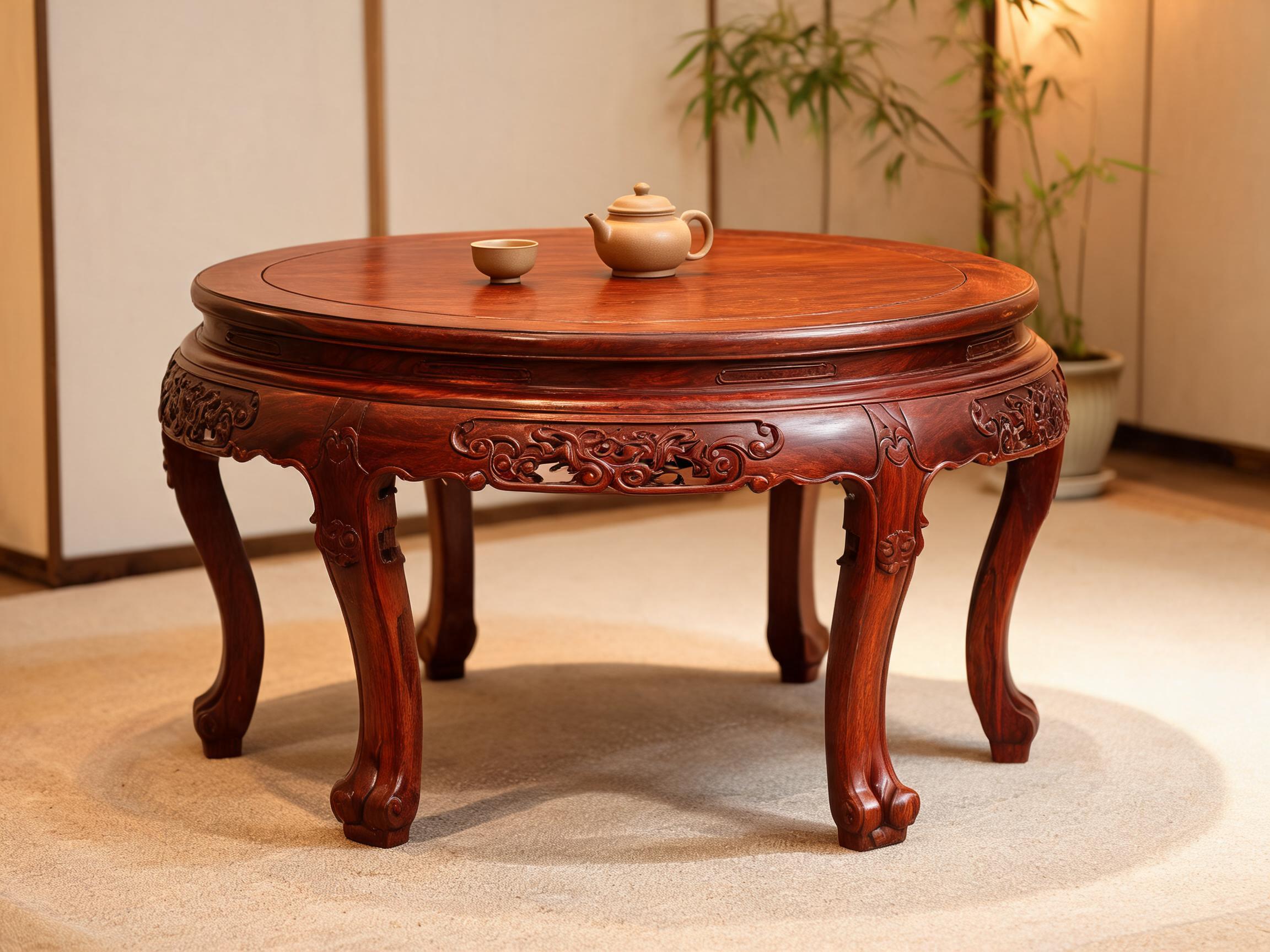
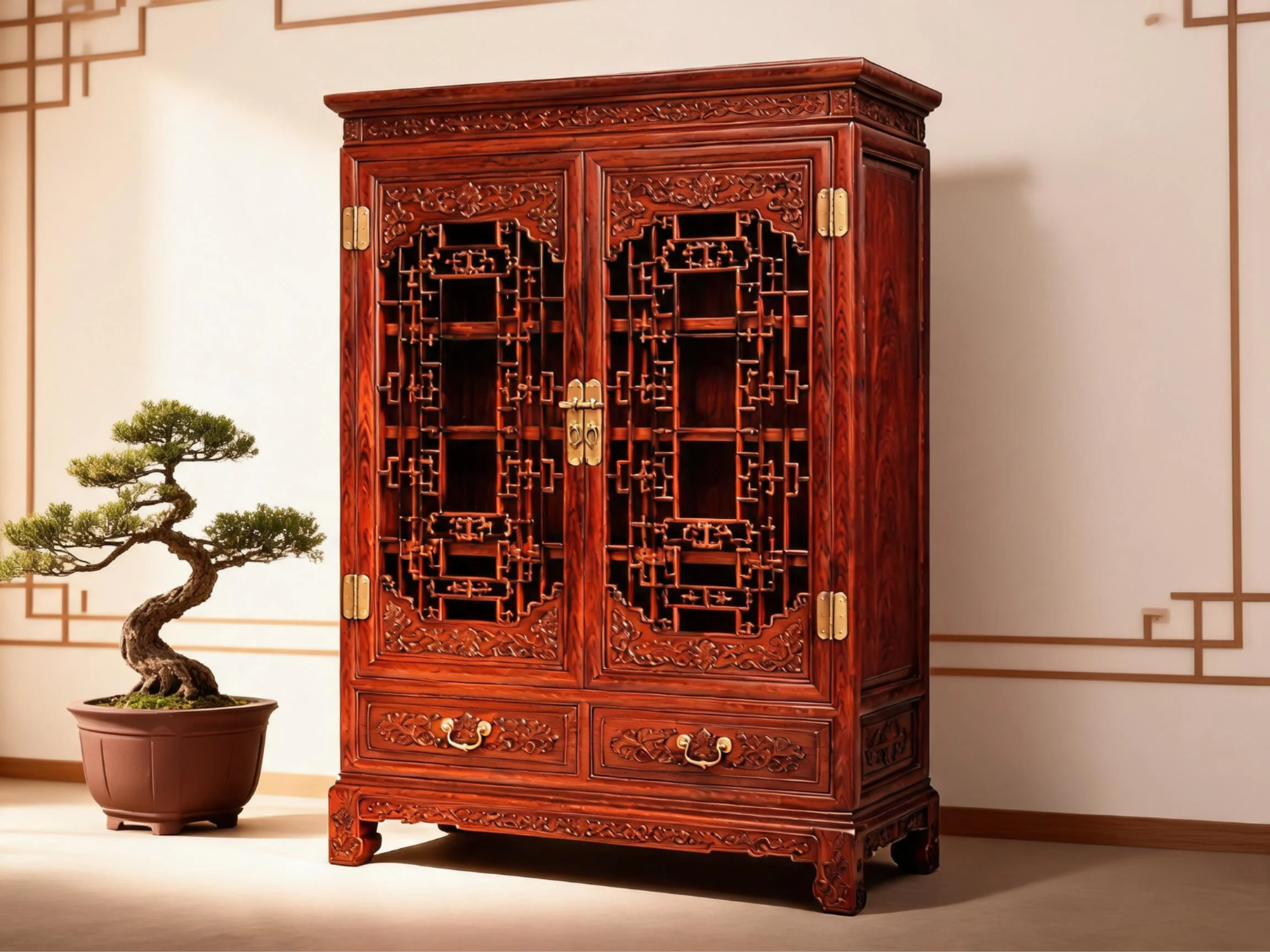
For a B2B portfolio, the altar table also plays well alongside the categories importers already buy. It pairs naturally with the rosewood tea tables used in villa and hotel lobby projects, it complements a solid Siamese rosewood sideboard with dovetail drawers in the same grain and finish, and it gives a display wall a lower counterpart when matched with a rosewood display cabinet with carved lattice doors. Stocking the form alongside these pieces lets a wholesaler sell a coordinated classical scheme rather than isolated items — and coordinated schemes are what design-build clients actually purchase.
Where the Altar Table Works: Placement Ideas from Lobby to Private Suite
Because the form is so specific, buyers often ask where an altar table actually performs best. The honest answer is that it needs a wall, a sightline and a purpose — and once those three exist, it is one of the most adaptable pieces in a classical furniture program.
Hotel lobbies and reception sequences. The classic application is the feature wall beside or behind the reception group, where a 2.0–2.4 meter altar table carries a ceramic or bronze centerpiece and anchors the arrival moment. Because the piece is only about half a meter deep, it works even in lobbies where circulation squeezes past a seating cluster. In larger properties, a second, smaller altar table often appears at the lift lobby or corridor junction, repeating the horizontal line so the geometry of the lobby travels through the building. Chinese New Year styling is a bonus: the surface is the natural stage for seasonal displays, and housekeeping teams find a single long surface far easier to dress and maintain than scattered arrangements.
Villa entryways and foyers. In residential projects the altar table has effectively become the luxury entry console. A 1.5–1.8 meter piece against the foyer wall, styled with a lamp, a tray and branches, gives the arrival sequence its first material impression of quality. Because guests pass within arm's reach, this is also where finish quality is judged most closely — another reason we recommend the raw lacquer build for touch-heavy locations rather than soft wax-only surfaces.
Private dining rooms and restaurants. A Chinese altar table behind the head table in a private dining room does three jobs at once: it elevates the host position, provides serving space for tea and ceremony, and defines the room's axis in photographs. Restaurants with Chinese or fusion concepts use the same trick in their main dining rooms, where the table's ritual proportions read as intentional design rather than decoration.
Spas, tea rooms and wellness areas. The cloud-scroll and bamboo carving programs pair naturally with wellness interiors. At 80–90 centimeters the surface is comfortable for a therapist to stage towels, oils and ceramics, and the slim depth keeps treatment corridors compliant. Tea houses, already familiar with the category through our tea-table lines, frequently bracket a tea table and chairs between two altar tables to create a complete classical composition.
Executive offices and boardrooms. Corporate projects use the form as a credenza alternative behind the executive desk or as a credenza wall in the boardroom anteroom. The message is deliberate: heritage, permanence and taste — attributes a laminate credenza cannot project. Several of our distribution partners position the altar table to corporate clients precisely because it survives re-branding cycles: the piece is architecture, not fashion.
For all of these placements, the practical support that matters to trade buyers is spatial, not decorative. Our project service includes free layout drawings so the interior team can drop the piece into the plan at true scale before ordering, and remote installation guidance once the container arrives — both are standard for hotel and villa programs of any size.
Altar Table, Console Table or Sideboard? Choosing the Right Form for Your Project
Because the three forms overlap visually, buyers frequently ask which one a given wall actually needs. The honest answer is that each solves a different problem, and the fastest way to decide is to ask what the surface must do. If the wall needs presence and styling only — art object, lamps, branches — the altar table wins on silhouette and cultural weight. If the entryway needs a landing zone for keys, parcels and correspondence, a rosewood console table for entryways, villas and hotels is the pragmatic choice, often with drawers. If the room needs storage — tableware, linens, media equipment — then a Chinese sideboard in luxury hotels and villas carries the classical language while providing cabinet volume, as in our 140 × 45 × 85 cm sideboard with hand-cut dovetail drawers and a seven-coat raw lacquer finish.
Dimension discipline matters more here than in most categories, because altar tables are unforgiving when mis-scaled. As a rule of thumb for project work: allow at least 90 centimeters of clear circulation in front of the piece; keep the tabletop height at 85–95 centimeters for standing display, or near 80 centimeters when the client intends to seat guests behind it; and cap the length at roughly 60–70 percent of the wall it furnishes so the piece breathes. For hotel corridors, check door and elevator clearances on the delivery path — a 2.4-meter top cannot turn a 1.1-meter corner, and on custom builds we routinely ask for the delivery route before finalizing length, or we build the top in two book-matched sections joined with a matched-grain seam.
It is also worth preparing your customers for the category's most common misconception. Search behavior shows buyers typing both "chinese altar table antique" and "chinese altar table for sale" in the same session, which tells you they are comparing heritage pieces with new production without a clear framework for the difference. The framework we give trade customers is simple: antiques are unique survivors, priced and certified as collectibles, with condition risk that grows during international shipping; new classical builds are repeatable, documented, repairable and warrantable, with the same visual language and materially better structural consistency. For any commercial installation — hotels above all — new production is not the compromise option; it is the only option that satisfies insurance, maintenance and replacement-part requirements.
Inside the Timber: Siamese Rosewood and How We Prepare It
The material question comes before the design question, because the timber determines both the price conversation and the durability conversation. The wood we use for altar tables and our tea-table lines is Siamese rosewood (Dalbergia cochinchinensis), known in the Chinese trade as a first-rank redwood and prized for a deep reddish-brown tone, fine interlocked grain and high density. Two properties matter most to overseas buyers. Density gives the carved apron its crisp edges — soft woods blur detail; dense rosewood holds a razor line through decades of hotel cleaning crews. And dimensional behavior after proper seasoning is what separates professional export furniture from pieces that crack in their first dry winter.
That is why our timber program is the least glamorous but most important part of the factory. Every board is graded on entry — we work in legally certified aged red wood and Grade-A tropical hardwood — and then kiln-dried and rested in constant-humidity conditions for 36 days before a single joint is cut. Timber moisture is audited to 8–14 percent and, critically, conditioned toward the destination climate before assembly: furniture bound for heated North American interiors is dried to a lower target than furniture bound for humid Southeast Asia, because wood always moves toward equilibrium with the air around it. Skip this step and the symptoms appear within months — open joints on the apron, cupped tops, hairline splits radiating from tenon shoulders. Almost every "rosewood cracked in my hotel" complaint traces back to under-seasoned timber, not to the species itself.
Buyers sourcing for regulated markets should also ask about documentation as early as they ask about price. Siamese rosewood is a protected species under CITES Appendix II, so compliant export requires permits and chain-of-custody paperwork for every shipment; our orders ship with CITES documentation, and FSC chain-of-custody certification is available for FSC-claimed orders. EU buyers face the EU Timber Regulation's due-diligence expectations and US buyers the Lacey Act's declaration requirements — a factory that cannot produce its timber paperwork quickly is a factory that can cost your shipment its customs clearance. We treat the documentation file as part of the product, and we recommend you treat any supplier's silence on CITES as a disqualifying answer, not a negotiation point.
Mortise-and-Tenon Joinery and Hand Carving: Construction That Survives Export
Structural system is where classical Chinese furniture quietly outperforms most modern alternates, and it is the single best thing to verify when you audit a factory. Traditional Chinese joinery connects members with interlocking wooden joints — mortise-and-tenon in its dozens of regional variants — so that the frame is held by geometry and glue rather than by screws and plates. Our furniture is assembled without metal nails in the primary frame, with bamboo dowel pins reinforcing critical joints. Why does this matter to a hotel buyer rather than a museum curator? Three reasons. Nails and screws in dense rosewood create rust points and split points under seasonal movement; metal-free frames move as a system, absorbing humidity change instead of fighting it. Second, joints distribute load across broad wooden surfaces, which is why a well-made altar table with slender legs can carry heavy stone or ceramic displays without racking. Third, repairability: a joint that loosens after years of service can be re-pegged and reglued by any competent restorer, whereas a failed metal connector inside dense hardwood is a far harder surgery.
Carving is the other half of the construction story, and the honest distinction is between hand carving, machine carving and the hybrid methods most export factories actually use. Machine-routed relief is fast and perfectly repeatable, but it produces uniform depth and rounded edges that read as "manufactured" at close range. Our master carvers hand-chisel the signature motifs — bamboo, clouds, dragons, lattice — using traditional tools and regional methods passed down through generations, and we train new carvers through a structured apprenticeship before they touch customer orders. In practice, large uniform fields may be machine-blocked and then hand-finished — this is standard across the industry and nothing to hide — but the eyes, the terminating details and any deep undercuts on a quality piece are hand work. When you compare suppliers, ask to see the same motif at two depths of finish; the difference in shadow quality is immediately visible.
Finish coats are the final structural layer. Our tea-table lines receive a six-coat hand-rubbed raw lacquer finish; cabinets receive seven coats. Raw lacquer — a natural finish derived from the lacquer tree, used on Chinese furniture for millennia — penetrates and hardens rather than sitting as a plastic film, which keeps the wood's tactile character while providing a washable, alcohol-tolerant surface appropriate for commercial use. Between finish and timber we apply eco-friendly beeswax treatments. The finish schedule is not cosmetic; each coat is sanded and cured, and the cumulative build is what lets the piece survive bell-cart impacts, housekeeping chemicals and dry hotel air.
Finishing and Compliance: EU REACH, US CARB and Indoor-Air Expectations
For projects in Europe and North America, finishing chemistry is now a procurement checklist item, not a detail. Our eco-friendly beeswax and raw lacquer finishing system is specified to meet EU REACH and US CARB standards, and solid-wood construction is tested for formaldehyde and benzene emissions against GB 18584 requirements, with current test reports provided with the quotation so buyers can verify before ordering rather than after arrival. This is worth insisting on in writing: a supplier who says "our finish is safe" without a document trail is asking you to carry the compliance risk for a five-star property's indoor-air commitments.
Practically, this affects three buying decisions. Hotel projects: specify the finishing standard in the purchase contract and request the test report as a shipping-document item. Villa and residential programs: the same documents protect you when end-clients ask about family-safe finishes. And finish-matching questions: because raw lacquer is a natural material with slight batch-to-batch tone variation, request a finish sample panel with your approval sample so the color you approve is the color you audit against at inspection — this is standard procedure on our custom orders and costs nothing to arrange.
Custom and OEM Altar Tables: Sizes, Carving Programs and Branding
Very few buyers need a stock altar table; nearly every project needs a specific one. This is the category where OEM/ODM capability earns its keep, and it is built into how we work. Custom length is the most common request — matching a reception wall at 2.0 meters, a villa entry at 1.8, or a suite's dresser wall at 1.5 — and our standard tea-table and console constructions scale across that range while keeping leg and apron proportions visually correct. Custom depth and height follow the circulation rules from the earlier section. Custom carving is where projects differentiate: a spa may want the cloud-scroll apron from our tea table with carved cloud apron re-scaled across a longer span; a hotel with a bamboo theme may adapt the hand-carved bamboo apron from our bamboo-carved rosewood tea table; heritage properties sometimes commission lattice fields matched to their own architecture. Our design team works from your drawings, references or a photographed antique, and provides layout drawings for project submissions.
OEM and ODM branding completes the trade offer. Depending on order scope we can build under your brand with your labels, adapt hardware and packaging specifications, and prepare private-label documentation — the same manufacturing platform that produces our private-label rosewood program for B2B buyers supports altar-table builds. Minimum order quantities are friendly to first-time importers: our tea-table lines start from a single piece, and trial single sets are an explicit part of how we onboard new partners, because a sample that arrives perfect is worth more than any catalog claim.
Two engineering notes worth raising with your own clients. On long tops — anything beyond about 1.8 meters — we prefer floating-panel or breadboard-end top construction with movement allowance, so seasonal expansion happens inside the joinery rather than against it. And on everted-end (qiaotou) forms, the upturned flanges are cut from the same board as the top or joined with long-grain scarf work rather than cross-grain glue-ups; it is a detail almost invisible in photos but decisive for how the piece ages. If a supplier cannot answer how they handle top movement on a two-meter altar table, keep shopping.
What Drives the Cost of an OEM Altar Table — and How to Compare Quotes
Buyers comparing quotations across factories often find the spread hard to explain, because a quotation line that reads "altar table, rosewood" hides every variable that actually drives cost. Understanding the cost structure protects you in both directions — from overpaying for marketing, and from accepting a quote that can only be honored by cutting the steps this guide has described.
Timber volume and grade. A long altar table consumes a large share of clear, high-grade boards, and Siamese rosewood is priced by grade and dimension. A quote noticeably below the market cannot be the same timber; it is usually a lighter-related species, a lower grade with more sapwood and color mismatch, or partial construction in engineered panels where the buyer will never see them — ask specifically about the apron interiors, drawer bottoms and back panels, which are the classic places to hide substitutions.
Carving density. Carving cost scales with depth, undercutting and coverage area, not merely with "has carving." A shallow Machine-relief apron can cost a fraction of a hand-finished deep-relief program. When comparing quotes, normalize by asking each supplier to state carving depth, hand-finishing scope and carving hours for the same motif — then the numbers become comparable.
Finish coats and curing time. Each additional hand-rubbed lacquer coat adds material, labor and — more importantly — calendar days of curing. A factory quoting an implausibly short lead time is usually quoting fewer coats or accelerated, force-dried schedules, and the difference shows up within the first year of commercial use.
Joinery complexity and size. Everted ends, recessed waists, book-matched long tops and drawer integration all add engineering and setup time. This is why a 2.2-meter qiaotou-form table costs structurally more than a straight-end table of the same length, and why quotes should always be compared at identical dimensioned drawings, never at similar photos.
Documentation and packing. CITES permits, FSC chain-of-custody handling, GB 18584 test reports, ISPM-15 custom crating and drop-test validation are real costs that legitimate factories carry and quote. If one quotation is dramatically cheaper while promising all the same documents, the documents are the first thing that will not materialize.
The practical method we recommend to trade buyers is a one-page comparison sheet: same drawing, same timber species and moisture target, same carving depth, same coat count, same hardware, same packing specification — five columns, one per supplier. It converts a confusing set of numbers into a decision you can defend to your own client, and it is exactly the sheet our own quotations are structured to fill in.
How to Audit an Altar Table Supplier Before You Order
Category demand attracts everyone from genuine workshops to trading companies and finish-only assemblers, so a short structured audit pays for itself. The following checklist mirrors what experienced importers verify before a first container, and each item can be checked remotely or during a visit to our own facility.
- Factory, not a facade. Confirm you are dealing with a manufacturer: a live video walkthrough of the carving and joinery workshops, not a showroom loop. We host B2B factory tours with showroom and sample rooms, and we run structured virtual audits for buyers who cannot travel.
- Timber and drying evidence. Ask for the kiln-drying schedule, the 36-day constant-humidity rest and moisture readings by batch — audited to 8–14 percent and climate-conditioned to the destination. Vague answers here predict cracked furniture.
- Joinery proof. Request close-up photos of open joints on a real work-in-progress frame: tenon shoulders, bamboo dowels, zero metal fasteners in the primary structure. This is a five-minute request that separates workshops from assemblers.
- Carving depth samples. Compare hand-finished versus machine-only carving on the same motif, and confirm who carves the terminating details on your order.
- Finish and compliance documents. EU REACH and US CARB conformance for the finish, GB 18584 emissions test reports, CITES export documentation and, where claimed, FSC chain-of-custody certificates — all as documents, not adjectives.
- Quality system. A factory operating under ISO 9001 quality management, as ours does, gives you a defined nonconformance and inspection process to hook your own inspection protocol into.
- Sample discipline. Order an approval sample of the exact size, carving and finish. Our samples are refundable against the production order — a policy worth seeking from any supplier, because it aligns incentives.
- Packing proof. Ask how carved edges are protected in transit and request the packing spec; details in the next section.
One more filter that saves buyers real money: ask the supplier to describe a past altar-table order end to end — timber batch, drying record, carving lead time, packing, inspection, shipping. Manufacturers answer in process steps and dates; intermediaries answer in adjectives. The difference is audible in a single phone call.
Lead Times, Export Documentation and Packing for Altar Table Orders
Plan the calendar around the finish, not the shipping line. Container orders of classical rosewood furniture take 45–60 working days after deposit in our factory, and altar tables sit inside that window unless carving is unusually deep; the lacquer schedule alone — multiple hand-rubbed coats, each sanded and cured — cannot be honestly compressed, and any supplier promising "three weeks for solid rosewood, hand-carved" is quoting a finish that will fail. Partial shipments are available for long-term partners, which matters when a hotel phase-opening needs a first batch ahead of the remainder. For buyers planning around Chinese New Year, place orders early in Q4: the national holiday pauses production for several weeks, and post-holiday capacity re-opens on a first-deposit basis.
Packing is a structural discipline for this category. Carved aprons and everted ends are the vulnerable geometry — projecting detail at exactly the height where fork tines, straps and sibling crates collide. Our export crates are ISPM-15 heat-treated, custom-built per piece with internal bracing, moisture barriers and corner protection, and our packing protocol is validated by an in-house one-metre six-face drop test. Full export documentation — commercial invoice, packing list, CITES permits where the species requires them, FSC documentation when claimed, and the finishing test reports noted earlier — is prepared by our internal team so your customs broker receives a complete file rather than a chase. For buyers new to the category, our pre-shipment inspection checklist for importers is a useful template to adapt, and remote installation guidance is available so your local team assembles and levels the piece correctly on site.
Maintenance expectations are part of the total cost of ownership and worth passing to your clients: dust with a soft dry cloth, avoid standing water and direct heat sources, refresh the beeswax surface once or twice a year, and treat minor surface wear as a re-wax rather than a refinishing event. Solid rosewood with a raw lacquer build is forgiving; the pieces that age badly are the veneered imitations, which is precisely the comparison your end-customers are weighing when they ask why a genuine piece costs what it costs.
Frequently Asked Questions from B2B Buyers
What is the difference between a chinese altar and a chinese altar table? In usage, "Chinese altar" refers to the ritual setting or the altar furniture group as a whole, while "Chinese altar table" names the long table form specifically. In trade catalogs the terms overlap, so always confirm the dimensioned drawing, not just the keyword.
Can you match an antique chinese altar my client photographed in a museum or auction catalog? We can reproduce the form, proportions, carving program and finish character of a historical piece as an OEM/ODM build in documented new timber. We do not sell antiques and we do not age-distress pieces to imitate period wear for resale as antique — that distinction protects your import documentation and your clients' trust.
What sizes and woods are available? Standard constructions span roughly 1.5–2.5 meters in length at 80–100 cm height; Siamese rosewood is the primary timber, with nanmu and other certified hardwoods available on selected builds. Custom dimensions and carving programs are quoted from drawings.
What is the minimum order quantity? Our tea-table and altar-form lines start from one piece, and sample orders are refundable against production. Mixed containers with tea tables, sideboards and display cabinets are routine — ask our team to plan the loading plan with you.
Can you keep the wood tone consistent across repeat orders and multiple production batches? Yes, and it is a defined process rather than a promise: boards are color- and grain-matched at the bench, finish batches are controlled against retained sample panels, and repeat orders are audited against the approved sample from your first shipment. For programs that span several containers, we keep reference panels from each batch so the tone line stays continuous. The color and grain matching process we use across full container orders explains the method in detail, and it applies to altar-table programs in exactly the same way.
How do I get an altar table for sale program started with Yunxiao? Send your target dimensions, carving reference and destination market; we return a quotation with the finishing test reports, lead time and a packing specification, and we can start with a refundable approval sample before any container commitment.
Request a Quote or Custom Design for Your Project
If you are furnishing a hotel lobby, a villa entryway or a resort spa, a chinese altar table built in solid Siamese rosewood — with full mortise-and-tenon joinery, hand carving and compliant raw lacquer finishing — is one of the highest-impact pieces you can specify, and it is exactly the kind of build our factory has produced for global B2B buyers since 2008. Send us your drawings, a reference image or simply the wall dimensions and the market you are serving; our team will respond with a quotation, layout drawings for the project file, documentation samples and a lead-time plan — and we can begin with a single refundable sample before you commit a container. Contact Yunxiao Rosewood Furniture to start the conversation, or browse our full classical rosewood catalog to see the constructions behind this guide.