
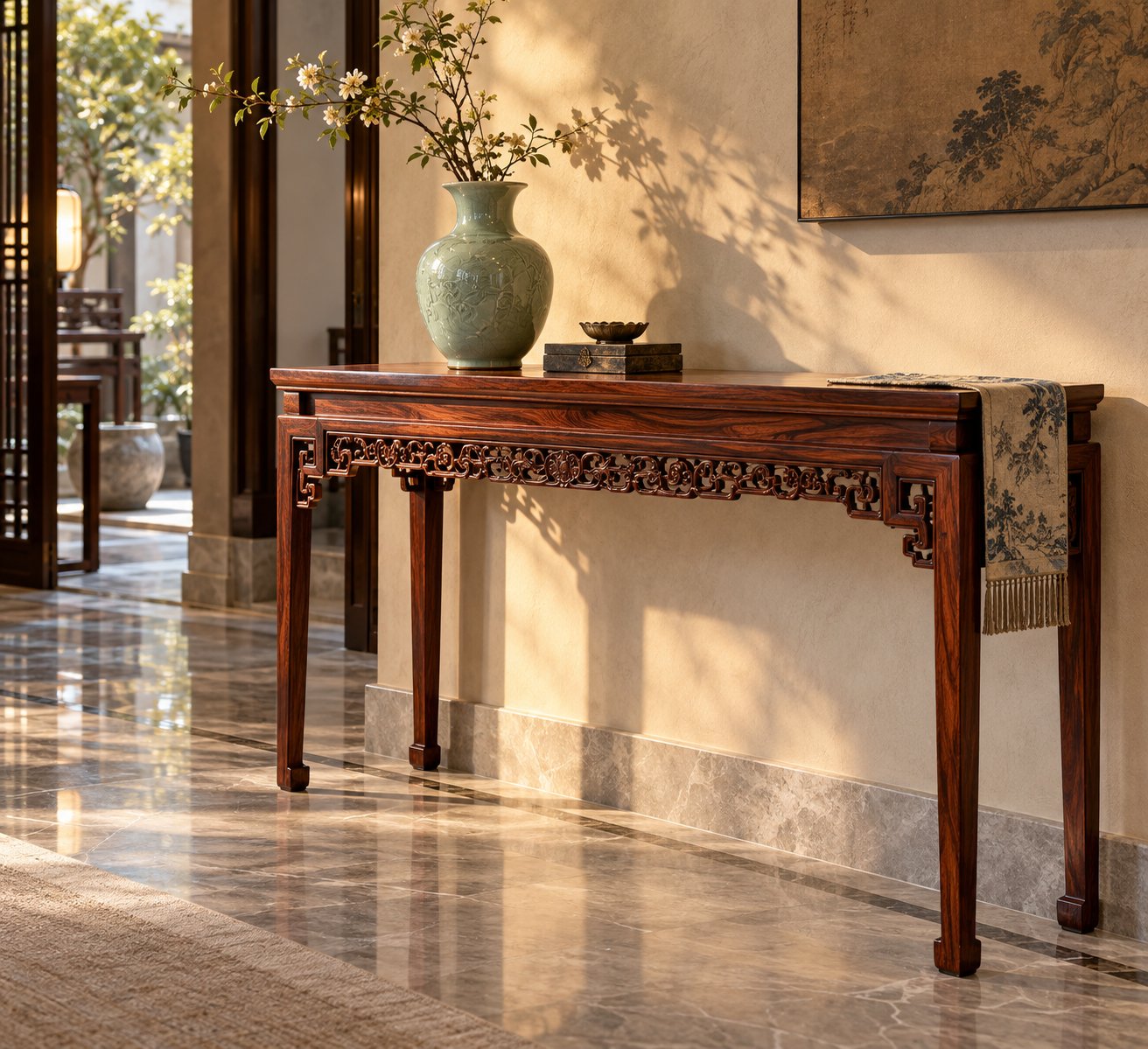
A B2B buyer's guide answering what a console table is used for: nine real placements across entryways, corridors, sofa backs, hotels and villas, plus sizing, rosewood construction, styling and sourcing checklists for importers of classical Chinese furniture.
What Is a Console Table Used For? The Short Answer
Ask ten interior designers what is a console table used for, and you will get ten variations of the same answer: it is the slim table that stands against a wall and quietly does a great deal of work. It catches keys and mail in an entryway, breaks up a long corridor wall, fills the awkward gap behind a sofa, stages a hotel lobby, and gives a villa entrance the kind of focal point that photographs beautifully. Very few furniture categories cover that much ground while occupying so little floor space.
For a B2B buyer — an importer, wholesaler, hotel project contractor or design studio — the question is more commercial. A console table is compact, which makes it container-efficient and easy to pair with larger sets. It carries a high perceived value per square metre of showroom space. And when the piece is built as a chinese console table in solid rosewood, with a hand-carved apron and traditional joinery, it stops being a filler item and becomes a statement product that supports a premium price and a coherent brand story.
This guide answers the buyer's version of the question in full: what a console table is used for in real projects, how it differs from a sofa table and a sideboard, which sizes actually fit, why rosewood construction matters for export markets, how to style and merchandise the piece, and what to verify before placing a bulk order with a Chinese factory. The company and process facts referenced throughout come from Yunxiao Rosewood Furniture Co., Ltd (yunxiaofurniture.com), a classical redwood furniture manufacturer founded in 2008 in Xianyou County, Putian, Fujian — a region known as the hometown of traditional hardwood craft — which supplies wholesalers, hotels and designers across Europe, North America, Australia and Southeast Asia.
What Is a Console Table? Definition and Origins
What is console table, in precise terms? A console table is a narrow, generally rectangular table designed to stand against a wall or behind another piece of furniture rather than in the middle of a room. Most designs share four characteristics:
- Height: typically between 75 and 85 cm, roughly at waist height or level with the back of a standard sofa.
- Depth: shallow, usually 30 to 45 cm, so it serves a wall without blocking circulation.
- Open structure below the top: legs and an apron rather than a closed cabinet body, which keeps the silhouette light and the piece easy to clean around.
- Display-first function: the surface is meant to hold objects — a vase, a lamp, a tray — rather than to seat diners or support heavy work.
The form has European roots. The word "console" comes from the French term for a bracket, and the earliest console tables of the seventeenth and eighteenth centuries were wall-hung or bracket-supported tables placed against the grand walls of French and English salons. As interiors relaxed, the console came down onto four legs, travelled into hallways and drawing rooms, and eventually crossed the Atlantic as a standard piece in American and colonial revival homes.
The Chinese lineage is older and, for buyers of classical furniture, more relevant. The direct ancestor of today's chinese console table is the altar table (条案, tiao'an), a long, narrow table that stood against the main wall of a Chinese hall. It held ancestral tablets, candles and ritual objects, and its proportions — narrow depth, long top, carved apron, recessed or straight legs — were codified in Ming dynasty furniture design and elaborated during the Qing dynasty. When a Western buyer searches for a chinese console table today, the piece they are usually imagining is this form: a rosewood entryway table with a hand-carved apron and visible joinery, carrying four centuries of hall furniture tradition into a modern foyer.
Contemporary console tables blend both traditions. A modern chinese console table may keep the altar-table silhouette while adopting proportions suited to apartment ceilings and hotel corridors. For importers this hybrid is the sweet spot: recognisably classical, but scaled and finished for the markets of Southeast Asia, Australia, Europe and North America.
Console Table vs. Sofa Table vs. Sideboard: Which Piece Fits Which Space?
Buyers often ask what is sofa table, and whether it is a different product from a console table. The honest answer: the terms overlap heavily, and in most Western markets they are used interchangeably for the same silhouette. The historical distinction is one of placement. A sofa table was designed specifically to stand behind a sofa, originally with two demi-lune (half-round) ends that folded down over the sofa's back. Its height was set to align with the sofa back — which is why most sofa tables sit in the same 75 to 85 cm band as console tables. Today, when a customer searches "what is sofa table", they are almost always describing a console table positioned behind a sofa, often narrower than the sofa itself so it does not block walkways at either end.
A sideboard, by contrast, is a closed case piece: a storage cabinet of full depth (typically 40 to 50 cm or more) with doors and drawers, used in dining rooms for serveware and linens. It is a different product category, and it answers a different buyer problem — storage rather than display.
| Feature | Console Table | Sofa Table | Sideboard |
|---|---|---|---|
| Typical height | 75–85 cm | 75–85 cm | 80–90 cm |
| Typical depth | 30–45 cm | 30–45 cm | 40–50 cm+ |
| Structure | Open legs, apron | Open legs, apron | Closed case, doors and drawers |
| Primary use | Wall display, entryway, hallway | Behind a sofa | Dining storage, serving surface |
| Storage | Optional shallow drawer or lower shelf | Optional lower shelf | Substantial: drawers, doors, shelves |
For a catalog planner, the practical takeaway is that a well-built console design can be merchandised three ways — as a rosewood entryway table, as a sofa table, and, with the addition of drawers, as a light-duty serving piece — which is exactly why the category earns its place in a mixed container alongside dining sets and bedroom suites.
The Nine Most Common Uses of a Console Table in Real Projects
The question "what is console table used for" is best answered project by project. These are the nine placements where the category earns its keep, drawn from the residential, hospitality and retail scenarios that classical furniture importers serve.
1. The Entryway: Where a Rosewood Entryway Table Earns Its Keep
The entryway is the classic placement and the easiest to sell. A console table against the foyer wall creates a "drop zone" — a surface for keys, bags and mail — while defining the first impression of the home. In villa and premium residential projects across Southeast Asia and Australia, buyers routinely specify a rosewood entryway table here precisely because it signals craftsmanship from the moment the door opens. The styling formula is simple and repeatable: a tall ceramic or bronze vase at one end, a tray or bowl for small items near the door swing, and a mirror or artwork above to double the sense of light and space.
For importers, the entryway console is also the most forgiving product in a classical line. It suits apartments and villas alike, needs no companion pieces to look complete, and photographs well against almost any wall colour.
2. Long Hallways and Corridor Walls
A long, bare corridor is one of the hardest interior problems to solve with furniture, because depth is limited. The console table is almost the only category that fits: at 30 to 45 cm deep it serves a 1.1 to 1.5 metre corridor without pinching the walkway. Spaced console tables along a corridor wall — or a single long altar-table form — add rhythm, give wall art a base line, and turn dead circulation space into a styled transition. In hotel projects, this is how designers dress the long approach to a ballroom or lift lobby without narrowing it.
3. Behind the Sofa: The Modern Sofa Table Placement
The sofa-back placement is where the "what is sofa table" search originates. When a sofa floats away from the wall — common in open-plan living rooms in North America and Australia — the gap behind it looks unfinished. A sofa table standing behind the backrest closes the composition, puts a lamp and a book within reach of the seat, and adds a second styling surface to the room without demanding extra floor area. The rule of thumb buyers should pass on to their customers: choose a table two-thirds to three-quarters of the sofa's length, and keep its height at or just below the sofa back so the silhouette does not crowd the room.
4. Dining Room Serving Surface
In dining rooms, a console table placed against a side wall works as a service station: it holds a drinks tray, coffee service or dessert display during gatherings, then carries a lamp and artwork between events. A design with a shallow drawer adds genuine utility here — cutlery, candles and linens stay within reach. It is also the natural companion piece to a formal dining set, and a frequent add-on order for importers who already stock rosewood dining tables and want to lift the average order value per container.
5. Hotel Lobbies and Reception Areas
Hospitality buyers are among the strongest customers for the console category. In a hotel lobby, a pair of matching console tables flanking the reception desk, or a single long piece against the check-in wall, provides a styling surface for flower arrangements and local art, a perch for signage, and a layer of warmth in what is often a hard-surfaced space. Because lobbies run heavy traffic, the material question is serious: veneered MDF tops chip and swell, while a solid rosewood console with dense grain and a lacquered surface tolerates decades of housekeeping. Procurement teams for boutique hotels and resorts increasingly source these pieces alongside bedroom and lobby seating programs from the same factory, for the sake of finish consistency.
6. Villa Entrances and Stair Landings
In villas, the console table performs a job Chinese garden design solved centuries ago: the framed view, or what Chinese interiors call the "ending scenery" (端景). Placed at the termination of an axis — facing the front door, at the top of a staircase, or at the end of a gallery — the table anchors the sightline and gives the eye a place to rest. A carved chinese console table in reddish-brown rosewood, styled with a single vase and lit from above, turns an architectural dead end into the most photographed corner of the house. Villa project buyers in Australia and North America specify this placement constantly, and it is the placement that sells the most premium carving levels.
7. Office Reception and Executive Interiors
Corporate reception areas use console tables the way hotels do — along the wall behind the visitor seating or beside the reception counter — but the stylistic register is different. A classical rosewood piece in an executive office or boardroom entrance communicates permanence and heritage, which is why law firms, tea brands and family offices across Southeast Asia favour the form. The piece works hardest in reception zones where a full desk would be too much and an empty wall would be too little.
8. Retail and Showroom Merchandising
For retailers, the console table is a merchandising instrument as much as a product. Placed on the sales floor, it presents accessories, tea ware or textiles at touch height; placed in the window, it builds a scene around a single hero piece. Because the category is visually light, it layers well in front of cabinets and beside dining sets without blocking them. Wholesalers report that a styled console in the showroom routinely pulls accessory sales and frequently converts into an order for the table itself — a rare double return on a single piece of inventory.
9. Tea Rooms and Quiet Corners
Not every space wants a full-height table. In tea rooms and meditation corners, the altar-table heritage of the chinese console table translates naturally: a narrow table against the wall holds the tea service above seat height while low seating faces it. Buyers who serve this market usually pair the piece with a dedicated tea table and armchairs; Yunxiao's Classical Siamese Rosewood Tea Table with Carved Cloud Apron is a compact 80 × 50 cm companion for exactly this kind of setting, and the two categories are frequently quoted together in boutique hotel lounge projects.
Sizing a Console Table: The Dimensions That Decide Whether It Fits
Dimensions decide the sale. Before committing to a design or a container quantity, a buyer should verify five numbers, and a responsible factory should be able to supply all of them in the quotation:
- Overall height (75–85 cm typical): confirm it sits at or below the back of the sofa it will serve, and at a comfortable hand height in the entryway.
- Overall depth (30–45 cm typical): measure the wall or corridor it must serve and keep at least 90 cm of clear walkway in front of the piece. A drawer or lower shelf can add usable depth to the silhouette even when the top is shallow.
- Length: entry consoles typically run 90 to 150 cm; sofa tables should be two-thirds to three-quarters of the sofa length; hotel altar-form pieces may run 180 cm and beyond.
- Apron-to-floor clearance: if the design has a lower shelf or drawer box, confirm the clearance under it — this determines whether the space below can be used at all.
- Packed dimensions: for export planning, ask for the crated size and gross weight per unit. A shallow console is one of the most container-efficient case goods in a classical line, which directly improves the landed cost per unit.
Two cautions from the workshop floor. First, overall size is not usable size: a carved apron reduces the practical clearance between the top and the floor, so confirm the net dimensions rather than reading them off the silhouette. Second, if the table must pass a narrow doorway or a tight staircase in the destination market, check the packed crate against the tightest access point of the end building — this is a routine source of avoidable complaints in villa projects, and it costs one email to verify.
Why Choose a Rosewood Console Table? Material, Joinery and Finish
Console tables are sold in every material from powder-coated steel to veneered MDF, so why does the solid rosewood version command its price, and why does it survive export climates better than cheaper constructions?
Density and carving fidelity. The hardwoods used in classical Chinese furniture — above all the Dalbergia species marketed as rosewood — are dense, fine-grained timbers that hold crisp carved detail. On Yunxiao's carved pieces, only boards with a heartwood percentage above 80 percent enter the product line, because heartwood holds carving detail cleanly and resists dimensional movement. Softwoods and MDF cannot carry relief carving at this level of definition, which is why carved "look-alikes" in cheaper materials show rounded, mushy edges under inspection.
Joinery that survives movement. A console table is a long, narrow frame, which makes it more sensitive to wood movement than a cube-shaped piece. Solid-wood construction with traditional joinery manages this: on Yunxiao's furniture, components are assembled with mortise-and-tenon joints reinforced by bamboo dowel pins and no metal fasteners in the primary frame, so the structure flexes with the seasons instead of working loose around screw threads. This is a workshop-level practice the company has used since its founding in 2008 in Xianyou County, Fujian.
Drying and conditioning. The classic failure mode for exported solid-wood furniture is a top that splits when the piece travels from a humid factory to a dry, air-conditioned interior. Yunxiao conditions its timber in a 36-day constant-humidity drying process, and on its current tea-table line kiln-conditions boards to 8–12% moisture content over a four-week cycle with a 48-hour equalisation period. Buyers comparing suppliers should ask each factory to state its target moisture range and conditioning cycle in writing — it is one of the most revealing questions in the industry.
Finishing. Yunxiao finishes its carved furniture with hand-applied lacquer systems — six to seven coats on its current tea-table and sideboard lines, each coat cured for 24 hours and rubbed with pumice stone — supplemented by beeswax work, with finishing standards aimed at EU REACH and US CARB expectations. A well-built lacquer film is what lets a rosewood console survive hotel housekeeping chemicals and daily wiping without turning grey or sticky.
Repairability. A solid-wood, joinery-built console can be repaired: a loose tenon can be re-seated, a scratched top can be re-polished, a damaged leg can be replaced. Veneered and glued constructions are, in practice, disposable. For hotels and rental programs where furniture lives several lives, this difference alone justifies the unit-price premium.
The honest trade-offs. Solid rosewood costs more per unit than engineered alternatives, it is heavier to ship, and Dalbergia cochinchinensis — Siamese rosewood, the species on Yunxiao's tea-table line — is listed in CITES Appendix II, so international shipments require export permits. These are real costs, and buyers should price them into the comparison. What the premium buys is a product that arrives intact, ages well, and can be sold as a genuinely classical piece rather than a styled imitation.
What Makes a Chinese Console Table Different? Form, Carving and Motifs
Among the console categories a Western buyer can stock, the chinese console table is the most distinctive, for reasons that go beyond material.
Form. The altar-table silhouette — long, narrow, with the top overhanging recessed or straight legs — is immediately recognisable and reads as classical even to customers who know nothing about Chinese furniture. Ming-style versions favour clean lines, slim members and restraint; Qing-style versions favour fuller profiles, deeper carving and more ornament. A catalog can carry both registers to cover both price points.
Carving. Hand carving is the signature value layer. On Yunxiao's current carved lines, the workshop's master carvers chisel motifs such as dragons, clouds and lattice in relief — the cloud apron on the tea-table line takes roughly 12 carving hours per table at 2–3 mm relief depth, and the sideboard line's auspicious apron and base carving runs to approximately 25 hours per piece. Carvers work from reference drawings but adjust each motif to the grain of the individual board, which is why no two carved pieces are pixel-identical. Machine-carved imitations can approach the geometry but not the crisp edges that dense rosewood gives a hand chisel — a difference covered in depth in Yunxiao's guide to identifying hand-carved redwood furniture.
Meaning. Motifs carry meaning that end customers in Chinese-influenced markets read fluently: clouds for fortune, dragons for power, ruyi for wishes granted, lattice for ordered prosperity. For a distributor selling into Southeast Asian, Chinese diaspora and design-literate Western markets, this symbolism is a sales narrative that a plain console table cannot offer.
Placement heritage. Because the altar table was always a wall piece, the form is inherently proportioned for the console uses described in this guide — entryways, corridor walls, sofa backs and lobby focal points. Buyers are not adapting a dining table to a wall; they are selling the original wall furniture of the Chinese hall.
Styling a Console Table: A Practical Formula for Showrooms and Photography
A console table sells twice: once as furniture, once as a photograph. The styling formula that professional stagers use is simple enough to hand to any showroom team:
- One vertical anchor: a tall vase, lamp or sculpture at one end of the top, roughly two-thirds the height of any mirror or artwork above.
- One mid-level object: a bowl, tray, candle grouping or stack of books near the centre, breaking the horizontal line of the top.
- One horizontal texture: a runner, folded textile or trailing plant to soften the wood-to-wall transition.
- Art above, at 15–25 cm above the tabletop: a mirror doubles light in an entryway; a scroll or painting sets the classical register.
For e-commerce photography, the strongest-performing setup is a warm neutral wall, side or late-afternoon light raking across the carved apron (which throws the relief into shadow and shows the hand-carving), and a single ceramic accent. Buyers preparing listings for a rosewood console table should shoot one detail frame of the apron carving and one of the joinery — these are the frames that separate a genuine solid-wood piece from imitations in the customer's mind, and they cost nothing to capture during the standard photo session.
Sourcing Rosewood Console Tables from China: A B2B Checklist
For buyers convinced of the use cases, the next question is how to source well. The checklist below reflects the working practices documented on Yunxiao's own product lines and company profile, and it doubles as a set of questions worth putting to any supplier.
OEM and ODM: Getting the Design You Actually Need
Most importers do not want a catalogue clone; they want a console table matched to their market's ceiling heights, doorway widths and price bands. Yunxiao supports OEM and ODM customisation — custom sizes, custom carving patterns and buyer logos — with a 15-day design approval cycle on its current carved lines. When briefing a custom piece, specify: overall dimensions and depth budget, carving motif and relief depth, finish level, drawer or shelf configuration, and the packed-crate constraint for your market's tightest access. A factory that answers those five points in its drawing review is one that has actually built for export before.
MOQ, Samples and Trial Orders
Console tables suit a test-first sourcing strategy because the unit is compact and the freight cost of a single trial piece is modest. Yunxiao's company profile explicitly offers trial single sets and refundable samples, and its current carved product lines list a minimum order quantity of one piece, with volume pricing at higher tiers. A practical first order for a new market is a mixed evaluation: one console or altar-form piece, one tea table, one armchair — enough to judge carving, finish and packing quality across categories before committing a full container.
Lead Times and Payment Terms
For container orders, Yunxiao's stated production window is 45 to 60 working days after deposit; on its current tea-table line the quoted range is 35–50 days for a single piece and 60–75 days for batch orders of five or more. Payment terms on the current lines are a 30 percent T/T deposit with balance before shipment, and letter of credit is accepted on orders of five or more pieces. Confirm the terms that apply to your specific order in the quotation — terms vary by product line and order structure, and a serious supplier will put them in writing rather than leave them to a listing page.
Packing, Documents and Compliance
Export packing is where carved furniture is won or lost. Yunxiao packs its furniture in ISPM-15 heat-treated wooden crates with EPS foam corner blocks and moisture barriers, wrapped in acid-free tissue and corrugated board — a system engineered specifically for relief-carved pieces travelling by sea container. On documentation, shipments from the current carved lines include a commercial invoice with HS code 9403.60 and a wood drying certificate; the sideboard line additionally carries FSC chain-of-custody documentation and CITES export permits for Dalbergia cochinchinensis. Buyers importing into the EU or US should confirm which documents their shipment requires early, because CITES permit processing sits on the critical path — Yunxiao's guide to CITES regulations and the rosewood trade covers the 2026 landscape in detail.
Container Planning for Shallow Pieces
A console table is among the most freight-efficient pieces in a classical furniture program: shallow depth and light relative weight mean more units per container and lower landed cost per unit. On Yunxiao's tea-table line, a 20-foot container fits approximately 80 units by volume — the console category behaves similarly because the silhouette is comparable. Practical planning advice: combine console tables with the bulky pieces that need the floor (dining sets, beds, wardrobes) and let the shallow pieces fill the vertical space above and beside them. A factory experienced in mixed containers will plan this loading with you; Yunxiao provides free layout drawings for project orders and plans container loading to protect carved surfaces in transit.
Quality Checks Before You Place a Bulk Order
Whether the order goes to Yunxiao or to any other workshop, the same verification list applies. These are the checks that separate professional buyers from hopeful ones:
- Moisture content: ask for the target range in writing (Yunxiao's carved lines state 8–12%) and request three-point readings per unit on the pre-shipment report. Readings outside range mean re-conditioning, not negotiation.
- Joinery: confirm mortise-and-tenon construction with reinforcement details — bamboo dowel pins on Yunxiao's lines — and ask how the joints are checked. On current Yunxiao lines, each assembled frame is load-checked at 60 kg for 24 hours, and any joint showing separation is re-fitted before packing. This is an internal inspection procedure rather than a certified laboratory test, which is exactly the kind of distinction a good supplier states plainly.
- Tabletop construction: for solid tops, ask whether the panel floats inside the frame groove — the detail that absorbs seasonal movement instead of splitting. Yunxiao's tea-table line uses a floating panel with a 4 mm expansion gap.
- Carving quality: request close-up photos of relief carving at the sharpest motif transitions, and ask for the relief depth (2–3 mm shallow relief on Yunxiao's cloud apron) and carving hours per piece.
- Finish: confirm the coat count and cure process (six to seven coats, 24-hour cure, pumice rubbing on Yunxiao's carved lines) and whether the finish meets the chemical standards of your market (REACH/CARB expectations on Yunxiao's profile).
- Pre-shipment inspection: commission a third-party inspection or a structured self-inspection before the balance payment. Yunxiao's buyer checklist for inspecting rosewood furniture before shipment and its guide to conducting a virtual factory audit set out the working procedure, and buyers visiting Fujian can arrange a workshop tour to inspect timber stock, carving stations and the lacquer curing room in person.
Pairing a Console Table with the Rest of a Classical Rosewood Program
Console tables rarely sell alone; they anchor rooms that contain other classical pieces. Buyers building a program should plan the pairings deliberately:
- Entryway scene: a rosewood console or altar-form table, a mirror, and a pair of Classical Siamese Rosewood Armchairs with Carved Ruyi Backrests for seating — the classic hall composition.
- Living room scene: the console as a sofa table behind the seating group; the Ming Style Siamese Rosewood 9-Piece Grand Living Room Set is the anchor purchase it is quoted alongside.
- Dining scene: the console as a service station on the side wall, with a Classical Siamese Rosewood Sideboard with Dovetail Drawers carrying the storage load — the two pieces share construction and finish language.
- Lobby and display scene: the console under the artwork, with a Carved Lattice Display Cabinet on the adjacent wall for the full classical register.
When ordering several categories in one program, buyers should request unified wood selection and colour matching across all pieces in the same shipment — pairing pieces from one factory's kiln-conditioned stock is the most reliable way to keep grain tone consistent across a room, and it is the standard practice on Yunxiao's combined orders.
Frequently Asked Questions
What is a console table used for in a hotel project?
In hotels, console tables serve three jobs: styling walls in lobbies and corridors (flower arrangements, signage, local art), providing service surfaces near function rooms, and dressing lift lobbies and suite entry halls. Solid rosewood construction matters in this setting because housekeeping is aggressive and veneered alternatives chip and swell within a few seasons.
What is the difference between a console table and a sofa table?
Functionally, very little — both are narrow, 75–85 cm high tables with open legs. Historically, a sofa table was designed for placement behind a sofa (often with demi-lune ends), while a console table was designed for a wall. In today's market the terms are used interchangeably, and the same piece can be merchandised as both.
How tall should a console table be?
Most console tables stand between 75 and 85 cm high. Behind a sofa, choose a table at or just below the sofa back height. In an entryway, waist height (around 80–85 cm) is the most comfortable for setting down bags and keys. Confirm the exact height in the specification sheet rather than the product photo.
Can a console table have drawers or shelves?
Yes. A shallow drawer adds entryway utility without changing the silhouette, and a lower shelf doubles the display surface. Note that drawers and shelves add functional depth — if the piece must sit in a tight corridor, confirm the net depth with the drawer hardware accounted for.
What wood is best for a console table in export climates?
For classical furniture, dense solid hardwoods with proper conditioning perform best across the humidity swings of shipping and air-conditioned interiors. Look for stated kiln-drying targets (8–12% moisture on Yunxiao's carved lines), floating-panel tops, and mortise-and-tenon joinery without metal fasteners — these three details predict how the piece will behave after the container doors close.
What is a Chinese console table?
A chinese console table is the modern descendant of the altar table (tiao'an) of classical Chinese halls: a long, narrow wall table with a carved apron and traditional joinery, built today in rosewood species such as Dalbergia cochinchinensis. It carries Ming and Qing design language and reads as a statement piece in entryways, behind sofas and in hotel lobbies.
Can I order a custom-size console table for my market?
Yes. Yunxiao supports OEM and ODM customisation — custom sizes, carving patterns and buyer logos — with a 15-day design approval cycle on its current carved lines, and its profile offers trial single sets and refundable samples. Current product lines list MOQ of 1 piece with volume tiers above; confirm the terms that apply to a custom console design directly in your quotation.
How do I care for a lacquered rosewood console table?
Dust with a soft dry cotton cloth along the grain; for smudges, use a cloth wrung out in clean water and dry immediately. Avoid alcohol, ammonia and silicone-based sprays, use trivets for hot items, keep the piece out of prolonged direct sun, and maintain indoor relative humidity around 40–60% so seasonal wood movement stays within the structure's design range.
The Takeaway for Buyers
What is a console table used for? In practice: it is the most versatile wall-facing piece in a furniture program — entryway drop zone, corridor rhythm-maker, sofa-back finisher, dining service station, hotel lobby anchor and villa focal point — and the chinese console table in solid rosewood is the version of it that carries both the craft story and the margin story. The category is compact to ship, quick to style, easy to merchandise across price points, and it pulls sales for the larger pieces around it.
If you are planning a console-table program for your market, the practical next step is a specification conversation: destination port, preferred Incoterm, target dimensions and carving level, and whether the first move is a trial piece or a mixed container. Yunxiao Rosewood Furniture Co., Ltd publishes its company profile, current carved furniture lines and buyer guides at www.yunxiaofurniture.com, and its team quotes trial single sets, refundable samples, free project layout drawings and OEM/ODM console designs through the website's inquiry channels.