
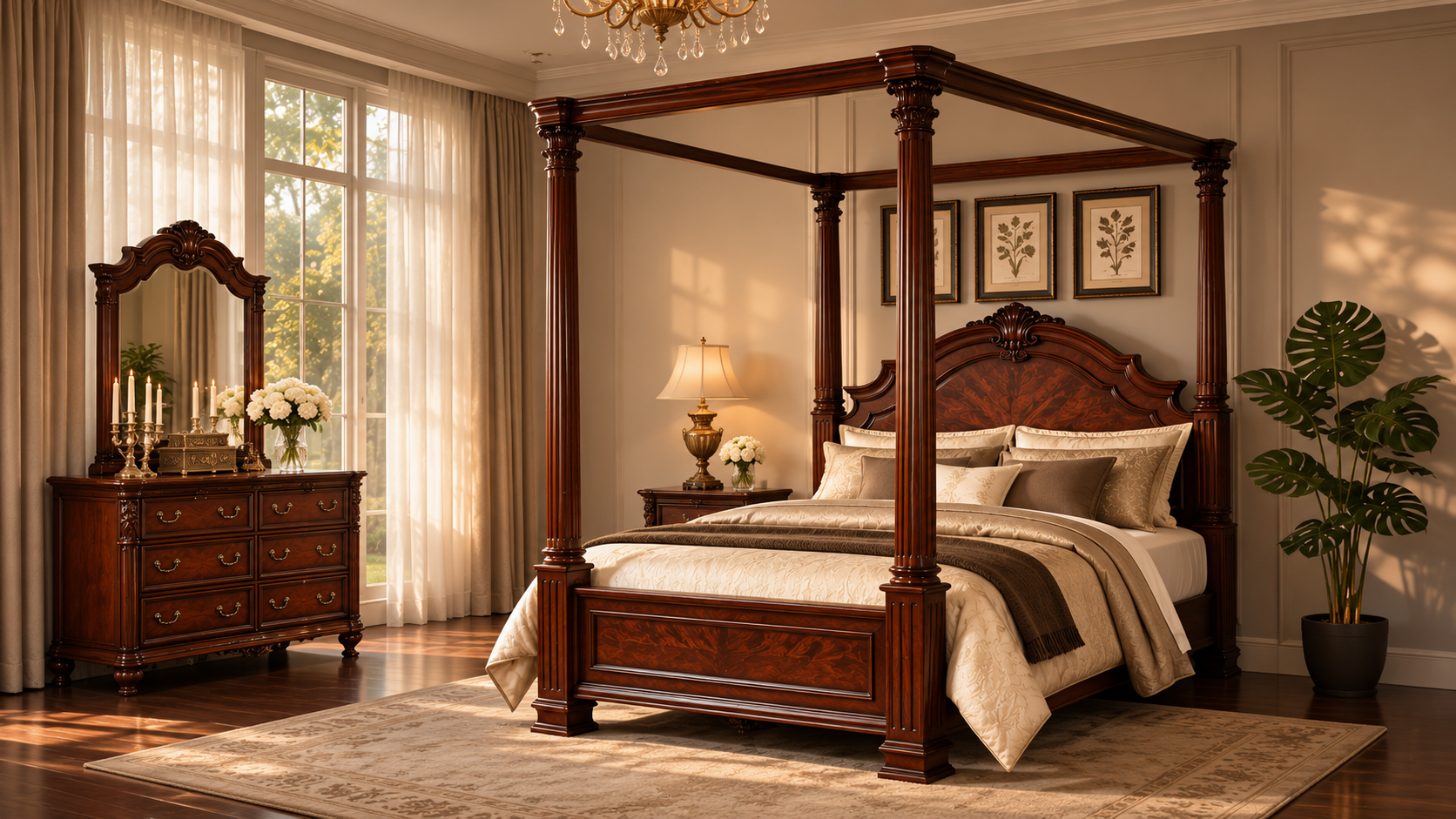
A B2B buyer's guide comparing US, EU, UK and Australian mattress size standards with the actual dimensions of Yunxiao's solid rosewood bed frames, including OEM custom sizing, slat base verification and a pre-order checklist for importers.
Why Mattress Compatibility Is a Critical B2B Question for Rosewood Bed Frames
When importers source a solid rosewood bed frame from China, the first questions usually focus on wood species, joinery, and finish. Yet one of the most common causes of customer complaints and returns has nothing to do with craftsmanship: the mattress does not fit the frame. A bed frame built for a European 180 x 200 cm mattress will not accept a North American king mattress, which measures 76 x 80 inches (193 x 203 cm). The difference is 13 cm in width and 3 cm in length, and no amount of careful packing or patient freight forwarding can fix it after the container has sailed.
This question matters even more for rosewood bedroom furniture than for flat-pack pine or upholstered beds. A solid rosewood bed frame with mortise-and-tenon joinery is a structural product: the side rails, slat base, and posts are cut to defined dimensions at the workshop, and the frame cannot be adjusted on site the way a metal bracket frame sometimes can. If the mattress platform is sized for the wrong market standard, the importer faces either a mattress that overhangs the rails or a gap along each side wide enough to swallow pillows, sheets, and, eventually, customer patience.
The stakes scale with the buyer type. A retail importer selling one bed at a time can absorb a single sizing error. A hotel project furnishing 40 guest rooms cannot: forty beds built to the wrong standard become a negotiation about rework, re-shipping, and project delays. This is why experienced B2B buyers treat mattress compatibility as a specification decision that is confirmed in writing before the deposit is paid, not a detail discovered during installation.
This guide answers the question the title asks in a structured way. It explains how bed frame dimensions relate to mattress dimensions, walks through the size standards in the United States, the United Kingdom, continental Europe, and Australia with exact figures in both inches and centimetres, and then shows how a rosewood furniture factory that supports OEM customization handles non-standard size requests. Throughout, we use the actual dimensions of the Classical Redwood Canopy Bed 3-Piece Bedroom Set and the Classical Four-Poster Redwood Bedroom Suite 5-Piece as worked examples, so every number in this article ties back to a product you can inspect on this site.
How Bed Frame Sizing Actually Works: Outer Dimensions Versus Mattress Platform Size
Before comparing market standards, buyers need to be clear about three different measurements that suppliers use interchangeably in quotations, often without noticing. First, the outer dimensions of the frame: the total footprint including posts, finials, and any carved headboard or footboard overhang. Second, the mattress platform size: the internal dimension between the side rails that directly receives the mattress. Third, the clearance: the space the frame needs for walkways, bedside tables, and, for canopy and four-poster designs, ceiling height.
The measurement that determines mattress compatibility is the second one, the platform. A practical rule used across the furniture trade is that the mattress platform should be equal to the nominal mattress size, or at most 1 to 2 cm larger, so the mattress sits snugly without being squeezed. If a platform built for a 180 x 200 cm mattress receives a 193 cm wide North American king instead, the mattress cannot drop between the rails; if it receives a 150 cm wide UK double, the mattress floats with a 15 cm gap per side.
Outer dimensions tell a different story, and they matter for logistics and installation rather than for mattress fit. Our four-poster suite page lists king outer dimensions of approximately 2.10 m by 2.25 m with a post height near 2.05 m, and clearance under the side rail of roughly 150 mm. Those numbers decide whether the bed passes through a hotel service elevator and clears a 2.4 m ceiling with room for the carved finials, but they say nothing about which mattress fits. When a supplier quotation states only "king size bed", a professional buyer asks for all three figures in writing, in centimetres and inches, before confirming the order.
There is also an assembly dimension worth noting for container planning. Both of our featured bed frames ship flat-packed: the canopy bed travels with posts, rails, canopy frame, and slat base separated, and the four-poster suite ships the same way with nightstands, wardrobe, and dresser fully assembled. The posts ship as single solid sections and cannot be broken down for tight stairwells, which is why our product pages ask buyers to measure doorway widths and staircase turns before ordering. None of this changes the mattress platform, but all of it belongs in the same pre-order conversation, because the buyer who verifies mattress size will also need to verify delivery access.
United States Mattress Sizes: Twin Through California King
The United States is the largest single export market for classical solid wood bedroom furniture, and it is also the market where sizing mistakes are most expensive, because US dimensions are defined in inches and differ from every metric standard. The commonly used US sizes are: Twin (also called Single) at 38 x 75 inches (96.5 x 190.5 cm); Twin XL at 38 x 80 inches (96.5 x 203 cm); Full or Double at 54 x 75 inches (137 x 190.5 cm); Queen at 60 x 80 inches (152.5 x 203 cm); standard King, sometimes called Eastern King, at 76 x 80 inches (193 x 203 cm); and California King at 72 x 84 inches (183 x 213.5 cm). These figures are consistent across mainstream US bedding references such as the Purple mattress size guide and Nectar's international size chart.
Two honest qualifications belong next to any US table. First, the United States does not enforce a single legal standard for mattress dimensions; the sizes above are trade conventions that are consistent in practice across major manufacturers, which is why converters between inches and centimetres occasionally differ by half a centimetre. Second, regional preferences vary: Queen is the most popular size in American homes and hotel rooms, while California King remains a niche option concentrated on the West Coast and in taller sleepers' preferences. For a B2B importer this means the specification conversation should name the exact mattress model or the exact inch dimensions the end customer uses, not just the word "king".
| US Size | Width x Length (inches) | Width x Length (cm) | Typical B2B Use |
|---|---|---|---|
| Twin | 38 x 75 | 96.5 x 190.5 | Kids' rooms, dormitories, compact guest rooms |
| Twin XL | 38 x 80 | 96.5 x 203 | College housing, taller single sleepers |
| Full / Double | 54 x 75 | 137 x 190.5 | Secondary bedrooms, boutique conversions |
| Queen | 60 x 80 | 152.5 x 203 | The default master bedroom and hotel standard |
| King (Eastern) | 76 x 80 | 193 x 203 | Luxury master bedrooms, premium suites |
| California King | 72 x 84 | 183 x 213.5 | Tall sleepers, West Coast premium projects |
Compare the US King with the platforms our catalogue uses and the mismatch becomes concrete. Our canopy bed is offered in king 180 x 200 cm or queen 150 x 200 cm, selectable at order. A US King mattress at 193 cm wide exceeds the 180 cm platform by 13 cm; a US Queen at 152.5 cm exceeds the 150 cm platform by 2.5 cm, which is within the tolerance some buyers accept but tighter than the 1 to 2 cm we recommend. The correct approach for a North American order is to specify the US Queen or US King platform at order time as an OEM dimension, which Section 9 explains in detail. Our four-poster suite FAQ already flags this on the product page: the frame fits standard 180 x 200 and 150 x 200 mattresses, and North American king dimensions of 193 x 203 cm differ, so the exact mattress standard should be confirmed at order.
United Kingdom Sizes and the "King" Naming Trap
The United Kingdom uses metric sizes that are narrower and mostly shorter than US equivalents, and it produces the most dangerous naming collision in international furniture trade: a UK King is 150 x 200 cm (approximately 59 x 78.7 inches), which is almost exactly a US Queen in width but 3 cm shorter in length. A buyer who reads "king bed frame" in a Chinese factory quotation and assumes 193 x 203 cm will be off by 43 cm in width when the order lands in a British warehouse.
The full UK ladder runs: Small Single 75 x 190 cm; Single 90 x 190 cm; Small Double 120 x 190 cm; Double 135 x 190 cm; King 150 x 200 cm; Super King 180 x 200 cm; and Emperor 200 x 200 cm. The 190 cm length of the smaller sizes is a real constraint: a mattress 10 cm shorter than the 200 cm platforms common in continental Europe will show a gap at the foot of a European-sized frame, so UK-targeted orders should confirm whether the end market stocks 190 cm or 200 cm lengths.
| UK Size | Width x Length (cm) | Approx. inches | Comparison Note |
|---|---|---|---|
| Single | 90 x 190 | 35.4 x 74.8 | Narrower than US Twin |
| Small Double | 120 x 190 | 47.2 x 74.8 | No direct US equivalent |
| Double | 135 x 190 | 53.1 x 74.8 | Close to US Full but 2 cm narrower, 15 cm shorter |
| King | 150 x 200 | 59.1 x 78.7 | Width of a US Queen, length of a UK Double plus 10 cm |
| Super King | 180 x 200 | 70.9 x 78.7 | 13 cm narrower than a US King |
| Emperor | 200 x 200 | 78.7 x 78.7 | No US equivalent |
For UK and Irish orders, the good news is that our standard platforms align well. The queen platform at 150 x 200 cm matches the UK King exactly, and the 180 x 200 cm king platform matches the UK Super King exactly. An importer serving the UK market can therefore order the canopy bed set in either size without OEM modification, provided the quotation states "platform 150 x 200 cm, fits UK King" rather than the unqualified word "queen", which in UK retail language is not a standard mattress name at all.
Continental Europe: The 90 / 140 / 160 / 180 x 200 System
Mainland Europe works on a clean metric ladder, almost entirely at 200 cm length: Single 90 x 200 cm; Double 140 x 200 cm; Queen 160 x 200 cm; King 180 x 200 cm; and, in the premium segment and central Europe, 200 x 200 cm. Scandinavian countries add their own conventions, with 160 x 200 cm common in Sweden and 180 x 200 cm widespread in Germany, Austria, and Switzerland. Because the lengths are uniform, European sizing errors are usually width errors, and they are smaller than transatlantic errors, but they still matter: a 160 cm EU Queen mattress on a 150 cm UK King platform overhangs by 5 cm per 100 cm of rail, which distorts the mattress edge over time.
| EU Size | Width x Length (cm) | Approx. inches | Typical B2B Use |
|---|---|---|---|
| Single | 90 x 200 | 35.4 x 78.7 | Hostels, compact guest rooms |
| Double | 140 x 200 | 55.1 x 78.7 | Secondary bedrooms, serviced apartments |
| Queen | 160 x 200 | 63 x 78.7 | Master bedrooms, boutique hotels |
| King | 180 x 200 | 70.9 x 78.7 | Premium residential, hotel suites |
Here the alignment with our catalogue is direct: the 180 x 200 cm platform matches the EU King exactly, and the four-poster suite page already serves European importers with that assumption. The EU Queen at 160 x 200 cm has no stock equivalent in our current bedroom sets, but it is one of the most straightforward OEM requests because the difference from the existing 150 cm platform is a 5 cm rail adjustment with no change to joinery geometry, post count, or carving layout.
Australia and New Zealand: Long Metrics With Their Own Widths
Australian sizing looks superficially metric-European but hides two differences that catch importers: lengths of 188 cm for singles and doubles, and a King width of 183 cm, which is neither the 180 cm EU King nor the 193 cm US King. The Australian ladder is: Single 92 x 188 cm; King Single 107 x 203 cm; Double 138 x 188 cm; Queen 153 x 203 cm; King 183 x 203 cm; and Super King 203 x 203 cm. New Zealand follows the same system with minor variations in naming.
| AU Size | Width x Length (cm) | Approx. inches | Comparison Note |
|---|---|---|---|
| Single | 92 x 188 | 36.2 x 74 | Shorter than US Twin and EU Single |
| King Single | 107 x 203 | 42.1 x 79.9 | Popular for teens and guest rooms |
| Double | 138 x 188 | 54.3 x 74 | Close to US Full in width |
| Queen | 153 x 203 | 60.2 x 79.9 | Near US Queen; 0.5 cm wider |
| King | 183 x 203 | 72 x 79.9 | Between EU King and US King |
| Super King | 203 x 203 | 79.9 x 79.9 | Largest standard; square |
The practical takeaway for an Australian or New Zealand order is that the AU Queen at 153 x 203 cm is close enough to a 150 x 200 cm platform to raise a judgement call: 3 cm of combined width slack and 3 cm of length slack is more than the 1 to 2 cm snug-fit rule, so we would treat it as an OEM adjustment rather than assume compatibility. The AU King at 183 cm needs a dedicated platform. Because our target markets include Australia, these conversions are a routine part of the pre-order worksheet rather than an exotic exception.
One Table to Compare Them All
The table below places the most trade-relevant sizes from all four systems side by side, sorted by width, so the "same name, different bed" problem is visible in a single scan. Figures are nominal; US sizes convert at 1 inch = 2.54 cm, and minor half-centimetre variations exist between manufacturers.
| Market | Name | Width x Length (cm) | Width x Length (inches) |
|---|---|---|---|
| US | Twin | 96.5 x 190.5 | 38 x 75 |
| UK | Single | 90 x 190 | 35.4 x 74.8 |
| EU | Single | 90 x 200 | 35.4 x 78.7 |
| AU | King Single | 107 x 203 | 42.1 x 79.9 |
| US | Full / Double | 137 x 190.5 | 54 x 75 |
| UK | Double | 135 x 190 | 53.1 x 74.8 |
| EU | Double | 140 x 200 | 55.1 x 78.7 |
| AU | Double | 138 x 188 | 54.3 x 74 |
| US | Queen | 152.5 x 203 | 60 x 80 |
| UK | King | 150 x 200 | 59.1 x 78.7 |
| AU | Queen | 153 x 203 | 60.2 x 79.9 |
| EU | Queen | 160 x 200 | 63 x 78.7 |
| AU | King | 183 x 203 | 72 x 79.9 |
| UK | Super King | 180 x 200 | 70.9 x 78.7 |
| EU | King | 180 x 200 | 70.9 x 78.7 |
| US | King | 193 x 203 | 76 x 80 |
| US | California King | 183 x 213.5 | 72 x 84 |
| AU | Super King | 203 x 203 | 79.9 x 79.9 |
A mattress size name is a local convention, not an international standard. Every bed frame order should carry two written dimensions, width and length in centimetres, plus the destination market, and the factory should confirm the mattress platform to those exact figures before production.
How Yunxiao Rosewood Bed Frames Are Sized: The 180 x 200 and 150 x 200 Platforms
Our bedroom collection is built around the two platforms that cover most of Europe, the UK, and much of Southeast Asia: king 180 x 200 cm and queen 150 x 200 cm, selectable at order on both the canopy bed 3-piece set and the four-poster 5-piece suite. Because both frames are cut from solid Siamese rosewood (Dalbergia cochinchinensis) with mortise-and-tenon joinery, the platform dimension is a production decision made before joinery cutting, not an afterthought adjusted with brackets.
The full dimension set for the canopy bed, as listed on the product page, reads: king outer platform 180 x 200 cm or queen 150 x 200 cm; canopy height approximately 210 cm; nightstands 50 x 40 x 55 cm each; timber moisture content 8 to 12 percent; slat spacing approximately 90 mm centres. The four-poster suite adds king outer dimensions of approximately 2.10 x 2.25 m, a post height near 2.05 m, and roughly 150 mm of clearance under the side rail. These are catalogue specifications, and we present them as such: they tell the buyer what the product is built to, while the buyer's own room survey confirms whether the product fits the building.
The slat base deserves specific attention because it defines what the frame can hold. Both bed frames recess the slat base into the side rails and support a standard innerspring or latex mattress without a box spring, with cross-slats at approximately 90 mm centres to limit mattress sag over years of use. This is a meaningful cost and logistics point for importers: a frame that does not require a box spring eliminates one bulky, low-value component from the container and one assembly step at the destination. Buyers whose end market expects a box spring, which is still common in parts of North America, should state this at inquiry so the slat base can be discussed as part of the specification rather than discovered at installation.
Climate stability is the third dimension of sizing that buyers in heated or air-conditioned buildings should understand. The timber in both frames is kiln-dried to 8 to 12 percent moisture content, with floating-panel construction on adjacent case goods so solid wood can move seasonally without splitting the frame. A solid rosewood bed frame sized correctly for the mattress but dried for the wrong climate can still develop small seasonal movement, which is why our product pages pair the platform dimensions with moisture data and a 24-month structural warranty covering joinery and frame under normal indoor use.
OEM Custom Sizing: How Non-Standard Platforms Are Produced
For buyers serving North America, whose Queen is 152.5 x 203 cm and King 193 x 203 cm, or the niche 160 x 200 cm EU Queen segment, the answer is OEM customization rather than compromise. Yunxiao supports OEM custom dimensions and ODM design development with a 15-day design approval cycle, confirmed on the product pages of both featured bed frames. In practice, a custom-size order follows a defined sequence.
First, the buyer supplies the target platform in writing: width and length in centimetres, the destination market, and the mattress type, whether innerspring, latex, or hybrid. Second, the factory checks whether the requested platform falls inside the structural envelope of the existing design. This check matters because a bed frame is a load path: corner posts, side rails, and the slat base are sized together, and a platform more than about 15 cm wider than the base design may need rail thickness or slat count adjustments rather than a simple stretch. Third, revised drawings are issued for approval within the 15-day cycle, and production begins after the buyer signs off. Fourth, the finished frame passes the same structural checks as standard production: the canopy bed specification, for example, includes a 150 kg distributed load test for 24 hours and a 10 kg lateral force test at each canopy corner before packing.
Custom sizing does not change the other export variables. MOQ remains 1 set for the canopy bed configuration, lead time runs 45 to 60 days from deposit confirmation for a single set and 70 to 85 days for batches of three or more, and terms are 30 percent T/T deposit with balance before shipment, with L/C accepted on larger orders. What a custom platform does change, slightly, is packing geometry: a 193 cm wide platform still fits standard container loading because the frame ships flat-packed, but buyers ordering near the 203 cm AU Super King should confirm crate dimensions at quotation so container planning stays accurate. Our container loading guide covers the packing side in depth.
Buyers sometimes ask whether a custom-size rosewood frame costs proportionally more. The honest answer is that pricing depends on timber consumption, not on percentages: a wider platform consumes wider boards, and dense hardwood with clean grain is graded by the board. The quotation therefore prices each custom size on its own timber take-off, and buyers comparing options should ask for the timber-specification line item rather than a flat custom surcharge.
Reading a Bed Frame Quotation: A Worked Example
To make the sizing discipline concrete, consider a hypothetical quotation line for a four-poster bed, written the way a specification-minded supplier should present it: "Four-poster bed, solid Siamese rosewood, king configuration; outer dimensions approx. 2100 x 2250 mm; mattress platform 1800 x 2000 mm; post height approx. 2050 mm; clearance under side rail approx. 150 mm; slat base at approx. 90 mm centres; flat-packed, two crates; fits EU King / UK Super King mattress." This is an illustrative example for training purposes, not a customer document, but every figure in it corresponds to a real item on our product pages.
Walk the line item the way a buyer should. The outer dimensions tell the logistics team whether the crate loads the planned container and whether the posts clear the delivery route. The platform figure, 1800 x 2000 mm, is the one that decides mattress compatibility, and it should be matched letter for letter against the mattress specification the end customer will buy. The post height drives the ceiling check for canopy designs. The clearance figure affects housekeeping and under-bed storage expectations. The slat spacing is the item most often missing from competitor quotations, and the one that determines whether the mattress warranty stays valid at the destination.
If any of these five figures is absent from a quotation you receive, ask for it in writing before the deposit. A supplier who answers all five questions with numbers has done the engineering; a supplier who replies with another adjective has not. The same five-point reading works in reverse when you brief us: the more complete your dimension brief is, the shorter the quotation cycle becomes, because the specification leaves no room for the assumptions that cause sizing failures in the first place.
The Slat Base and Mattress Support: What Importers Should Verify Before Ordering
Mattress compatibility is not only about platform width and length. The support surface decides whether a warranty-quality mattress performs as designed, and it is one of the few areas where bed frame construction differs sharply between solid-wood classical frames and metal-frame commodity products.
Three verifiable points should be in every pre-order note. First, slat spacing: our frames use cross-slats at approximately 90 mm centres, which limits mattress sag; most mattress warranties in the US and EU specify a maximum slat gap, commonly around 75 to 100 mm depending on the brand, so the buyer should check the mattress brands their end customers will use. Second, support without a box spring: our slat base sits recessed into the side rails and is designed for innerspring or latex mattresses placed directly on the slats. Third, rail height and clearance: the four-poster suite lists roughly 150 mm of clearance under the side rail, which affects under-bed storage and, for hospitality buyers, housekeeping vacuum access.
Hospitality buyers should add a fourth point: durability under turnover. A guest-room mattress is lifted, edges are sat on, and housekeeping trolleys contact the rails weekly. This is the subject of our separate guide on how durable hotel bedroom furniture needs to be; the sizing-specific version of that question is whether the platform and rails tolerate the mattress weights common in contract-grade bedding, which for queen and king hybrid mattresses can exceed 45 kg. The 150 kg distributed load standard we apply to the assembled canopy frame gives hospitality buyers a reference point that is stated as an in-house test on the product page rather than an external certification.
Sizing Hospitality Projects Around Standard Platforms
Hotel and resort projects add a layer of planning that retail orders do not have: the bed platform must work inside a room module that was drawn by an architect, not chosen by a furniture buyer. A guest room with a 3.6 metre clear width accepts a 180 cm platform with bedside tables on both sides and comfortable walkways; the same room with a 193 cm US King loses 13 cm that usually comes out of the walkway, not the furniture budget. This is why hospitality specification sheets increasingly state the platform size before the style: the room module sets the maximum outer footprint, and the platform choice flows from it.
Mixed room programs raise a second planning question. A typical boutique property splits its key count between king rooms and twin rooms. Our catalogue approaches this through the same solid rosewood construction in different configurations: the king platforms at 180 x 200 cm or 150 x 200 cm serve the doubles, while twin rooms are planned around paired single platforms, most commonly 90 x 200 cm in Europe or 92 x 188 cm in Australia. Because all configurations share the same timber batch, joinery, and finishing process, a mixed order still reads as one coordinated room program, which matters for the batch-matched carving we recommend confirming at inquiry for multi-room projects.
Phased delivery is the third hospitality-specific point. Our four-poster suite page notes that a 40-foot container loads approximately 6 to 10 complete suites and that projects of 20 suites or more can run as dedicated batch production with phased delivery. Platform size belongs in the phasing conversation for a practical reason: if the project imports mattresses locally in phases, the factory platform confirmation should reference the mattress supplier's specification sheet for each phase, so a mid-project change of mattress brand does not strand the later batches with a platform built for the first phase's mattress.
Six Common Sizing Mistakes B2B Buyers Make, and How to Avoid Them
Across export orders, sizing failures cluster into a small number of repeating patterns. Naming them explicitly is more useful than a generic warning.
- Assuming "king" means the same thing everywhere. As the comparison table shows, king width runs 150 cm in the UK, 180 cm in the EU, 183 cm in Australia, and 193 cm in the US. The fix costs nothing: write the dimensions next to the name in every quotation, PO, and packing list.
- Quoting outer dimensions as mattress size. A "2.10 x 2.25 m king bed" description, taken from our four-poster suite's outer footprint, describes the post-to-post exterior, not the platform. Buyers who spec from outer dimensions order a frame whose platform is 20 to 30 cm smaller than expected.
- Ignoring mattress length differences. UK singles and doubles are 190 cm long while EU sizes are 200 cm; Australia runs 188 cm for smaller sizes. Length mismatches show up as a visible gap or overhang at the footboard, often only noticed during installation photos.
- Forgetting the box spring assumption. North American buyers used to box springs may order thinking the frame includes one, or the opposite: assume slats cannot hold a mattress without one. State the support method in writing, as our product pages do.
- Ordering one size for a multi-market catalog. A distributor selling into both the UK and the US needs two platform variants of the same bed design. With OEM sizing supported, the efficient path is one design, two platform specs, ordered to each market rather than forced to fit.
- Skipping the ceiling and doorway survey for canopy designs. The canopy bed stands approximately 210 cm and the four-poster posts near 2.05 m, and posts ship as single sections. The sizing decision and the access decision belong in the same conversation.
None of these mistakes involve bad faith on either side. They are naming-convention traps that the furniture trade has inherited from regional retail history, and the only reliable defence is written dimensions at every step from inquiry to packing list.
A Pre-Order Sizing Checklist for Importers
Before confirming any rosewood bed frame order, work through this list. It takes ten minutes and has saved more containers than any other quality practice we recommend to new buyers.
- Write the platform size, not just the size name, in the PO: width x length in centimetres, plus the inch conversion for US orders.
- Name the destination market and, if known, the mattress brands or models the end customer will use.
- Confirm slat spacing against the mattress warranties in your market; ours is approximately 90 mm centres as listed.
- Confirm whether the end market uses a box spring, and state the support method: our frames support innerspring or latex mattresses directly on slats.
- Measure ceiling height, doorway widths, and staircase turns for canopy and four-poster designs, since posts ship as single sections.
- For non-standard platforms, request OEM custom sizing with the 15-day design approval cycle and approve drawings in writing before production.
- For hotel projects, confirm room count so batch-matched timber and carving can be planned, as our product pages recommend.
- Keep the dimension confirmation in the same document trail as the CITES and FSC paperwork, so container loading checks against one consistent specification.
Buyers building their first import program may also find our rosewood bedroom set selection guide useful for the commercial side of the same decision, and our mortise-and-tenon bed frame explainer for the structural reasoning behind fixed platforms.
Frequently Asked Questions
Will a US Queen mattress fit a 150 x 200 cm platform?
It sits within about 2.5 cm in width and length, which is tighter than the 1 to 2 cm clearance we recommend. Some buyers accept it with a flexible-sided mattress; we prefer to treat US Queen as an OEM platform at 152.5 x 203 cm so the fit is exact. Confirm at order and the adjustment is straightforward.
Which platform matches the UK King?
The 150 x 200 cm platform matches the UK King exactly, and it is one of our two standard selectable sizes. Order it by dimensions in the PO rather than the word "queen", which has no standard UK mattress meaning.
Do your bed frames need a box spring?
No. The slat base is recessed into the side rails and supports standard innerspring or latex mattresses directly, with cross-slats at approximately 90 mm centres. Buyers whose market expects a box spring should state this at inquiry so the support method is agreed in the specification.
Can one frame accept both 190 cm and 200 cm mattress lengths?
No. The platform is a fixed dimension cut into the side rails, so a frame built at 200 cm length will show roughly a 10 cm gap at the foot of a 190 cm UK mattress. Choose the platform length per market: 200 cm for EU-aligned programs, 190 cm where the end market stocks UK-spec smaller sizes, and state the choice in the PO.
Can you build a frame for a US King or California King?
Yes, through OEM custom sizing with a 15-day design approval cycle. The structural check confirms rail and slat specifications for the wider platform, drawings are approved in writing, and production follows the same load testing as standard frames. California King's 213.5 cm length is likewise produced as a custom platform; confirm crate dimensions at quotation since the longer rails change packing geometry slightly.
What documentation travels with a bed frame shipment?
Shipments of Siamese rosewood bedroom furniture include the CITES export permit and FSC chain-of-custody documentation, a commercial invoice with HS code 9403.60, and a wood drying certificate, as listed on our product pages. Dimension confirmations belong in the same document set so installation teams check one specification.
How many bed sets fit in a container?
A standard 40-foot container loads approximately 6 to 10 complete five-piece suites depending on configuration, per the suite's product page. Flat-packed frames load efficiently; exact counts are confirmed at quotation against the final platform sizes and crate dimensions.
What is the lead time for a custom-size order?
45 to 60 days from deposit confirmation for a single set, 70 to 85 days for three or more, with the 15-day design approval cycle running at the start for custom platforms. These figures follow the published product specifications.
Conclusion: Confirm Dimensions in Writing, Then Let the Craftsmanship Speak
The answer to the title question is specific. A solid rosewood bed frame from our workshop fits any mattress whose nominal dimensions match the platform specified at order: the standard 180 x 200 cm king platform serves the EU King and UK Super King; the 150 x 200 cm platform serves the UK King; and US Queen, US King, EU Queen, and Australian sizes are produced as OEM platforms through the same mortise-and-tenon construction, with a 15-day design approval cycle and the same structural testing as standard production.
What the buyer contributes is the discipline the first section described: treating mattress compatibility as a written specification, confirmed in centimetres and inches, tied to the destination market, and carried through the document trail from PO to packing list. When that discipline is in place, the remaining qualities of a classical rosewood bed frame, the single-section posts, the through-wedged canopy joinery, the seven-coat hand-rubbed raw lacquer, and the FSC and CITES documentation behind every shipment, do their work undisturbed by the one failure mode no amount of carving skill can repair.
If you are planning a bedroom furniture program and want platform sizing confirmed against your target market, send the mattress standard, room count, and destination port with your inquiry. Our team will return the platform specification, crate dimensions, and documentation set for your exact configuration before production begins.