
Isang sunod-sunod na gabay sa kung paano sinusuportahan ng isang rosewood furniture factory ang mga hotel at villa project mula simula hanggang matapos: layout drawings, timber batch planning, kiln drying, OEM at ODM carving, mortise-and-tenon construction, compliant f…
A five-star resort in Southeast Asia orders forty carved rosewood sofa sets, a boutique villa developer in Australia needs twelve coordinated bedroom suites, and a hotel group in Europe wants dining furniture for three restaurants delivered before a scheduled opening. None of these buyers is shopping the way a retail customer shops. They are commissioning a rosewood furniture factory to deliver a coordinated, export-ready furniture program on a fixed schedule — and the factory's ability to support that program, from the first layout drawing to the last container at the port, is what separates a true manufacturing partner from a catalogue seller.
At Yunxiao Rosewood Furniture Co., Ltd, we have been manufacturing classical redwood furniture sets since 2008 from our 12,000-square-meter factory in Xianyou County, Putian City, Fujian — a region known across China as the hometown of traditional hardwood craftsmanship. Over seventeen years of export business, we have learned that hotel and villa projects succeed or fail on support, not just on carving quality. This article walks through, step by step, how a rosewood furniture factory supports hospitality and residential projects end to end: layout drawings, timber selection, kiln drying, custom carving, construction, finishing, inspection, export packing, container delivery, installation guidance and after-sales. If you are planning a hotel, resort, villa or showroom project, this is the process you should expect from any factory you shortlist.
1. Why Hotel and Villa Projects Demand a Different Kind of Factory
Buying rosewood furniture for a home is fundamentally different from buying it for a hotel or a villa development, and the difference starts with volume and coordination. A retail buyer orders one sofa set and judges it on its own merits. A hotel project buyer orders dozens of sets that must look and feel identical, arrive on a schedule tied to construction milestones, survive commercial use, and comply with import regulations in the destination market. A villa developer may need living room, dining room and bedroom programs across multiple buildings, each with different room dimensions but one consistent design language.
These requirements put pressure on parts of a furniture factory that retail orders never touch. Consistency of timber color becomes critical when ten reception sofas must sit in the same lobby. Production capacity planning matters when forty dining sets must be finished, dried, packed and shipped in a specific sequence. Documentation becomes a compliance issue when the destination customs authority asks for timber species declarations or FSC certificates. Packing engineering matters when hand-carved aprons travel thousands of kilometers in a shipping container.
A factory that only excels at making beautiful single pieces can fail a project buyer on exactly these points. That is why, when evaluating suppliers for a hospitality project, buyers should ask not only "what can you make?" but "how will you support this project from drawings to delivery?" The remainder of this article describes each stage of that support in detail, based on how we run projects at Yunxiao.
What project buyers typically need that retail buyers do not
- Layout and specification drawings that map furniture to actual room dimensions before production starts.
- Mixed-product coordination — sofas, tea tables, dining sets, bedroom suites and display cabinets produced together with consistent tone and carving style.
- Customization — adjusted sizes, modified carving motifs, project-specific finishes and branding where required.
- Compliance documentation — timber legality documents, FSC certification, and finishes that meet EU REACH and US CARB expectations.
- Export-grade packing engineered for carved, heavy, solid-wood furniture moved by sea freight.
- Schedule reliability — production planned backward from the hotel's or villa's opening date, with partial shipments where useful.
- Installation and after-sales support for teams working far from the manufacturing site.
Every stage below exists because at least one real project needed it. Treat this as a practical checklist you can use in supplier conversations, not as marketing copy.
2. Step One: From Project Brief to Layout Drawings
Every successful project we support begins long before a single piece of timber is cut. It begins with the buyer's brief: room dimensions, the style direction, the number of rooms or public areas, the target budget band, and the delivery deadline. From that brief, the factory's project team translates architectural reality into a furniture layout — and this is where professional support starts to show.
Why free layout drawings matter
We provide free layout drawings for projects, and this service solves several expensive problems before they happen. First, it confirms fit. A Ming-style round dining table set for eight seats has a real footprint, and so does a ten-seat rectangular carved set with chairs pulled back for service circulation. In a restaurant, chairs need clearance to move; in a hotel lobby, a nine-seat imperial dragon carved sofa arrangement needs space for both the furniture and the guests around it. A layout drawing places the actual dimensions of each piece into the actual floor plan, so buyers discover conflicts on paper rather than after the container arrives.
Second, layout drawings force quantity precision. Once every room is mapped, the buyer's order becomes a specific list — for example: two seven-piece living room sofa sets for the villas' living areas, four six-seat oval dining sets for the restaurant, twelve three-piece bedroom sets plus wardrobes for guest rooms, two display cabinets for the reception area. That list drives an accurate quotation, an accurate container plan and an accurate production schedule. Vague orders produce vague timelines; mapped orders produce commitments a factory can keep.
Third, drawings create a shared reference for customization. When the buyer's designer wants the carved apron of a tea table adapted, or a canopy bed resized for a particular room, the change is marked on the drawing, quoted, and confirmed before production. This prevents the classic project failure mode: a verbal agreement about "slightly smaller" that nobody can verify months later.
What a good project brief should include
Buyers who provide the following information at the start get faster, more accurate support from any factory:
- Floor plans or room dimensions (length, width, ceiling height where relevant, and door widths for delivery paths).
- The style direction — for example, Ming-style restraint or Qing-style carved richness — ideally with references from the factory's own catalogue.
- Quantity per room type and per product line, including spares or display samples.
- Target delivery date and the destination port.
- Any compliance requirements from the destination market.
- Whether the project is phased — for example, model villas first, full delivery later.
With this brief in hand, the factory's team prepares layout drawings, proposes product selections from existing lines (which shortens the timeline, since tooling and carving programs already exist), and flags where customization is genuinely needed versus where a catalog piece already fits.
3. Step Two: Timber Selection and Batch Consistency Across Rooms
Once the product list is fixed, the question becomes material: which timber, from which batches, and how will forty pieces made over several weeks end up looking like one family of furniture? For classical redwood furniture, the timber decision shapes cost, appearance, weight, stability and even import documentation.
The timbers we use and what they suit
At Yunxiao we work with legally certified Machilus Nanmu, aged red wood and Grade-A tropical hardwood, including Siamese rosewood for our premium classical lines. Each material serves a different project logic. Siamese rosewood (Dalbergia cochinchinensis) delivers the deep, dense, richly grained timber that buyers associate with high-end classical Chinese furniture; it suits flagship lobbies, presidential suites and villas where the furniture itself is a statement. Machilus Nanmu offers a lighter, even-toned alternative that takes carving beautifully and suits larger programs where budget per room matters. Aged red wood brings warmth and depth for pieces where a more rustic, historical character is desired.
For a project buyer, the important question to ask any factory is not only "which wood?" but "which wood for which rooms, and can you keep it consistent?" A mixed program — say, Siamese rosewood for public areas and Nanmu for guest rooms — is a legitimate way to balance budget and impact, provided the factory plans it deliberately.
How a factory keeps tone and grain consistent across a full order
Wood is a natural material; two boards from the same log can differ in tone. Consistency across a hotel program is therefore an active manufacturing task, not luck. The practices that matter include:
- Batch planning at the start: the factory reserves timber for the whole project from matched batches before production begins, rather than buying piece by piece as orders arrive.
- Color and grain sorting: components are sorted so that pieces destined for the same room or the same visible zone come from timber of closely matched tone and figure.
- Room-set pairing: when a dining set includes a table and eight chairs, those pieces are selected and finished together so the grain reads as one composition across the set.
- Finishing calibration: the lacquer and wax process is applied to a consistent standard across batches, with reference pieces kept on site so later production matches earlier containers.
Buyers evaluating a factory can simply ask: "If I order forty sets delivered in three shipments, how will you keep shipment three matching shipment one?" A factory with real project experience will have a concrete answer. Ours is batch reservation plus room-set pairing plus reference-piece calibration — and it is one of the reasons full-container orders from us maintain a consistent character from the first set to the last.
4. Step Three: Kiln Drying and Climate Adaptation for Overseas Projects
Solid wood moves. It expands with humidity and contracts with dryness, and nothing damages a furniture program faster than furniture engineered for one climate and installed in another. For hotel and villa projects in Southeast Asia's humidity, Australia's coastal variability, Europe's dry indoor heating and North America's wide seasonal swings, moisture control is not a technical detail — it is the difference between furniture that stays tight and square for decades and furniture that develops cracks within a year.
Why 36 days of constant-humidity drying matters
At Yunxiao, every product undergoes 36 days of constant-humidity kiln drying before assembly. This is a deliberate, lengthy process, and its purpose is straightforward: bring each component's internal moisture content to a stable target matched to the destination climate, so the wood does not continue moving significantly after installation. Kiln drying also kills insects and larvae in the timber, an unglamorous but essential step for export goods, and it equalizes moisture between thick carved members and thinner panels so the assembled piece does not stress itself as seasons change.
Buyers sometimes ask why drying adds weeks to a schedule. The honest answer is that skipping it is how projects get furniture that arrives beautiful and cracks after one dry season or one monsoon. For a hotel, replacing cracked furniture in occupied rooms is far more expensive than the drying time ever was. When comparing quotations between factories, drying discipline is one of the first hidden differences worth asking about.
Matching drying targets to the destination
Professional factories adjust kiln targets to the destination market. Furniture bound for Southeast Asian resorts is conditioned for consistently high humidity; furniture for European hotels is conditioned for dry, heated interiors; furniture for Australian coastal projects accounts for moderate but variable conditions. This is why the project brief should always state the destination clearly — the same sofa, technically, may need different preparation for a Bali resort and a Zurich hotel.
The nail-free assembly principle
Related to stability is joinery philosophy. All Yunxiao furniture is assembled without metal nails, using classical mortise-and-tenon construction (covered in detail below). This matters for overseas climates because metal fasteners and moving wood do not get along: as timber expands and contracts around a rigid nail or screw, stress concentrates at the fastener and leads to splits. Traditional joinery lets the structure flex as a unified wooden system. For project buyers, the practical takeaway is to treat "no metal nails in the frame" as a legitimate technical specification, not a romantic flourish.
5. Step Four: Custom Carving, OEM and ODM, and Sample Approval
Carving is where classical rosewood furniture becomes art — and for hotel and villa projects it is also where branding, cultural themes and design direction get expressed. This stage is where a factory's OEM and ODM capability directly serves the project's identity.
OEM and ODM in a rosewood context
OEM (original equipment manufacturing) means producing to the buyer's design; ODM (original design manufacturing) means the factory adapts or develops designs with the buyer. In rosewood furniture projects, customization typically takes several practical forms:
- Size adaptation: a standard tea table resized for a narrow villa lounge, or a dining set extended to twelve seats for a banqueting room. Our lines already span four-seat compact sets through twelve-seat banqueting tables, but room-specific adjustments are common.
- Motif selection and adaptation: choosing from established carving programs — dragons and phoenixes for imperial richness, auspicious clouds for calm elegance, bamboo and lattice for literati restraint — or adapting a motif set to the project's cultural theme.
- Finish adjustment: tone and sheen calibrated to the interior design palette, from deep antique warmth to a lighter satin presentation.
- Configuration changes: combining pieces from different sets, or adjusting a bedroom suite's composition to fit specific room counts.
We supply carved sofas with tea tables, six-to-twelve-seat dining sets and complete bedroom suites with flexible OEM and ODM custom sizes and patterns for villas and resorts — and for project buyers, the value of an experienced carving workshop is that most requests stay within proven craft territory rather than becoming risky experiments.
Carving depth, hours and what they mean for cost
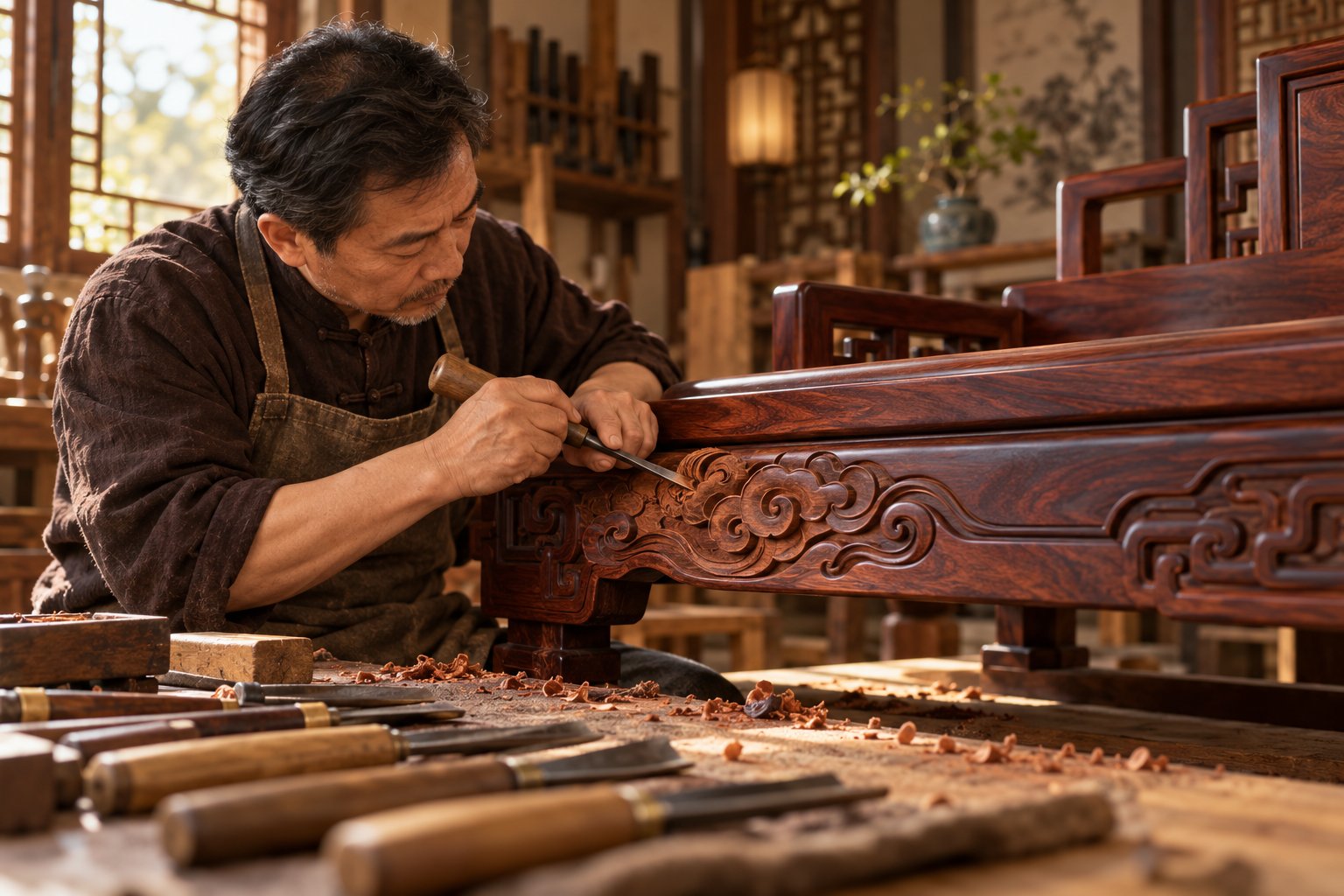
Hand carving is priced by skill and time, and buyers benefit from understanding the arithmetic. A single tea table's cloud apron, carved in relief at two to three millimeters deep, represents roughly twelve hours of a carver's work; a heavily carved Qing-style sofa set represents many times that. When a project quotes vary dramatically between factories, carving depth and carving hours are usually the hidden variable. A factory that quotes suspiciously low on "hand-carved" sets is often substituting shallow machine carving with light hand cleanup. Project buyers who care about authenticity should ask specifically about carving depth, hand finishing and the workshop's carving capacity for the project's timeline.
Samples and sample approval for projects
We offer trial single sets and refundable samples, and for project buyers this service has a precise role: de-risking the specification before committing to a container. The recommended sequence is straightforward. First, select the candidate pieces from the catalogue or layout drawings. Second, order the sample or trial set and review it in the destination market — checking the tone against the interior palette, the carving quality in person, the finish feel, and the fit against the actual room. Third, lock the approved sample as the reference standard for production. From that point, every production batch is measured against the buyer-approved reference, which turns "I'll know it when I see it" into an enforceable specification.
For large projects, sample approval also anchors the customization loop: any motif adaptation or size change is proven on the sample first, quoted accurately, and only then released to full production. This is how both sides avoid expensive surprises at container opening.
6. Step Five: Mortise-and-Tenon Construction Engineered for Export
Once timber is dried and designs are approved, construction begins — and for classical furniture, construction means mortise-and-tenon joinery. This is the joinery system that has held Chinese wooden architecture and furniture together for thousands of years: a projecting tenon cut into one member fits a matching mortise cut into another, often locked with wooden dowels, creating joints that strengthen under load and accommodate seasonal wood movement.
Why mortise-and-tenon matters specifically for hotels and villas
Commercial and hospitality furniture works harder than domestic furniture. Chairs in a banquet hall are pulled, stacked, knocked and sat in by guests of every size, thousands of times a season. A sofa in a hotel lobby takes continuous use all day. Joinery that depends on glue and screws can fail in these conditions; well-executed mortise-and-tenon frames distribute stress through the wooden structure itself. Combined with nail-free assembly, this also means repairs, when ever needed, are joint repairs rather than metal-hardware replacements — a practical advantage for maintenance teams abroad.
There is also an aesthetic dimension that project designers appreciate: no visible hardware interrupting carved surfaces, clean silhouettes from every angle, and structural elements that participate in the design rather than hiding from it. In a photographed hotel lobby, that difference is visible.
What buyers should verify about construction
- That load-bearing frames are genuinely mortise-and-tenon with wooden dowels, not screwed butt joints.
- That panels are framed to float within their frames, allowing seasonal movement without cracking.
- That the factory inspects joint fit before finishing — a joint filled with glue is a joint that will fail.
- That drawers use dovetail construction, as they do in our Siamese rosewood sideboards, for durability under daily use.
Construction quality is invisible at delivery and decisive at year three. Project buyers who include joinery verification in their pre-shipment inspection (covered below) protect themselves precisely where problems hide.
7. Step Six: Finishing — Beeswax and Lacquer That Meet EU REACH and US CARB
The finish is the furniture's armor and its face. It determines how the timber reads under hotel lighting, how it resists spills and cleaning, and — increasingly critical for institutional buyers — whether it passes the chemical compliance expectations of the destination market.
The finishing system we use
Each Yunxiao product receives an eco-friendly beeswax and lacquer finishing process that meets EU REACH and US CARB standards. In our premium lines, the process is meticulous: a tea table in our Siamese rosewood line, for example, receives six coats of raw lacquer, each coat cured for twenty-four hours and hand-rubbed with pumice stone between coats, producing a penetrating satin sheen rather than a plastic film. This traditional approach leaves the wood grain visible and tactile, deepens with age, and can be maintained and renewed by local technicians instead of requiring refinishing equipment.
Why REACH and CARB compliance matters to project buyers
EU REACH regulates the chemicals used in products sold into the European Union, and US CARB sets formaldehyde emission standards for composite wood products — but in practical export terms both signal the same thing to a hotel group or villa developer: the furniture's finishes and materials documentation will withstand scrutiny. Project buyers should ask every shortlisted factory two questions: what standards do your finishes meet, and can you document that? A factory used to exporting to Europe and North America answers both without hesitation, because it deals with these requirements on every container.
Finish selection for commercial use
For hotel dining areas and restaurant projects, buyers should also discuss service durability honestly. Solid wood dining surfaces in commercial use benefit from sensible operational practices — promptly wiping spills, using appropriate cleaning products, and understanding that any natural finish will develop character over years of service. Our related article on caring for wood dining tables in hotels, restaurants and banquet halls covers this in practical detail, and we are always willing to discuss finish options suited to a project's specific service conditions.
8. Step Seven: Pre-Shipment Inspection — The Buyer's Protection Point
Before any project container is sealed, inspection is the buyer's last chance to verify the program against the approved standard. For project buyers who cannot fly to the factory, virtual inspection support becomes essential, and a factory confident in its quality system makes that easy.
How a project inspection should work
A thorough pre-shipment inspection for a rosewood furniture project covers, item by item against the approved sample and the order list:
- Identity and completeness: every piece on the packing list present, correctly configured, and matching the ordered model and size.
- Tone consistency: pieces destined for the same room compared side by side under neutral light.
- Carving quality: depth, sharpness of detail, absence of tear-out or repair patches in visible areas.
- Joinery: tight mortise-and-tenon joints, smooth drawer action, doors aligned within their frames.
- Finish: even sheen, no runs or dust inclusions, edges and undersides finished to the same standard as visible faces.
- Dimensions: critical dimensions checked against the approved layout, especially customized pieces.
We support buyer-appointed third-party inspection and provide detailed photo and video documentation for each order, so overseas buyers can conduct what is effectively a virtual factory audit. Buyers who want a structured approach can use a pre-shipment inspection checklist; the important principle is that inspection happens before packing, when corrections are still cheap, not after the container arrives, when they are not.
9. Step Eight: ISPM 15 Export Packing and Container Loading for Carved Furniture
Packing is where many first-time importers underestimate the engineering involved. Carved solid wood furniture is heavy, rigid, valuable and fragile in specific ways: a carved apron can chip, a leg can snap under point loads, surfaces can scratch, and — in long sea transit through humid climates — unprotected timber can reabsorb moisture.
ISPM 15 heat-treated packaging
All export crates we produce use ISPM 15 heat-treated packaging — the international standard requiring solid wood packing material to be heat-treated and stamped to prevent the spread of wood pests. For project buyers, ISPM 15 compliance is not optional paperwork: shipments arriving with non-compliant wooden packaging can be held, treated at the buyer's expense, or turned back. Verifying that your factory's crates carry proper ISPM 15 treatment marks is basic due diligence.
Engineering protection for carved surfaces
Within that compliant framework, our export packing protocol for carved furniture includes custom crating sized to each piece, moisture barriers around the furniture inside the crate, foam and edge protection on carved projections, and internal bracing that locks heavy pieces against transit movement. Carved aprons and raised motifs — the highest-value, most vulnerable surfaces — get dedicated cushioning so no carved detail carries weight in transit.
Loading the container as a planned operation
Container loading for a mixed furniture program is a planning exercise: heavy wardrobes and beds low and distributed for weight balance, fragile carved pieces crated and oriented so nothing loads on top of them, drawers and loose components secured inside their parent pieces, and every cubic meter used — because for a hotel project, unused container space is wasted budget. Buyers can read our detailed guide on planning container loading for rosewood furniture exports without damaging carved sets; the short version is that a factory which treats loading as engineering, not muscle, delivers containers that open as cleanly as they were closed.
10. Step Nine: Delivery, Remote Installation Guidance and After-Sales
The container arrives; the project is not over. Furniture still needs to reach rooms, be unpacked, assembled where necessary, positioned, and — years later — maintained. This final stage of support is where long-term manufacturing partnerships are built.
Remote installation guidance
Classical rosewood furniture assembled with mortise-and-tenon joinery is designed to be assembled and disassembled by joints, which means local teams can handle installation with proper guidance rather than specialized equipment. We provide remote installation guidance for overseas buyers — written sequences, photographs, and video calls where needed — so a local furniture team can unpack, position and assemble beds, tables and cabinet components correctly. Buyers often ask whether their local team can assemble imported rosewood furniture; with proper guidance, yes, and our article on how remote installation guidance works covers the practical detail.
Partial shipments for phased projects
Long-term partners benefit from partial shipments. A villa development may need model-villa furniture months before the full program; a hotel renovation may phase floors. We support partial shipments for long-term partners, which lets project cash flow and construction schedules drive delivery instead of forcing an all-or-nothing container plan. Each partial shipment carries the same batch-consistency discipline described earlier, with reference pieces ensuring later shipments match earlier ones.
After-sales for a decades-long asset
Solid rosewood furniture is not consumable; it is a decades-long asset that appreciates in perceived value when maintained. After-sales support for projects includes maintenance guidance for the local team, advice on humidity management in the property, spare-part and repair consultations, and documentation retention — we keep each project's specifications on file so a future expansion order can match the original program. A factory that knows your project's timber batch, carving program and finish standard can produce a matching additional container years later. That capability is only possible when the factory, not a trading intermediary, holds the production records.
11. Managing the Timeline: 45–60 Working Days After Deposit
Project schedules live and die on realistic timelines. For container orders, our production window is 45 to 60 working days after deposit — a range that reflects real manufacturing arithmetic rather than sales optimism. Understanding what fills those days helps buyers plan honestly:
| Stage | What Happens | Why It Takes the Time It Takes |
|---|---|---|
| Confirmation & drawings | Layout drawings finalized, customization quoted and confirmed, deposit received | Prevents rework; every later stage depends on a locked specification |
| Timber reservation & batch planning | Matched timber batches reserved for the whole program | Consistency across containers is decided here, not at finishing |
| Component cutting & carving | Components cut; hand carving executed by the carving workshop | Heavily carved sets consume many carver-hours per piece |
| Assembly | Mortise-and-tenon assembly with wooden dowels | Joint fit is checked piece by piece; no glue shortcuts |
| Drying & conditioning | 36-day constant-humidity kiln drying with destination-matched targets | Non-negotiable for overseas climate stability |
| Finishing | Multi-coat beeswax and lacquer, cured and hand-rubbed | Each coat needs its cure time; rushing shows immediately |
| Inspection & packing | Pre-shipment inspection, ISPM 15 crating, moisture barriers | Last correction point before the container seals |
| Booking & loading | Shipping booked, container loaded as a planned operation | Vessel schedules and port cut-offs shape final dates |
Two planning notes for project buyers. First, customization adds time honestly: a new carving program or unusual size means new tooling and carving time on top of the standard window — which is exactly why sample approval happens early. Second, phased projects should book production slots against construction milestones rather than a single delivery date; partial shipments exist precisely to make that alignment workable.
12. Working with Designers, Procurement Agents and Project Managers
Hotel and villa furniture programs are rarely ordered by a single person. A typical project involves an interior designer defining the aesthetic, a procurement team managing budgets and contracts, a project manager tracking construction milestones, and sometimes a purchasing agent in China coordinating inspections. A capable rosewood furniture factory supports this whole ecosystem, not just the final signature.
For designers, the factory provides the technical basis for confident specification: real dimensions, timber options, carving program references and finish samples that can be presented to the client. For procurement teams, it provides transparent quotations structured by room and product line, sample programs that de-risk the decision, and documentation that satisfies compliance review. For project managers, it provides schedule clarity — production slots, drying windows, inspection dates and shipping cut-offs that can be mapped onto the construction program. And for agents on the ground in China, it provides factory access: the ability to visit the workshop, review pieces in production, and verify quality in person before containers seal.
We work with all of these roles routinely, and the practical advice is the same for each: bring the factory into the conversation early. Factories that learn about a project after the design is frozen can only react; factories involved from the brief stage can propose proven solutions — an existing dining set that already fits the banquet room, a carving motif that matches the theme without new tooling — that save both money and schedule. Early involvement turns the factory from a vendor into part of the project team, and that is how the best hospitality furniture outcomes are produced.
13. Frequently Asked Questions from Hotel and Villa Project Buyers
Can you match an existing interior design theme or a reference style?
Yes — send the design direction, whether it is Ming-style restraint, Qing-style carved richness, or a specific project theme. We adapt motif programs, proportions and finish tones within proven classical craft territory, and the result is confirmed on a sample before full production.
What is the minimum order for a project, and can we start smaller?
We offer trial single sets and refundable samples specifically so project buyers can validate quality before committing to full containers. Once the specification is approved, container orders follow the standard 45–60 working day production window.
How do you ensure forty sets look consistent when production spans weeks?
Through batch reservation, room-set pairing, reference-piece calibration and consistent finishing standards. This is an active manufacturing discipline, and it is one of the clearest differences between factories with genuine project experience and catalogue sellers.
Can you provide documentation for customs and compliance?
Yes. Our internal team prepares full export documents, FSC certificates and ISPM 15 heat-treated packaging, and our finishing process meets EU REACH and US CARB standards. Buyers should still confirm destination-specific requirements with their customs broker, and we supply the factory-side documentation to support that process.
What if we need more furniture in two years to expand the project?
We retain each project's specifications — timber batches, carving programs, finish standards — so an expansion order can be matched to the original program. This is a practical reason to work directly with a factory rather than through intermediaries that hold no production records.
Do you work with designers and procurement agents?
Yes. We regularly coordinate with interior designers, procurement agents and project managers, providing layout drawings, specification support and sample programs that make third-party coordination straightforward.
14. Conclusion: Choose a Factory That Owns the Whole Chain
Hotel and villa projects succeed when one accountable partner controls the chain from drawings to delivery. Every stage described in this article — layout drawings, timber batch planning, climate-matched kiln drying, OEM and ODM carving, mortise-and-tenon construction, REACH and CARB compliant finishing, pre-shipment inspection, ISPM 15 packing, planned container loading, remote installation guidance and long-term after-sales — is a place where a weak supplier can hurt your project. A factory that performs all of them in-house has nowhere to hide and every incentive to get each container right.
Since 2008, Yunxiao Rosewood Furniture has built its export business on exactly this full-chain support for wholesalers, hotels and designers across Europe, North America, Australia and Southeast Asia. Whether you are furnishing a single villa or a full resort program, the process starts the same way: share your room dimensions and design direction, and we will return layout drawings and a specific proposal you can evaluate against any shortlisted factory.
To see the product lines referenced in this article, explore our Ming-style round redwood dining table set, the imperial dragon carved redwood sofa set, the classical redwood canopy bedroom suite, our Siamese rosewood tea table with carved cloud apron, and the Siamese rosewood display cabinet with carved lattice doors.
Start Your Hotel or Villa Project with Us
Send us your floor plan, room list and design direction. We will prepare free layout drawings, recommend pieces from our classical rosewood lines, quote your program, and schedule sample approval — from a factory that has delivered classical redwood furniture projects to resort, hotel and villa buyers since 2008.