
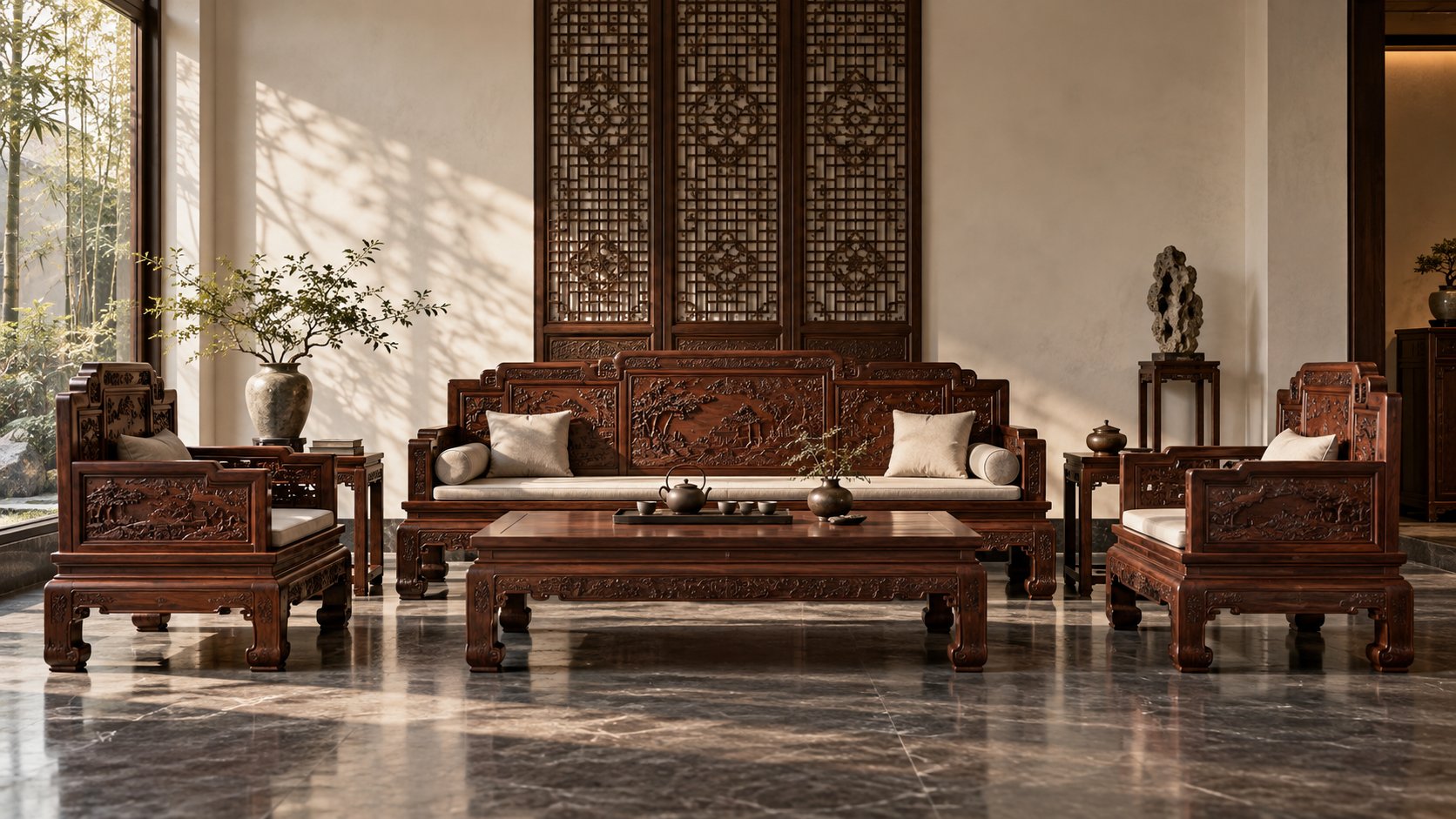
Furnitur rosewood klasik berukuran besar, lambat diproduksi, dan difinishing dengan tangan, sehingga pembeli mengasumsikan pabrik hanya menerima pesanan kontainer penuh. Panduan ini menjelaskan bagaimana jumlah pesanan minimum sebenarnya dihitung, bagaimana pemuatan kontainer campuran bekerja, syarat pembayaran dan perdagangan apa yang harus diharapkan, serta dokumen apa yang harus dibawa oleh kiriman rosewood.
Every importer who contacts a Chinese rosewood furniture factory eventually asks the same cluster of questions, and they usually arrive in the same order. First comes the product question — can you make this sofa, this dining set, this bedroom suite? Then comes the commercial question, and it is the one that actually decides whether a deal happens: what is your minimum order quantity for rosewood furniture, and can I start smaller than a full container?
That second question is where a great many first-time and even repeat buyers stall. Classical redwood furniture is bulky, heavy, hand-finished and slow to produce. A single carved sofa set can occupy a meaningful share of a 40HQ container on its own. So the instinctive assumption is that factories will only talk to buyers who can commit to a full container of one product, paid in full up front, with no flexibility on anything.
That assumption is worth testing, because it is not how a well-organised export factory actually works. This article walks through how minimum order quantities, mixed-container loading, payment terms and trade terms really function when you buy classical rosewood furniture from China — and what a buyer should verify before signing anything.
Why Rosewood Furniture Has a Minimum Order Quantity at All
Before negotiating an MOQ, it helps to understand why it exists. It is not arbitrary gatekeeping. It is a direct consequence of how solid hardwood furniture is made.
Timber is bought and dried in batches, not in single pieces
Solid rosewood and other dense hardwoods are not picked off a shelf. A factory buys timber in lots, and those lots then go through a drying cycle that cannot be shortened without risking the furniture later. At Yunxiao, each product receives a 36-day constant-humidity drying process before it is cut and assembled. Thirty-six days is not a marketing number — it is the period required to bring the moisture content of dense hardwood down gradually enough that the internal stresses in the board are released rather than locked in.
If you dry too fast, the outside of the board shrinks before the inside does. The board looks fine when it leaves the kiln and cracks six months later in a dry, centrally heated apartment in Melbourne or a monsoon-humid hotel lobby in Bangkok. That is the single most common failure mode in exported solid wood furniture, and it is why drying capacity, not assembly capacity, is usually the real constraint on a factory's schedule.
A drying batch has a minimum economic size. Running the kiln for one armchair costs almost the same as running it for a full set, which is why factories group orders.
Hand carving is a per-piece labour commitment
Carved rosewood furniture is not stamped out. The relief carving on a sofa backrest, the apron of a tea table, or the panel doors of a wardrobe is chiselled by hand. Yunxiao's carvers work in the traditional regional method of Xianyou County in Putian, Fujian — the area long known for hardwood craft — using hand tools to cut dragon, cloud, bamboo and lattice motifs into solid rosewood.
That means a carved set consumes a fixed block of skilled artisan time. A factory can schedule one artisan onto one set, but the setup, tooling and quality-check overhead per order does not shrink proportionally. MOQ is partly a way of keeping that overhead sane.
Finishing and curing take calendar time
Traditional raw lacquer and beeswax finishing is applied in multiple coats, and each coat needs to cure. You cannot compress the curing schedule by adding more workers. A piece that is packed before the finish has fully cured will arrive with the lacquer still soft, and the protective wrapping will leave marks on the surface.
So the MOQ is really the sum of three minimums: a minimum drying batch, a minimum artisan allocation, and a minimum finishing cycle. Understanding that gives you something to negotiate with, because each of those three can be handled differently.
How a factory actually calculates your minimum
When a factory gives you an MOQ, it is usually working backwards from three numbers. The first is the minimum drying batch — how many cubic metres of timber the kiln can process economically in one cycle. The second is the artisan allocation — how many carver-days a set consumes, and how many sets can be scheduled in parallel without one order starving another. The third is the finishing cycle — how many pieces can be lacquered and cured in one pass without the pieces touching each other.
If you ask a supplier to explain their MOQ in those terms, you learn a great deal about how the factory is organised. A supplier who can tell you the drying batch size, the carving hours per set and the finishing throughput is describing a real production floor. A supplier who says "that is just our policy" is telling you they have not thought about it, or that the number is a negotiating position rather than a constraint.
This matters because each of the three minimums can be worked around differently. A drying-batch minimum can be met by grouping your order with another buyer's order of the same species. An artisan minimum can be met by accepting a longer lead time so your set is scheduled alongside other carved work. A finishing minimum can be met by accepting a slightly larger quantity of a single finish specification. None of these require the factory to lose money, which is why they are negotiable.
Why the same product can have different minimums at different factories
Two factories can quote very different minimums for what looks like the same carved sofa set, and both can be honest. The difference usually comes down to scale and specialisation. A factory with a large kiln and a deep carving bench can absorb a small order into an existing batch at low marginal cost. A smaller workshop with one kiln and two carvers cannot — a small order genuinely disrupts its schedule.
This is why a very low MOQ is not automatically a good sign. It can mean the factory is underloaded and hungry for work, which is fine, or it can mean the factory is small enough that your order will sit behind larger customers when capacity tightens. The useful question is not "how low is your MOQ" but "how does my order fit into your existing schedule, and what happens to my lead time if you take on a large order while mine is in production?"
What Is a Realistic Minimum Order Quantity for Rosewood Furniture?
There is no single industry-wide number, and any supplier who quotes you one universal figure without asking what you want to buy is not giving you a considered answer. The realistic MOQ depends on the product category, because the categories differ enormously in volume and production complexity.
MOQ by product category
| Product category | Typical order shape | What drives the minimum |
|---|---|---|
| Single accent pieces — tea tables, folding stools, side tables, armchairs | Small quantities are workable; these are the natural entry point for a first order | Small timber sections, short carving time, easy to group with other orders in the same drying batch |
| Sofa sets — 3-piece, 5-piece, 6-piece, 7-piece, 9-piece, 10-seat | Usually one or a few sets; a single large set can be a substantial share of a container | Large carved panels, long drying time for thick sections, high artisan hours per set |
| Dining sets — 4-seat through 12-seat | Often ordered as a set plus extra chairs | Table top thickness and diameter, number of carved chairs, matching grain across the set |
| Bedroom suites — 3-piece, 4-piece, 5-piece, 6-piece | Typically one suite per bedroom type in a project | Four-poster posts and wardrobe panels are the largest single components in the whole catalogue |
| Wardrobes, display cabinets, sideboards | Frequently ordered alongside a bedroom or dining set | Floating-panel construction and large door frames; volume-heavy in a container |
The practical takeaway: if you are testing a supplier for the first time, the accent-piece and single-set categories are where a smaller commitment is genuinely feasible. If you want a full bedroom suite plus a dining set plus a sofa set, you are already at or beyond a container, and the conversation shifts from MOQ to loading plan.
Why the MOQ conversation changes once you are near a container
Here is the counter-intuitive part that surprises most buyers. Below a certain order size, the binding constraint is production. Above it, the binding constraint becomes freight. A 40HQ container has a fixed cost whether it is 60% full or 95% full. Once your order is large enough that production is no longer the issue, the factory's incentive flips: it now wants to help you fill the container efficiently, because a well-loaded container is better for both sides.
That is why experienced importers stop asking "what is your MOQ?" and start asking "what is the smallest order you can load efficiently?" The second question gets you a much more useful answer.
Can You Mix Different Rosewood Furniture Pieces in One Container?
Yes — and for most importers building a first catalogue, mixed loading is the single most useful mechanism available. Instead of committing to a container of identical sofas, you combine categories so that the container is commercially sensible and physically well packed.
What a mixed container typically contains
A realistic mixed load for a buyer testing the market might combine:
- One carved sofa set as the display centrepiece — for example a 10-seat imperial dragon carved redwood sofa set or a smaller 3-piece carved sofa set with armrests
- One dining set sized to the target market — a Ming style round redwood dining table 8-seat set for residential buyers, or a 12-seat banqueting set for hospitality
- One bedroom suite — a five-piece four-poster bedroom suite or a three-piece canopy bed set
- Smaller accent pieces to fill the gaps — round tea tables with carved aprons, folding stools, side tables
- Volume-filling storage pieces — a wardrobe with carved panel doors or a sideboard
This is a genuinely useful structure for a new importer because it lets you test several product lines in one shipment, spread the freight cost across a broader range of sellable SKUs, and present a coherent "classical interior" story to your own customers rather than a single isolated sofa.
How mixed loading actually works in practice
Mixed loading is not simply "throw different items in a box." It requires planning, and the planning is where a good factory earns its keep.
- Volume and weight calculation. Each piece is measured and its packed volume estimated. Dense hardwood is heavy, so weight distribution matters as much as cubic volume. A container loaded to the ceiling with wardrobes may be under its weight limit; a container of solid dining tables may hit the weight limit before it is full.
- Nesting and stacking logic. Chairs nest, stools stack, tea tables can be inverted or placed inside larger voids. A skilled loading plan can recover a surprising amount of space.
- Protection of carved surfaces. Carved relief is the most vulnerable part of the shipment. Pieces with deep carving cannot simply be stacked against each other. Custom crating, moisture barriers and internal bracing are used to keep carved faces away from contact points.
- Loading sequence. Heavy, rigid items go low and central; lighter carved pieces go higher and are braced against movement. The sequence is planned before the container arrives, not improvised on the loading dock.
- Photographic record. A well-run factory photographs the loading process, so the buyer can see how the container was packed and can compare the packed condition against the pre-shipment inspection.
Partial shipments for long-term partners
There is a further option worth asking about. Some factories will arrange partial shipments for established, long-term partners — releasing part of an order earlier rather than holding everything until the full quantity is complete. This is not a standard offer and it depends on the production schedule, but it is a legitimate question to raise once you have an order history. It is far more likely to be granted to a buyer with a track record than to a first-time enquiry.
A worked example of mixed-loading arithmetic
To see why loading planning matters so much, consider a buyer assembling a first container for a residential furniture retailer. The product list looks reasonable on paper: one 10-seat carved sofa set, one 8-seat round dining set, one 5-piece bedroom suite, one wardrobe, and four tea tables.
Now consider the physical reality. The 10-seat sofa set alone includes a long three-seat sofa, several armchairs and a large tea table, all with deep carved backrests that cannot be stacked face-to-face. The bedroom suite includes a four-poster bed with single-section corner posts — long, rigid components that dictate how the container is divided. The wardrobe is tall and boxy and consumes volume efficiently but adds significant weight. The dining table top is a large flat slab that must be protected on both faces.
Loaded carelessly, this list might fill a 40HQ container to roughly two-thirds of its usable volume while already approaching the weight limit, because dense hardwood is heavy and the carved pieces cannot be packed tightly. Loaded with a proper plan — chairs nested, stools stacked inside voids, tea tables inverted and placed within the footprint of larger items, the dining table top laid flat with the bed posts braced alongside — the same list can be made to fill the container far more completely.
The difference between those two outcomes is not luck. It is whether someone measured the packed volume of every piece and drew a loading plan before the container was booked. On a container whose freight cost is fixed, that difference translates directly into your landed cost per unit.
What to send the factory so they can plan properly
Mixed loading works best when you give the factory enough information to plan rather than just a list of product names. Useful inputs include:
- The full product list with quantities, using the factory's own product references so there is no ambiguity about which sofa or which dining set you mean
- Your target market and the intended end use — residential retail, hotel project, restaurant, corporate office — because this affects which sizes and configurations make sense
- Any fixed constraints, such as a maximum weight you can handle at your warehouse or a maximum crate dimension for your unloading equipment
- Whether you need the shipment to arrive as a single lot or whether staged arrival would actually suit your cash flow better
- Your destination port, so the factory can quote a trade term that reflects the real routing
Buyers who send a clear brief at this stage routinely get a better loading plan than buyers who send a one-line enquiry and then try to adjust the mix after production has started. Adjusting the mix late is expensive, because the pieces are already cut.
Payment Terms and Trade Terms: What to Expect and What to Verify
Payment structure is the second half of the commercial conversation, and it is where buyers most often accept terms without understanding what they are actually buying.
The standard structure
For custom and made-to-order solid wood furniture, the normal structure is a deposit followed by a balance payment. The deposit funds the timber purchase and the start of production; the balance is settled before or at shipment. This is standard because the factory is committing real material and artisan time to a product that cannot be resold to another buyer if you walk away — a carved sofa set made to your specification has no general market.
What matters is not the existence of a deposit but its size, the trigger for the balance, and what documentation accompanies each stage.
Questions that reveal how a supplier actually operates
- What exactly does the deposit cover? A clear answer references timber procurement and production scheduling. A vague answer suggests the money is going somewhere less traceable.
- What triggers the balance payment? The best answer ties it to a verifiable milestone — completion of production, pre-shipment inspection, or presentation of shipping documents. Avoid structures where you pay the balance before you have any evidence the goods exist in finished form.
- Which trade terms are you quoting? FOB, CIF and EXW place very different obligations on each side. Confirm the named port and confirm who arranges and pays for inland transport, export clearance, ocean freight and insurance. A price that looks lower may simply be quoting a term that leaves more cost with you.
- What documents come with the shipment? For rosewood specifically, documentation is not optional. Ask which certificates are issued, by whom, and at what point in the process.
- What happens if the goods fail inspection? A supplier with a real quality process will have an answer. A supplier who has never been asked will improvise one.
Documentation that should accompany a rosewood shipment
Classical rosewood furniture crosses borders with a paper trail, and the paper trail is part of what you are paying for. Buyers importing into Europe and North America should expect to discuss:
- FSC chain-of-custody documentation — evidence that the timber in your order traces back through a certified supply chain. Yunxiao supplies FSC chain-of-custody documentation with each shipment.
- CITES export permits — several rosewood species are CITES-listed, and shipments of those species require an export permit issued by the Chinese CITES Management Authority. This is issued per shipment and is species-specific.
- EU Timber Regulation and US Lacey Act due diligence — both regimes place an obligation on the importer to demonstrate that the timber was legally harvested. Your supplier's documentation feeds directly into your own compliance file.
- ISPM 15 heat-treated packaging — solid wood packing material must meet the ISPM 15 phytosanitary standard or it will be refused or fumigated at your cost on arrival.
- Finish compliance — the lacquer and beeswax finishing system should meet the finish-emission standards of your destination market. Yunxiao's eco-friendly beeswax and lacquer finishing is formulated to meet EU REACH and US CARB standards.
Notice that these are not interchangeable. A CITES permit for one species does not cover another. An FSC chain-of-custody document is not the same as a CITES permit. A finish compliance statement says nothing about timber legality. Buyers who treat "we provide certificates" as a single undifferentiated promise are the ones who discover the gap at the port.
Lead Time, Scheduling and What Actually Drives Your Delivery Date
Lead time is the third leg of the commercial conversation, and it is the one most often misunderstood. Buyers tend to treat a quoted lead time as a promise about their order. In practice it is a statement about the factory's production sequence, and understanding that sequence lets you plan around it instead of being surprised by it.
The stages that make up a rosewood furniture lead time
| Stage | What happens | Why it takes the time it takes |
|---|---|---|
| Timber selection and preparation | Boards are selected for the specific pieces in your order, matched for colour and grain, and cut to rough dimension | Colour and grain matching across a multi-piece set requires selecting from a wider pool of boards than the set itself needs |
| Constant-humidity drying | Timber is dried over a 36-day cycle at controlled humidity | Dense hardwood must release internal stress gradually; drying faster causes the cracking that appears months later in the destination climate |
| Cutting and joinery | Components are cut to final dimension and mortise-and-tenon joints are cut and fitted | Joinery is cut to fit, not forced; each joint is a hand-fitted operation on classical construction |
| Hand carving | Carvers chisel the relief motifs — dragon, cloud, bamboo, lattice — into the prepared surfaces | Carving is the least compressible stage; it is skilled manual work measured in artisan-days per set |
| Assembly | Pieces are assembled without metal nails, using mortise-and-tenon joints and wooden dowels | Dry assembly and fitting checks catch alignment problems before finishing, when they are still correctable |
| Finishing and curing | Multiple coats of raw lacquer and beeswax are applied and cured between coats | Curing is a chemical process that cannot be accelerated by adding labour |
| Packing | Custom crating, moisture barriers and internal bracing are built around each piece | Carved surfaces need protection from contact, and dense hardwood needs bracing against movement in transit |
Yunxiao's container orders take 45–60 working days after deposit. That range is not padding. It reflects the sequence above, and the variation within the range comes from how your specific order interacts with the factory's existing schedule — how many carved pieces are in it, which species, and how the drying batches line up.
Why the same order can take different lengths of time
Two orders of identical size can have different lead times for entirely legitimate reasons. If your order uses a species that is already in a drying batch, it can move faster. If it requires a species that must be procured, the clock starts later. If your order is heavy on carved pieces, it consumes more artisan time and may queue behind other carved work. If it is heavy on flat-panel pieces such as wardrobes and sideboards, it may move faster because it uses less carving capacity.
This is why a supplier who asks detailed questions about your order before quoting a lead time is more useful than one who quotes a number immediately. The detailed questions mean they are actually scheduling your order rather than giving you a generic figure.
How to protect your delivery date
- Confirm the lead time starts from deposit, not from enquiry. The clock begins when the deposit clears and the order is formally released to production.
- Ask for the production milestones in writing. A supplier who can tell you when drying completes, when carving completes and when finishing completes is managing your order. A supplier who can only tell you a final date is not.
- Lock the specification before production starts. Changes to size, carving pattern or finish after cutting has begun are the single most common cause of slipped delivery dates, because they force rework at the most expensive point in the process.
- Plan your own downstream commitments around the range, not the best case. If you have promised a retail customer a delivery date, build it on the outer end of the quoted range.
- Ask about partial shipments if your cash flow needs it. For long-term partners, partial shipments can be arranged subject to the production schedule, which lets part of an order ship earlier rather than everything waiting for the last piece.
Customisation, OEM and ODM: How They Affect Order Size
Many importers want to differentiate their catalogue rather than resell a standard product, and this is where OEM and ODM arrangements come in. It is worth understanding how customisation interacts with order size, because the two are linked.
The difference between OEM and ODM in furniture
In OEM (original equipment manufacturing), you bring the design and the factory builds to your specification — your dimensions, your carving motifs, your finish, and potentially your own branding. In ODM (original design manufacturing), the factory offers an existing design that you can adapt, which is usually faster and cheaper because the design and its production method are already proven.
For a first order, ODM is generally the lower-risk route. You are buying a design the factory has already built many times, so the production risk is known. OEM becomes more attractive once you have a clear view of what your market wants and you are ready to invest in a differentiated range.
How customisation changes the minimum
Custom work carries a higher effective minimum than standard work, for a straightforward reason: a custom piece consumes design and pattern-making effort that cannot be amortised across other orders. If you ask for a new carving motif, someone has to draw it, produce a pattern, and test it on a sample before it goes into production. That effort is a fixed cost per design, so it makes sense to spread it across more pieces.
Yunxiao offers flexible OEM and ODM custom sizes and patterns for villas and resorts. The practical implication for a buyer is that customisation is most economical when it is applied to a category you intend to order in depth, and least economical when it is applied to a single piece you are testing.
What to prepare before requesting custom work
- Dimensions with tolerances. Give the target dimension and the acceptable range. Furniture that must fit a specific alcove or lift opening needs the constraint stated, not assumed.
- Reference imagery for the motif or style. A photograph or drawing communicates a carving pattern far more reliably than a written description.
- Finish direction. Specify whether you want the natural tone of the timber, a deeper lacquer build, or a particular sheen level, and confirm it against a physical sample rather than a screen.
- Intended use and environment. A piece destined for a humid coastal resort and a piece destined for a dry heated apartment should not be dried to the same moisture content. Tell the factory where the furniture is going.
- Volume expectation. Be honest about whether this is a one-off test or the start of a range. It changes how the factory prices the design effort.
How to Structure a First Order Without Overcommitting
The goal of a first order is not to maximise volume. It is to verify that the supplier can deliver what was promised, at the quality level promised, on the schedule promised — while still getting a commercially viable shipment.
A staged approach that works
- Start with samples or a trial single set. Yunxiao offers trial single sets and refundable samples. This is the cheapest possible way to evaluate joinery quality, carving depth, finish consistency and packing before you commit to a container. Judge the sample on the things that matter: does the mortise-and-tenon joinery fit tightly, is the carving crisp rather than shallow, is the finish even across the whole surface, does the wood colour match across the pieces of the set.
- Move to a mixed container. Once the sample passes, build a mixed load that covers the categories you intend to sell. This tests the factory's loading discipline and gives you a spread of products to show your own customers.
- Then move to focused repeat orders. Once you know which SKUs sell, order those in depth. This is also the point at which you have the standing to ask about partial shipments and more flexible scheduling.
What to verify before you place the container order
- Colour and grain consistency across the set. Solid hardwood is a natural material and no two boards are identical, but a full container order should still look like one coherent collection. Ask how the factory matches colour and grain across a multi-piece order — this is a real production discipline, not a cosmetic detail.
- Moisture content and drying records. Ask what the target moisture content is for your destination climate and how it is verified. A factory that dries to a single fixed target regardless of destination is not thinking about where the furniture is going.
- Joinery method. Classical rosewood furniture is assembled without metal nails, using mortise-and-tenon joints and wooden dowels. Confirm this is the construction method used on your order, because it is the primary reason this furniture survives seasonal wood movement without splitting.
- Pre-shipment inspection. Agree the inspection checklist and the inspection point before production starts, not after. Inspecting finished goods that are already crated is far less useful than inspecting them before packing.
- After-sales and spare parts. Ask what happens if a piece arrives damaged, and what the process is for replacement or repair. Get the answer in writing before you need it.
Common Mistakes Buyers Make on Their First Rosewood Order
Optimising for the lowest unit price
The lowest quoted unit price is frequently the one that omits something. It may exclude the export documentation, quote a trade term that shifts freight cost to you, or assume a packing standard that will not survive an ocean voyage. Compare quotes on a like-for-like basis: same trade term, same documentation package, same packing specification, same finish standard. Only then is the price comparison meaningful.
Treating MOQ as a fixed wall
MOQ is usually a production-economics number, and production economics can be restructured. Mixing categories, accepting a slightly longer lead time so your order can be grouped with another batch, or starting with a trial set are all legitimate ways to reduce the size of your first commitment. Ask what is possible rather than assuming the first number quoted is final.
Ignoring the drying question
Buyers spend a great deal of attention on carving and finish, which are visible, and very little on drying, which is not. Yet drying is what determines whether the furniture is still sound in three years. In overseas climates — dry heated interiors in North America and Europe, humid coastal conditions in Southeast Asia and northern Australia — moisture-related movement is the leading cause of cracking and joint failure. Ask about drying before you ask about anything cosmetic.
Assuming all certificates are equivalent
As covered above, FSC chain-of-custody, CITES permits, ISPM 15 packing treatment and finish-emission compliance are four separate things serving four separate purposes. Confirm each one individually, and confirm it applies to your specific order, species and destination.
Not planning the container before production
Container planning should start at the quotation stage, not the loading dock. If you know the packed volume of each piece early, you can adjust the mix to fill the container efficiently, which directly reduces your per-unit freight cost. Buyers who finalise their product list first and think about loading later routinely pay for air they did not need.
Frequently Asked Questions
What is the minimum order quantity for rosewood furniture from China?
There is no single industry figure. It depends on the product category. Small accent pieces such as tea tables, stools and armchairs can be ordered in small quantities. Large carved sofa sets, dining sets and bedroom suites carry higher minimums because of drying time, artisan hours and packed volume. The most useful question to ask a factory is not "what is your MOQ" but "what is the smallest order you can produce and load efficiently" — the answer will be more specific and more negotiable.
Can I order less than a full container of rosewood furniture?
In many cases yes, particularly for accent pieces and single sets. For larger orders, mixed-container loading is usually the better route: combining a sofa set, a dining set, a bedroom suite and smaller accent pieces into one container so that the shipment is commercially varied and physically well packed. Ask for the loading plan and loading photographs before the container departs.
How long does production take after I place a deposit?
Yunxiao's container orders take 45–60 working days after deposit. That window reflects the real production sequence — timber selection, a 36-day constant-humidity drying cycle, cutting and joinery, hand carving, multi-coat finishing and curing, then packing. Partial shipments are available for long-term partners, subject to the production schedule.
What payment structure should I expect?
A deposit followed by a balance payment is standard for made-to-order solid wood furniture, because the factory commits timber and artisan time to a product that cannot be resold if the order is cancelled. What matters is the deposit size, the specific milestone that triggers the balance, and the documentation that accompanies each stage. Tie the balance to a verifiable milestone rather than to a date.
Which certificates should come with a rosewood furniture shipment?
For European and North American imports, expect to discuss FSC chain-of-custody documentation, CITES export permits for any CITES-listed species in the order, ISPM 15 heat-treated packing material, and finish compliance with the destination market's emission standards. Yunxiao supplies FSC chain-of-custody documentation and CITES export permits issued by the Chinese CITES Management Authority with each shipment, and its beeswax and lacquer finishing is formulated to meet EU REACH and US CARB standards. These are separate documents serving separate purposes — verify each one for your specific order.
How do I check quality before the goods are shipped?
Agree the inspection checklist and the inspection point before production begins. Inspect finished pieces before they are crated, not after. Check joinery tightness, carving depth and crispness, finish evenness, colour and grain consistency across the set, and the packed condition against the loading plan. A trial single set or refundable sample is the cheapest way to establish the quality baseline before committing to a container.
Will solid rosewood furniture crack in my market's climate?
Moisture-related movement is the main risk for solid hardwood furniture in overseas climates, and it is manageable through correct drying rather than through any surface treatment. Furniture dried to a moisture content appropriate for the destination climate, assembled with mortise-and-tenon joinery and floating panels that allow for seasonal movement, is far more stable than furniture dried to a single fixed target. Ask what moisture content the factory targets for your destination.
What to Do Next
The commercial terms of a rosewood furniture order — MOQ, mixed loading, payment structure, documentation — are not obstacles placed in your way. They are the mechanics of a manufacturing process that involves slow-dried dense hardwood, skilled hand carving and multi-coat finishing. Once you understand why each constraint exists, you can negotiate around it intelligently instead of accepting the first number you are quoted.
The practical sequence is straightforward. Start with a trial set or sample to establish the quality baseline. Build a mixed container that covers the categories you intend to sell. Verify the documentation package against your destination market's requirements. Plan the container before production, not after. And ask about drying, because that is the question that determines whether the furniture is still sound in three years.
Planning Your First Rosewood Container?
Tell us which categories you want to test, your target market and your intended order size. We will come back with a mixed-loading proposal, the documentation package for your destination, and a production schedule — so you can see the real numbers before you commit.