
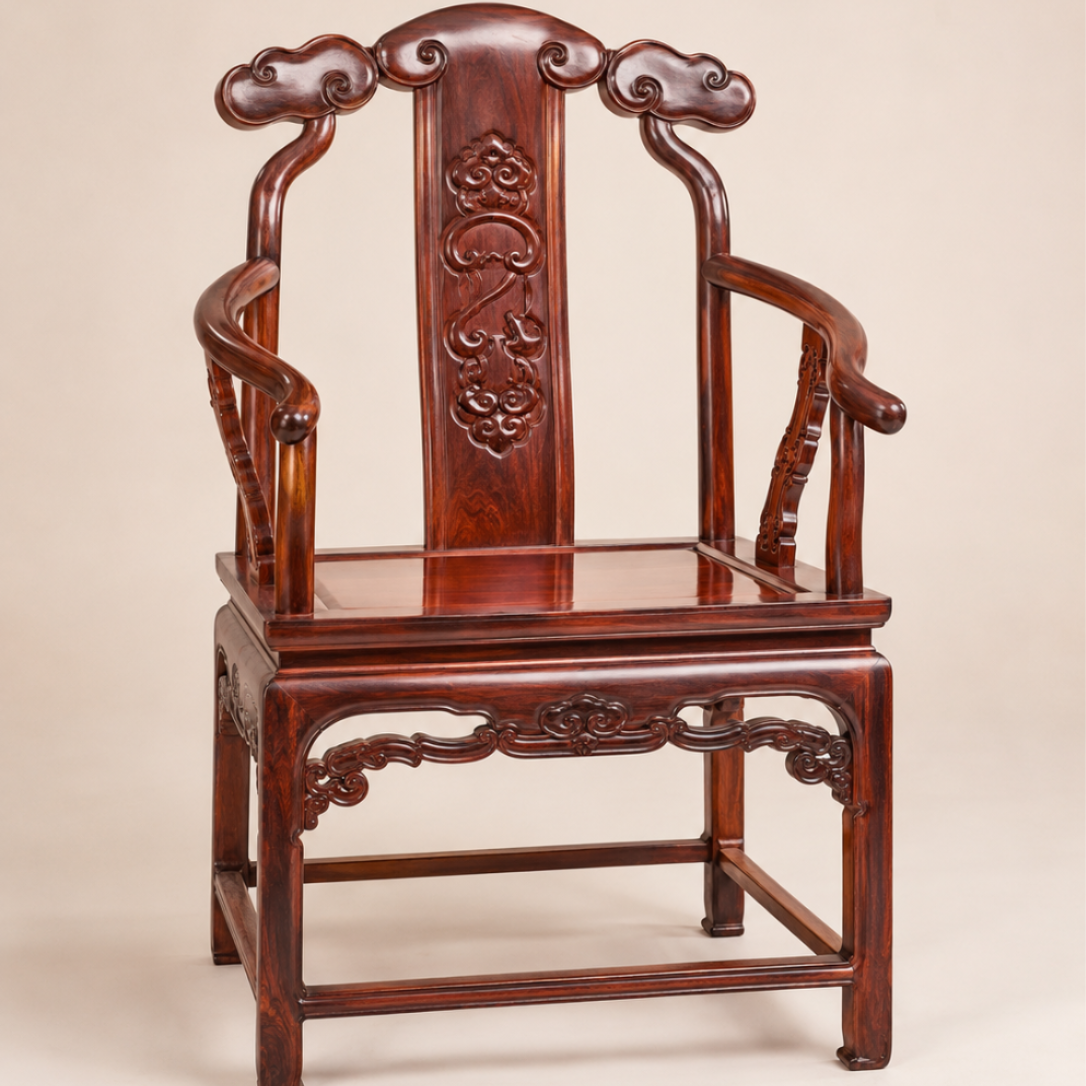
The Art and Craft of Hand-Carved carved rosewood chair
Hand carving is the defining feature that elevates a rosewood chair from functional furniture to a work of decorative art. For B2B buyers sourcing carved rosewood chairs for luxury retailers, interior design studios, or hospitality projects, understanding the technical aspects of wood carving is essential for evaluating quality, comparing suppliers, and communicating value to end customers. This guide provides a detailed examination of carving techniques, quality assessment methods, and procurement considerations specific to carved rosewood seating.
Yunxiao's carving workshop is located in Xianyou County, a region with centuries of hardwood carving tradition. Master artisans use traditional hand tools including chisels, gouges, and knives to create relief carvings in solid Siamese rosewood. Each carving motif requires specialized tool sets and techniques developed through years of apprenticeship and practice.
Relief Carving Techniques Used in carved rosewood chair
Relief carving is the primary technique used in rosewood chair backrests and decorative panels. In relief carving, the design is carved into the wood surface so that the motif projects from the background. Yunxiao's carvers work at relief depths of 1-5 mm depending on the motif complexity and the structural requirements of the piece.
The carving process begins with pattern transfer, where the motif outline is traced onto the wood surface. The carver then removes background wood to establish the relief depth, followed by shaping the motif elements and adding fine detail. The final step is hand-finishing with progressively finer tools to create smooth transitions and crisp edges. A single chair backrest with a ruyi motif requires approximately 18 hours of carving time, while more complex dragon or phoenix motifs may require 20 hours or more.
Carving Motif Catalog and Symbolism
Yunxiao offers a catalog of traditional carving motifs, each with distinct visual characteristics and cultural symbolism. Buyers can select from standard motifs or commission custom designs. Understanding the symbolism helps buyers match motifs to their target market and marketing narrative.
| Motif | Visual Description | Carving Hours | Relief Depth | Cultural Meaning |
|---|---|---|---|---|
| Ruyi Sceptre | Curved ornamental shape with cloud-like terminals | ~18 hrs | 2-4 mm | Power, good fortune, wishes fulfilled |
| Dragon | Serpentine body with scales, claws, and flaming pearl | ~20 hrs | 3-5 mm | Imperial power, authority, strength |
| Phoenix | Graceful bird with flowing tail feathers | ~20 hrs | 3-5 mm | Grace, virtue, marital harmony |
| Cloud | Flowing spiral and curl patterns | ~16 hrs | 2-3 mm | Auspicious blessings, good fortune |
| Bamboo | Vertical stalks with leaves and joints | ~16 hrs | 2-3 mm | Integrity, resilience, scholarly virtue |
| Lattice | Geometric interlocking patterns | ~14 hrs | 1-3 mm | Order, continuity, interconnectedness |
Assessing Carving Quality: A Buyer's Inspection Guide
Evaluating carving quality requires attention to several technical indicators that distinguish master-level work from mediocre carving. When inspecting a sample chair, examine the following quality markers:
- Edge crispness: Clean, sharp edges on motif elements indicate skilled tool control. Rounded or fuzzy edges suggest rushed work or dull tools.
- Background uniformity: The carved-away background should be evenly recessed with consistent depth. Uneven background depth indicates inexperienced carving.
- Detail resolution: Fine details such as dragon scales, feather barbs, or leaf veins should be distinct and recognizable, not blurred or merged.
- Tool mark quality: Hand-carved pieces show subtle tool marks that indicate genuine handwork. Excessively smooth surfaces may indicate machine carving disguised as handwork.
- Symmetry: Bilaterally symmetrical motifs should match precisely on left and right sides. Asymmetry in symmetrical designs indicates carver error.
- Grain awareness: Skilled carvers orient motifs to work with the wood grain, avoiding carving across grain in ways that create weak points.
Tool Marks vs. Machine Carving: Authentication
Distinguishing genuine hand carving from machine-carved imitations is critical for buyers marketing chairs as handcrafted. Machine carving typically produces uniformly smooth surfaces with repetitive, identical elements. Hand carving shows natural variation in depth, edge quality, and detail between elements, even within the same motif.
Examine the carved surface under raking light (light directed at a low angle across the surface) to reveal tool marks. Genuine hand carving will show subtle striations from chisel and gouge cuts. Machine-carved surfaces will appear uniformly smooth or show repetitive tool paths. Request a carving process video or workshop photographs from the supplier to document the hand carving claim.
Structural Impact of Carving on Chair Integrity
Carving removes wood from the backrest panel, which can affect structural integrity if not executed properly. Yunxiao's carvers are trained to maintain structural support ribs behind carved panels and to limit relief depth based on the panel thickness. For chairs with deep relief carving (3-5 mm), the backrest panel is typically thicker to compensate for material removal.
Buyers should verify that carved panels do not flex when pressure is applied. A well-carved backrest should be as rigid as an uncarved panel of the same dimensions. If flexing is detected, the carving may have removed too much material, compromising the panel's structural role.
Custom Carving and Bespoke Motif Development
For buyers seeking unique designs, Yunxiao offers custom carving services. The process begins with a design consultation where the buyer provides reference images, sketches, or concept descriptions. Yunxiao's master carvers create a prototype carving sample for approval before proceeding with production. Custom motifs may require additional lead time of 5-10 days for design development and sample carving.
Custom carving is particularly valuable for hospitality brands seeking distinctive furniture that reinforces their brand identity. A hotel chain might commission a custom motif incorporating elements of their logo or regional design traditions. Minimum order quantities for custom-carved chairs are typically higher than standard designs due to the additional design and setup time required.
Carving Repair and Restoration Considerations
Despite careful packaging, carved rosewood chairs may occasionally sustain minor damage during shipping or use. Understanding repair options helps buyers assess the long-term maintenance cost of carved furniture. Minor chips and scratches can often be repaired in-situ using wood filler colored to match the surrounding rosewood, followed by lacquer touch-up.
More significant damage to carved motifs may require returning the piece to the workshop for professional re-carving. Buyers should discuss repair and restoration support with the supplier before placing a large order. For hospitality projects, consider ordering one or two spare chairs to serve as replacements while damaged pieces are being repaired.
Cost Drivers in Carved carved rosewood chair Production
Carving labor is the primary cost driver in hand-carved rosewood chairs. A chair requiring 20 hours of carving at master artisan rates will cost significantly more than a chair requiring 14 hours. The complexity of the motif, the depth of relief, and the level of detail all influence carving time and cost. Buyers can optimize costs by:
- Selecting simpler motifs with shallower relief for high-quantity orders
- Reserving complex, deep-relief motifs for accent chairs rather than full sets
- Ordering in container quantities to amortize design and setup costs
- Using standard motifs from the existing catalog rather than custom designs
- Considering lattice or bamboo patterns for cost-sensitive projects
Timeline for Carved Chair Production
The production timeline for carved rosewood chairs includes several stages: timber selection and drying (completed in advance for stock timber), rough shaping and assembly (5-7 days), carving (14-20 days depending on motif complexity and quantity), finishing (10-14 days for multi-coat lacquer), and quality inspection and packaging (3-5 days). Total production time for a container order is 45-60 working days.
For custom carving projects, add 5-10 days for design development and prototype carving. Rush orders may be possible for an additional fee, but rushing carving work risks quality degradation and should be approached with caution.
FAQ: carved rosewood chair Carving and Craftsmanship
How can I tell if the carving is genuinely hand-done?
Look for subtle tool marks under raking light, natural variation in depth and edge quality between elements, and slight asymmetry in supposedly symmetrical motifs. Machine carving produces uniformly smooth, repetitive surfaces. Request workshop photos or process videos to document hand carving.
What is the typical carving time per chair?
Carving time ranges from 14 hours for simple lattice patterns to 20 hours for complex dragon or phoenix motifs. Ruyi and cloud motifs require approximately 16-18 hours per chair backrest.
Can I commission a custom carving motif?
Yes, custom carving is available. Provide reference images or concept descriptions. A prototype sample is created for approval before production. Custom designs require additional lead time of 5-10 days and higher minimum order quantities.
Does carving weaken the chair structurally?
When executed properly, carving does not compromise structural integrity. Yunxiao maintains support ribs behind carved panels and adjusts panel thickness based on relief depth. Carved panels should be as rigid as uncarved panels.
What relief depth is standard for carved backrests?
Relief depth ranges from 1-3 mm for lattice and bamboo patterns to 3-5 mm for dragon and phoenix motifs. The depth is chosen based on motif complexity and panel structural requirements.
How do I repair minor carving damage?
Minor chips can be repaired with colored wood filler and lacquer touch-up. Significant motif damage may require workshop re-carving. Order spare chairs for hospitality projects to serve as replacements during repairs.
Which motifs are most cost-effective for large orders?
Lattice and bamboo patterns with 1-3 mm relief depth are the most cost-effective due to shorter carving time. Reserve complex dragon and phoenix motifs for accent pieces in high-visibility settings.
What is the production timeline for carved chairs?
Container orders take 45-60 working days including carving (14-20 days), finishing (10-14 days), and packaging. Custom carving adds 5-10 days for design development and prototype creation.
Can I see the carving process before ordering?
Yes, Yunxiao can provide workshop photographs, carving process videos, and sample carvings for evaluation. Request these materials during the quotation process to document hand carving authenticity.