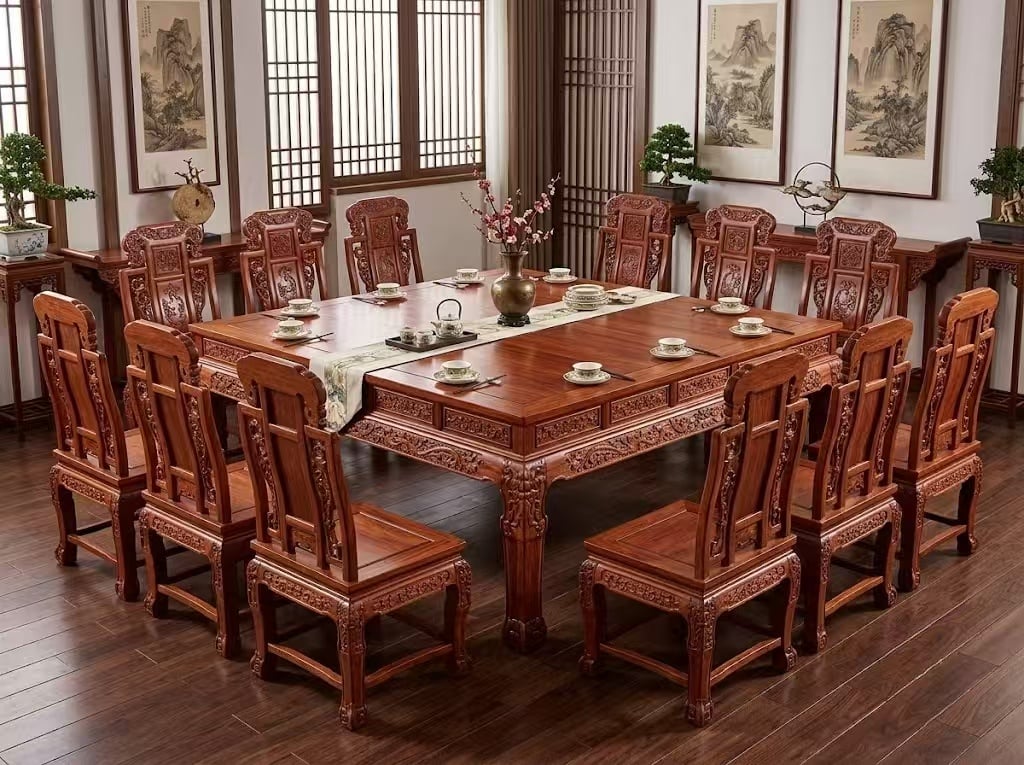
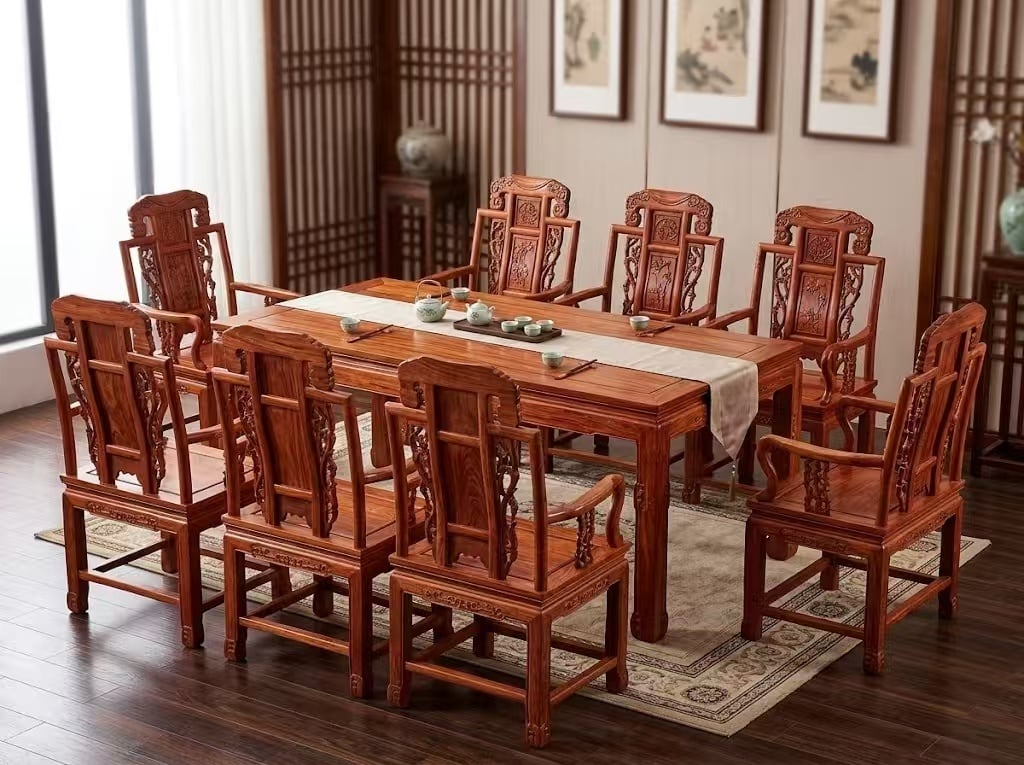
Analyzing the chinese rosewood dining table and chairs Search Intent
When importers search for a rosewood dining table and chairs combination, they are usually past the browsing stage. They have a room, a seat count, or a project specification in hand, and they need to know whether the table geometry, chair ergonomics, carving program, and compliance file can be sourced as one coordinated system from one factory. This page answers that question at the component level: how table and chairs are engineered to work together, how to specify the combination, and how to verify it before it ships.
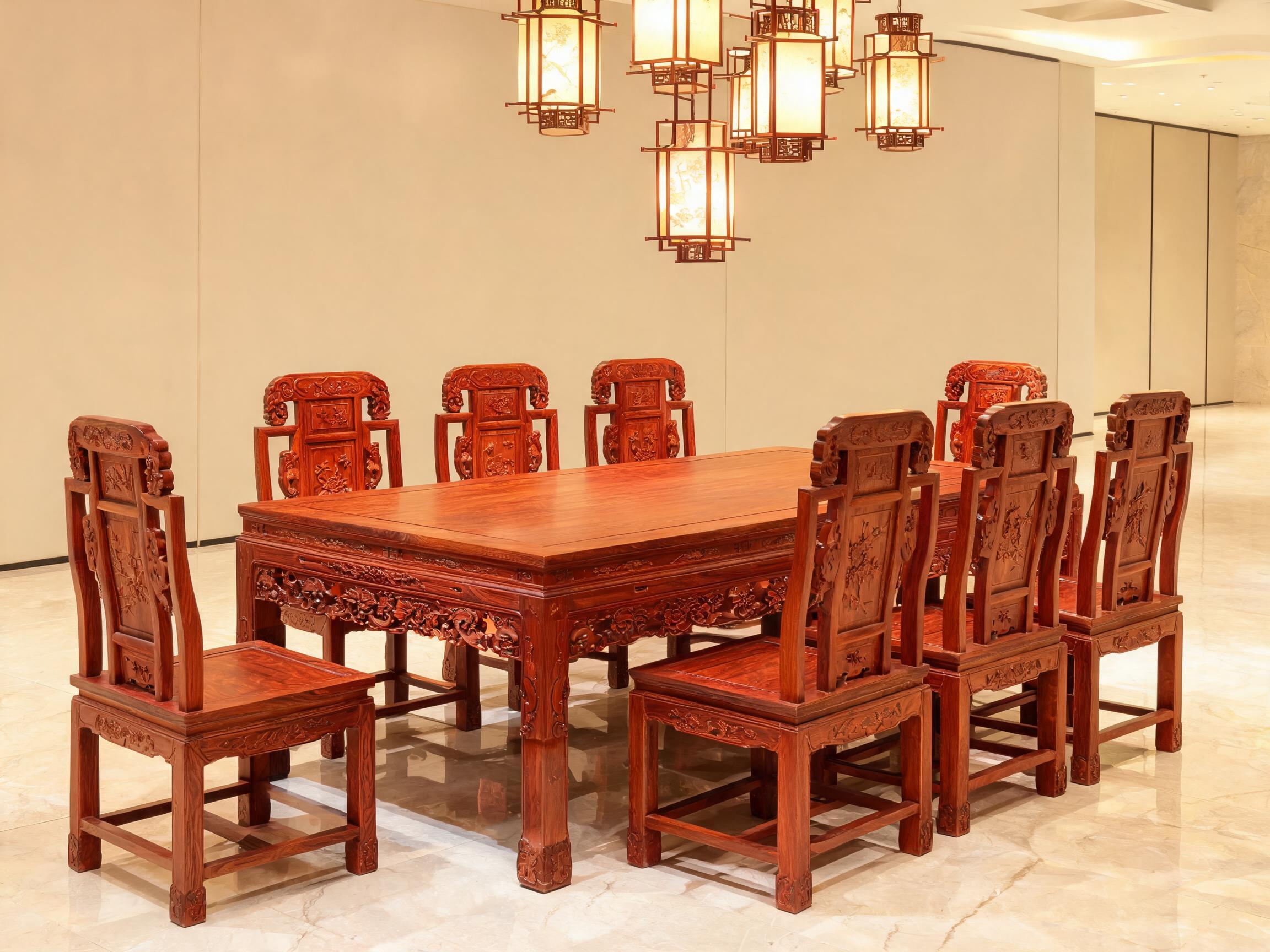
Yunxiao Rosewood Furniture Co., Ltd builds that combination natively. Seven catalog models pair round, rectangular, oval, and square tables with carved chair programs matched in motif, finish, and joinery, produced in a 12,000-square-meter factory in Xianyou County, Fujian Province. In-house carving, assembly, and lacquer teams mean the table-and-chair relationship is controlled end to end, not assembled from subcontracted parts.
Component-level sourcing matters because mismatched tables and chairs are among the most common complaints in imported classical furniture: chairs that do not slide under the apron, backrest motifs that differ chair to chair, or finishes that drift in tone between table and chairs. Every section below prevents one of those specific failures.
Table-Chair Dimensional Standards
The table-and-chair system follows measurable interface standards. Seat height of 45 to 48 centimeters pairs with a table top surface at 74 to 76 centimeters, leaving comfortable thigh clearance for adults across long commercial dining service. Chair armrests, where present, must clear the table apron bottom so chairs slide fully under the table when not in use.
| Interface | Standard | Why It Matters |
|---|---|---|
| Seat height | 45-48 cm | Pairs with 74-76 cm top height for correct posture in commercial dining |
| Armrest-to-apron clearance | Set at drawing approval | Prevents chairs that cannot slide under the table when stored |
| Backrest angle | Consistent across the set | Uneven angles are the most visible sign of inconsistent assembly |
| Chair spacing | 60-65 cm per position | Guarantees elbow room at 6, 8, and 12-seat configurations |
These interfaces are checked at the assembly verification checkpoint, where joinery tightness and dimensional accuracy are documented for each chair - not just the table.
Chair Engineering for Commercial Dining
Chairs in commercial dining fail long before tables do. They are moved, scooted, stacked for cleaning, and loaded dynamically hundreds of times per week in restaurant use. Verify three engineering points on every chair program: leg-to-seat joinery using through-tenon with wedge construction identical to the table's engineering; stretchers that prevent racking under repeated lateral movement; and seat frames built for dynamic load rather than static weight alone.
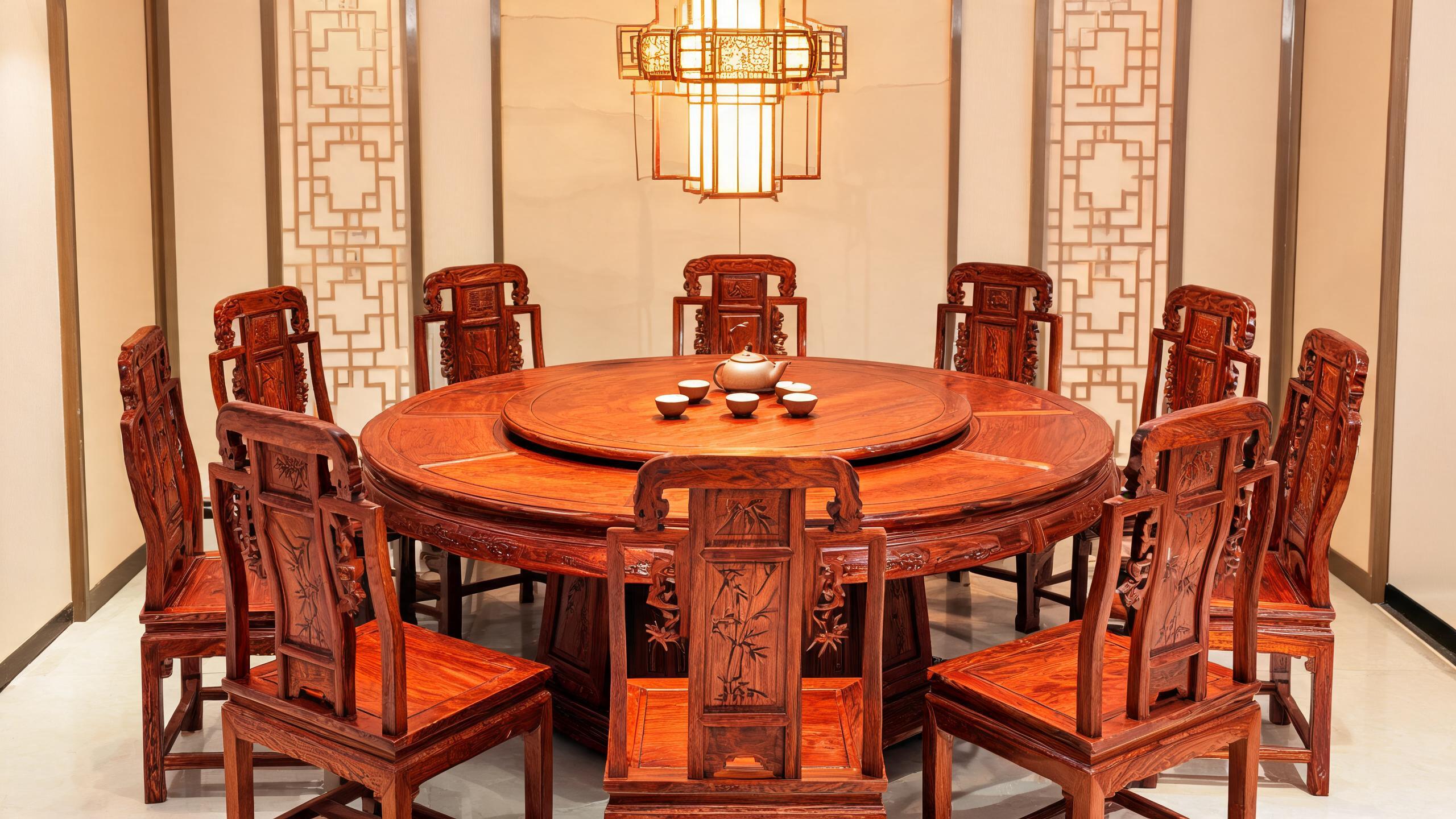
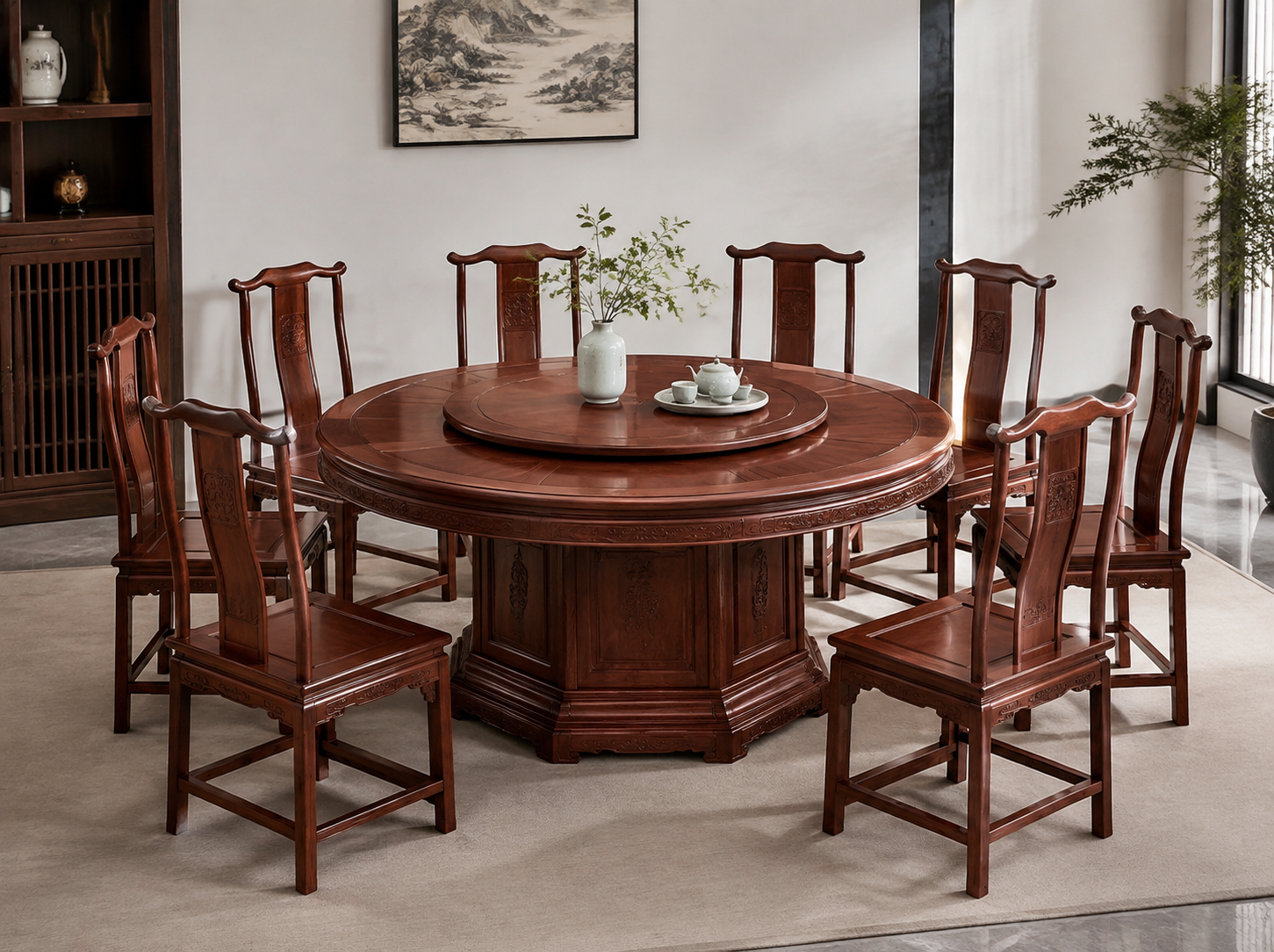
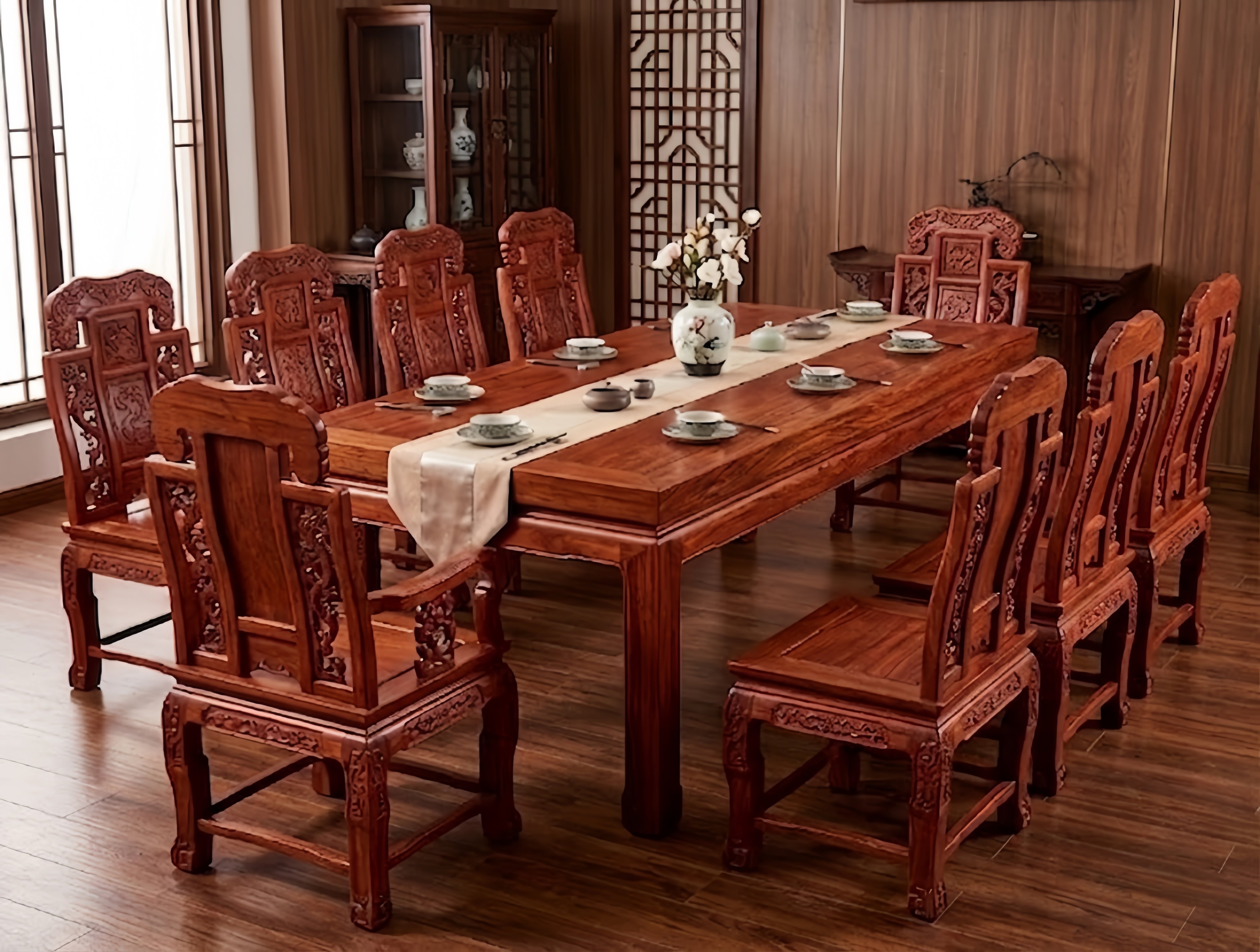
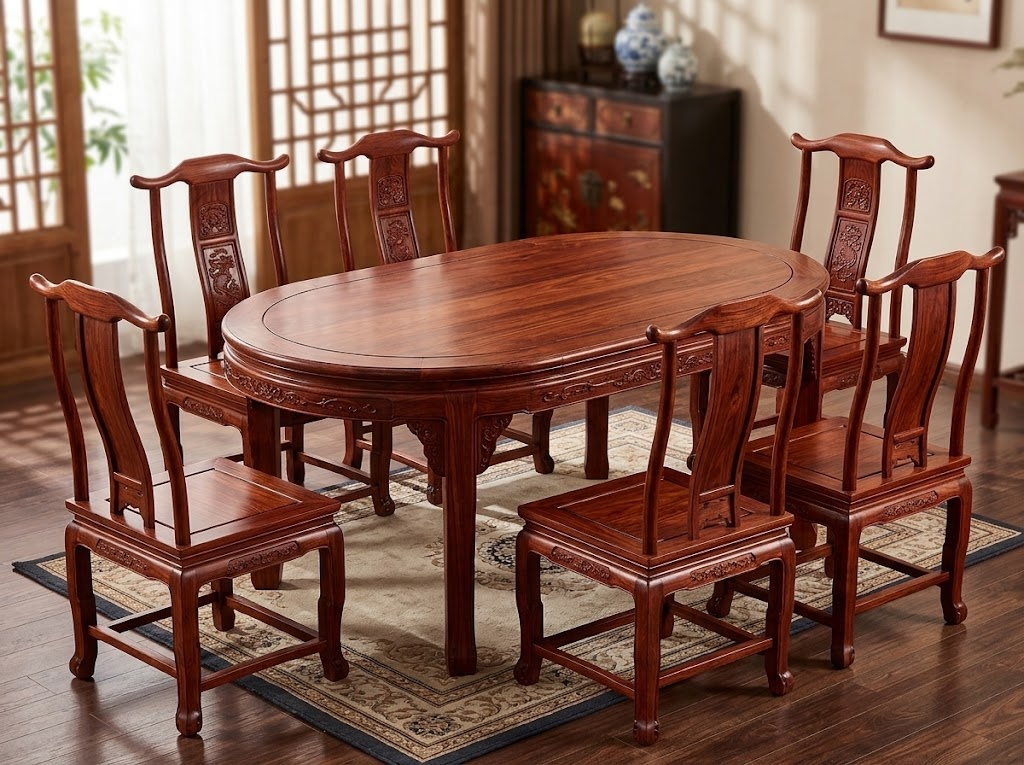
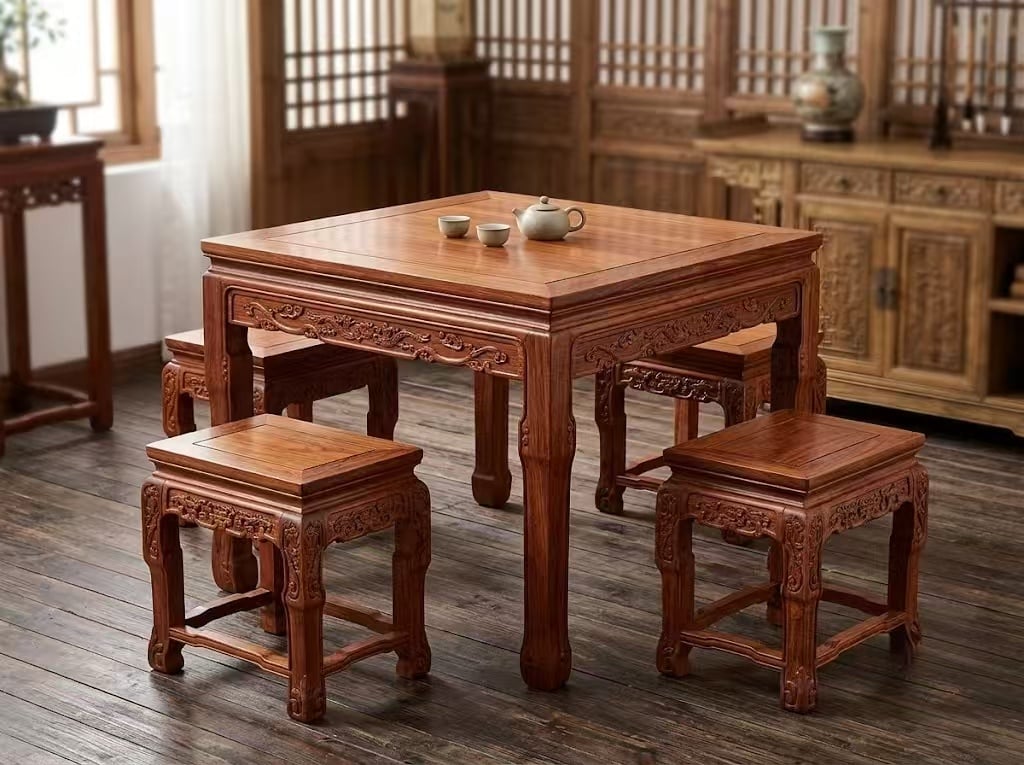
The catalog's carved chairs follow this grammar across models: bamboo motif chairs on the Rectangular 8-Seat Set, Ming style chairs on the Round 8-Seat and Oval 6-Seat Sets, carved stools on the 4-Seat Compact Set, and carved chairs on the 10-Seat and 12-Seat banqueting sets. Because tables and chairs share one joinery grammar, they can be warranted as a system rather than as separate items.
Carving Program Consistency Across Sets
In three-step relief carving, one backrest panel takes 30 to 40 hours of hand work by a Xianyou master artisan. For a 10-chair order, that represents 300 to 400 hours of carving labor; consistency across those hours is a production discipline, not an accident. The same carving team executes all instances of a motif, with relief depth checked at the carving inspection checkpoint against approved drawings.
Specify the motif at inquiry: dragon, phoenix and peony, cloud and Ruyi, lattice (hexagonal, diamond, ice-ray), or bamboo. Custom motifs incorporating hotel logos, cultural symbols, or region-specific designs are available through OEM customization, and custom carving templates remain the buyer's property, never reused without consent.
Specifying Your Combination: A Worksheet
Use this worksheet when requesting quotations, so the factory prices exactly what you need in one pass:
- Table: shape (round, rectangular, oval, or square), seating target, top dimensions, apron type (plain or carved), motif if carved.
- Chairs: count, with or without arms, motif, seat height requirement if non-standard.
- Finish: raw lacquer color tone, sheen level, FDA food-contact requirement for the top surface.
- Documentation: destination market (drives the CITES and FSC file) and sales channel (retail versus project).
A quotation built on this worksheet returns FOB Xiamen pricing, a container loading plan, document samples, and the production timeline within 48 hours - without the back-and-forth that unpriced specifications usually create.
Joinery Grammar Shared by Tables and Chairs
Both components use the same mortise-and-tenon grammar: through-tenon with wedge for legs and backrest posts, half-lap joints for stretchers, dovetail joints where drawers exist, and bamboo dowel pins securing tenons. Bamboo is chosen deliberately: its moisture expansion characteristics match rosewood, preventing the differential movement that loosens metal-fastened joints over time.
The verification point for buyers is simple: metal screws in primary structural joints are a red flag in classical furniture. If a third-party inspection report shows metal fasteners in primary frames, the piece is not built to traditional standard, no matter how classical it looks on the surface.
Finish Matching Between Table and Chairs
Drifting finish tone between table and chairs usually has one of two causes: separate finishing batches without color-matching control, or rushed final coats applied under time pressure. Yunxiao finishes each set in one continuous batch in humidity-controlled rooms, with the finish assessment checkpoint comparing every piece against the approved sample under controlled lighting before anything is approved for crating.
The 8-9 coat raw lacquer system spans 20 to 30 days: a wood sealing coat, grain-filling coats to level the surface, body coats building film thickness, and final curing for 7 to 10 days in a humidity-controlled room. The system meets EU REACH, US CARB, and FDA 21 CFR 175.300 for dining surfaces.
The Inspection Shot List for Matched Sets
A third-party inspection is only as useful as its shot list. For a matched table-and-chairs program, ask the inspector to photograph six things specifically: the primary leg-to-apron joints on the table (showing the through-tenon wedge); the panel gap on the tabletop edge (evidence of floating-panel construction); every chair backrest in one row (making motif consistency visible in a single frame); the seat height measurement of at least three chairs against a tape (uniformity check); the finish under raking light across table and chairs together (tone matching); and the interior bracing of one opened crate (packaging verification).
Send this list to your inspection agency when booking. Generic furniture inspections default to surface photography; a classical joinery program needs the joint and gap evidence that proves the construction standard, not just the appearance.
Chair Replacement and Expansion Planning
Buyers who sell dining sets eventually get asked for more chairs - a customer expands the household, a restaurant adds covers, a chair is damaged beyond repair. Plan for it at the first order. Because carving templates are retained per program and the same carving team executes each motif, reorder chairs arrive matching the originals in relief depth and line quality even months later; specify at order time that templates should be retained for your program.
The practical move is adding one or two spare chairs to the first container: they cost little in crate volume, they solve the first damage claim instantly, and they give your retail floor a matching display depth. For hospitality programs, a 10 percent chair overage is standard planning practice against commercial wear.
Unpacking and Acclimatization at Destination
What happens in the 48 hours after delivery affects the set as much as anything before it. Unpack in the room where the set will live, remove all wrapping materials completely rather than partially, and let the furniture stand for 24 to 48 hours before daily use - the wood equalizes to local humidity through the breathable lacquer in that window. Photograph each piece as it is unpacked, before any packaging is discarded; those photos are the claim baseline if transit damage appears.
Advise end customers against placing the set directly over radiators or against air-conditioning outlets in the first weeks, when the moisture balance is newest. This is standard solid-wood practice, and putting it in writing with the delivery is what separates a documented program from a shipped box.
Quality Control and Export Documentation
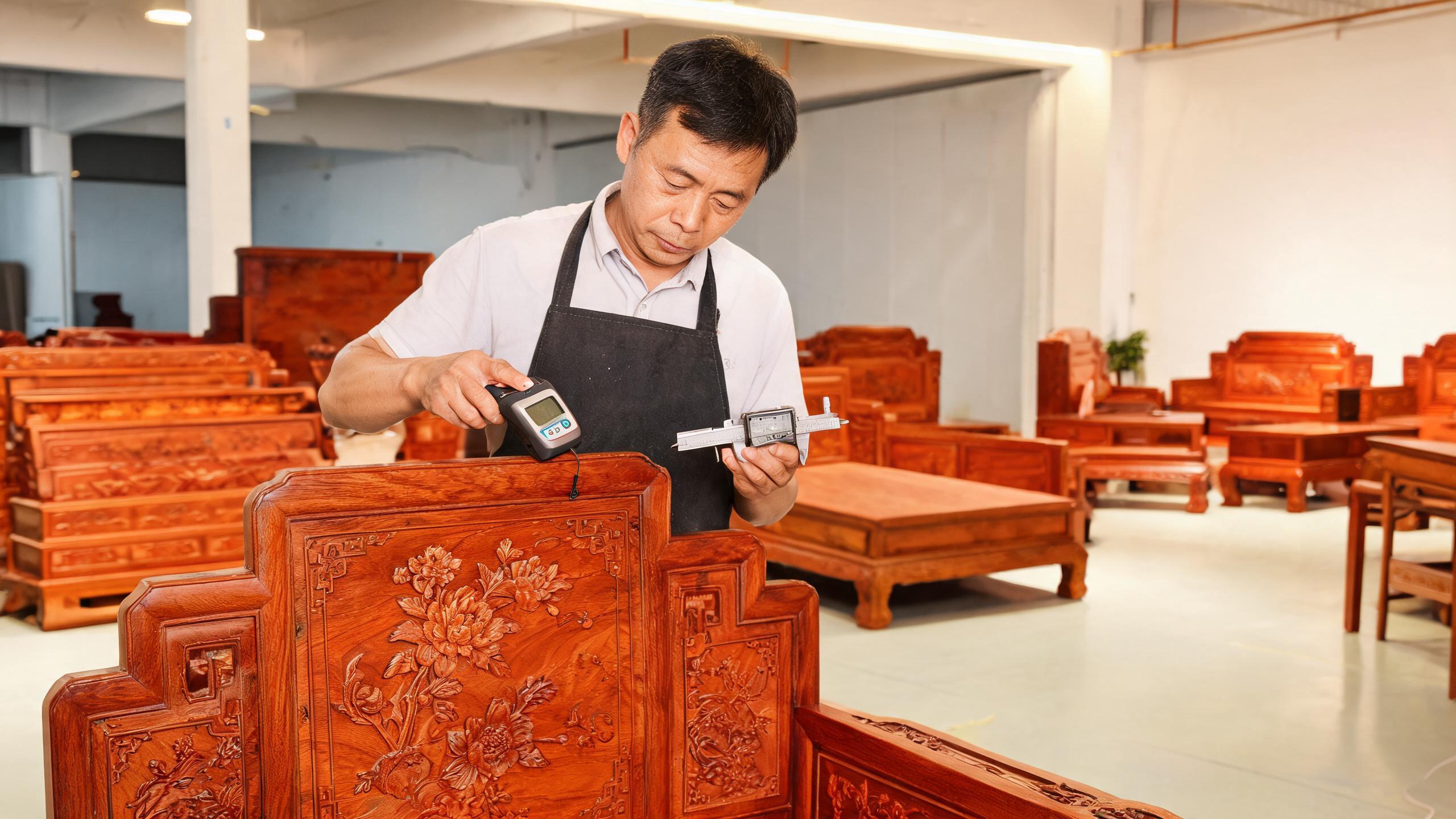
Four documented checkpoints govern the combination: timber verification (moisture readings from the 36-day kiln cycle, heartwood ratio, density sorting to 0.90-1.00 g/cm³), carving inspection (accuracy against drawings, relief depth consistency), assembly verification (joinery tightness, dimensional accuracy for each chair), and finish assessment (coverage, color consistency, sheen under controlled lighting). Third-party pre-shipment inspection is welcomed at buyer expense, with full access to production records and kiln drying logs; schedule the window after finish assessment and before ISPM-15 crating.
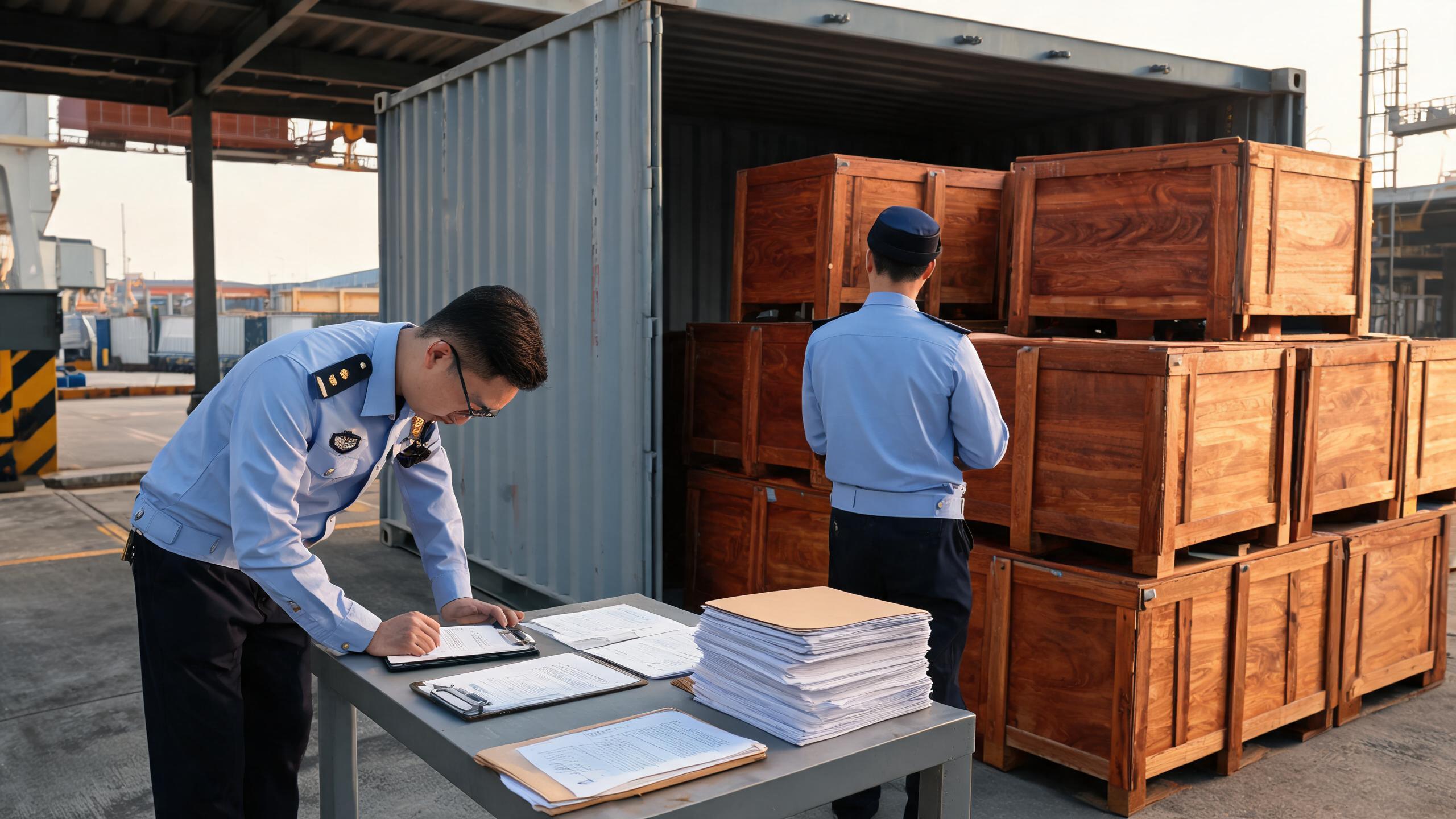
Because the chairs and table ship together as one program, the export file covers the full combination: the CITES Appendix II export permit (shipment-specific and non-transferable, 5-10 working days), FSC chain-of-custody certificate, ISPM-15 heat treatment certificate for the crates, REACH and CARB compliance declarations, FDA 21 CFR 175.300 compliance for the table top, the commercial invoice with HS code 9403.60, and a packing list itemizing each crate. Confirm your customs broker can process CITES Appendix II timber paperwork before booking vessel space - brokers experienced with regulated timber keep clearance predictable; generalist brokers sometimes learn on your clock.
Packaging Engineering for Carved Sets
Carved chair backrests are the most damage-vulnerable components in ocean transit. The packaging protocol treats them accordingly: acid-free tissue on all carved surfaces, custom-cut EPE foam brackets shaped to each component, VCI anti-corrosion film with desiccant packs, and ISPM-15 heat-treated wooden crates with internal bracing. Chairs are individually wrapped and braced so backrests never contact crate walls or each other during the 14 to 30 day ocean leg.
Container Loading and the Delivery Timeline
Chair volume dominates container math: a 12-chair banqueting set consumes nearly double the crate volume of a 6-chair set with the same table. When ordering multiple sets, request the container loading plan at quotation - it calculates total crate volume and recommends the optimal mix for a 40-foot container holding 6 to 10 sets. Loading photos are issued before departure to document baseline condition.
For a matched table-and-chairs order, plan on: quotation within 48 hours of a complete worksheet; 15 working days of design approval for custom motifs or non-standard dimensions; 45 to 60 working days of standard production or 60 to 75 for custom; CITES permit processing concurrent at 5 to 10 working days; 14 to 30 days of ocean transit from Xiamen. Payment terms are 30 percent T/T deposit with balance before shipment; L/C accepted above USD 30,000. Trial single sets and refundable samples let buyers verify the combination before container volume, and weekly production photos keep the build visible. Finished furniture can be held in climate-controlled storage for up to six months pending delivery scheduling.
Frequently Asked Questions
How do I match chairs to a rosewood dining table?
Verify three interfaces: seat height 45-48 cm against a 74-76 cm top, armrest-to-apron clearance so chairs slide under, and 60-65 cm chair spacing per position. In Yunxiao sets these interfaces are engineered and checked at drawing approval and assembly verification.
Can I order extra chairs beyond the set count?
Yes. Chair counts are specified at quotation within OEM and ODM scope, and the same carving team executes the added chairs so motif and relief depth match the original set.
Why do finishes sometimes mismatch between table and chairs?
Separate finishing batches or rushed final coats. Yunxiao finishes each set in one continuous batch in humidity-controlled rooms and verifies every piece against the approved sample under controlled lighting.
What chair motifs are available?
Dragon, phoenix and peony, cloud and Ruyi, lattice in hexagonal, diamond, and ice-ray patterns, and bamboo. Custom motifs with hotel logos or regional designs are available through OEM customization.
Are the chairs as structurally engineered as the tables?
Yes - identical joinery grammar: through-tenon with wedge on legs and backrest posts, half-lap stretchers, and bamboo dowel pins. Metal screws in primary joints are a red flag in classical construction.
How are carved chairs protected in shipping?
Acid-free tissue on carved surfaces, custom-cut EPE foam brackets, VCI film with desiccants, individually wrapped and braced in ISPM-15 heat-treated crates so backrests never contact crate walls.
What does a table-and-chairs quotation include?
FOB Xiamen pricing for the full combination, a container loading plan, CITES and FSC document samples, and the production timeline - returned within 48 hours of a complete specification worksheet.
Do dining surfaces meet food-contact rules?
The raw lacquer system meets FDA 21 CFR 175.300 for repeated food contact, plus EU REACH and US CARB. Compliance declarations accompany each shipment.
Can I get samples before a container order?
Trial single sets are available for new buyers, and refundable samples for qualified partners. Finish and carving samples on wood blocks can be mailed during design approval.
What happens if chairs arrive damaged?
Packaging is engineered to prevent it, but photographic documentation at unboxing and immediate notification within the claim window are required; loading photos issued before departure establish the baseline condition.
What should my inspection agency photograph?
Six shots: table leg-to-apron joints showing the through-tenon wedge, the tabletop panel gap, all chair backrests in one row, seat height measurements, the finish under raking light across table and chairs, and the interior bracing of one opened crate.
Will reorder chairs match my first shipment?
Yes, when carving templates are retained for your program and the same team executes the motif. Specify template retention at order time; relief depth and line quality stay consistent across production runs.