Planning Spaces Around a rosewood dining set
A rosewood dining table 6 chairs configuration is the volume anchor of family dining retail and mid-scale hospitality. Six chairs seat a family or a small private dining party, while the table remains compact enough for apartment dining rooms and restaurant floors of roughly 3.6 by 4.2 meters. This page treats the 6-chair configuration as a space-planning product: room mathematics, circulation, chair placement, and the specification details that make or break the configuration in commercial use.
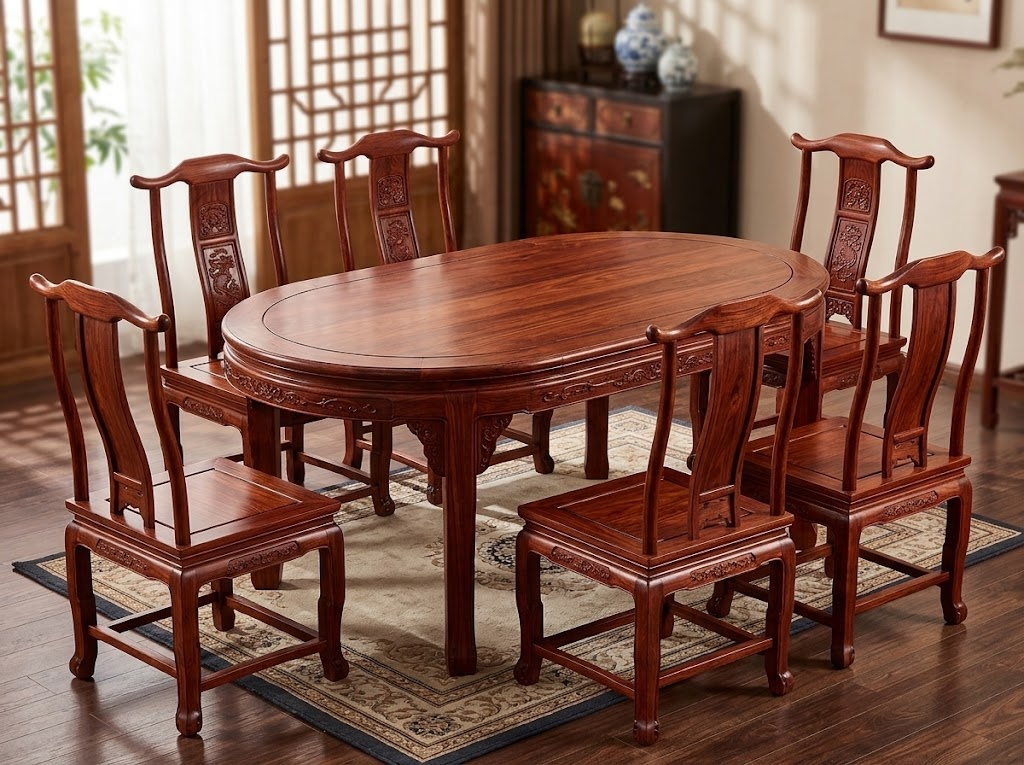
Yunxiao's native 6-chair offering is the Oval Redwood Dining Table 6-Seat Set with Ming Style Chairs - an oval top that softens room circulation and Ming-style chairs whose clean lines suit both classical and contemporary interiors. The same specification logic applies when configuring six chairs around round or rectangular tops through OEM customization, inside the 15-day design approval cycle.
Six chairs is also the sweet spot for first container orders: enough volume to justify direct import economics, small enough to test a market without overstock exposure. Wholesale buyers consistently find 6-chair sets move fastest across retail channels.
Room Sizing Math for Six Chairs
Plan the room before the table. For six chairs around an oval or rectangular top, allocate 60 to 65 centimeters per chair position, 90 to 100 centimeters of pull-out and service clearance per active side, and doorways at least 80 centimeters clear so the table enters the room assembled or in two sections.
| Room Dimension | Configuration Fit | Notes |
|---|---|---|
| 3.2 x 3.6 m | Tight fit, 2+2+2 placement only | Reduce clearance to 75 cm, use a fixed service point |
| 3.6 x 4.2 m | Comfortable 2+2+2 or 3+3 placement | Standard family dining room with 90-100 cm clearance |
| 4.2 x 4.8 m | Comfortable plus sideboard space | Adds 45 cm sideboard depth along one wall |
These figures assume the oval top distributes visual mass evenly; rectangular tops of the same seat count run longer and need length-oriented rooms.
Chair Placement Patterns: 2+2+2 and 3+3
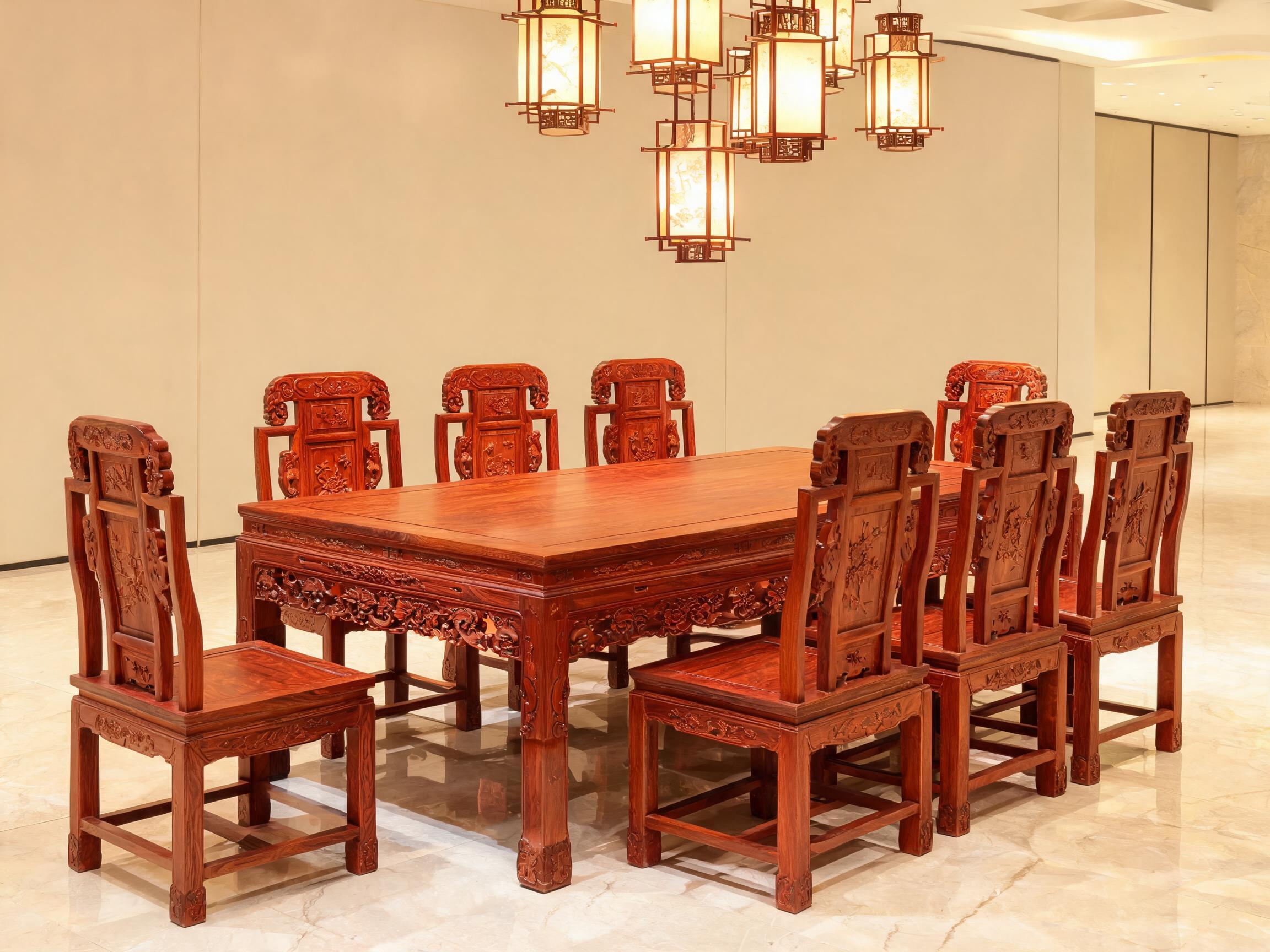
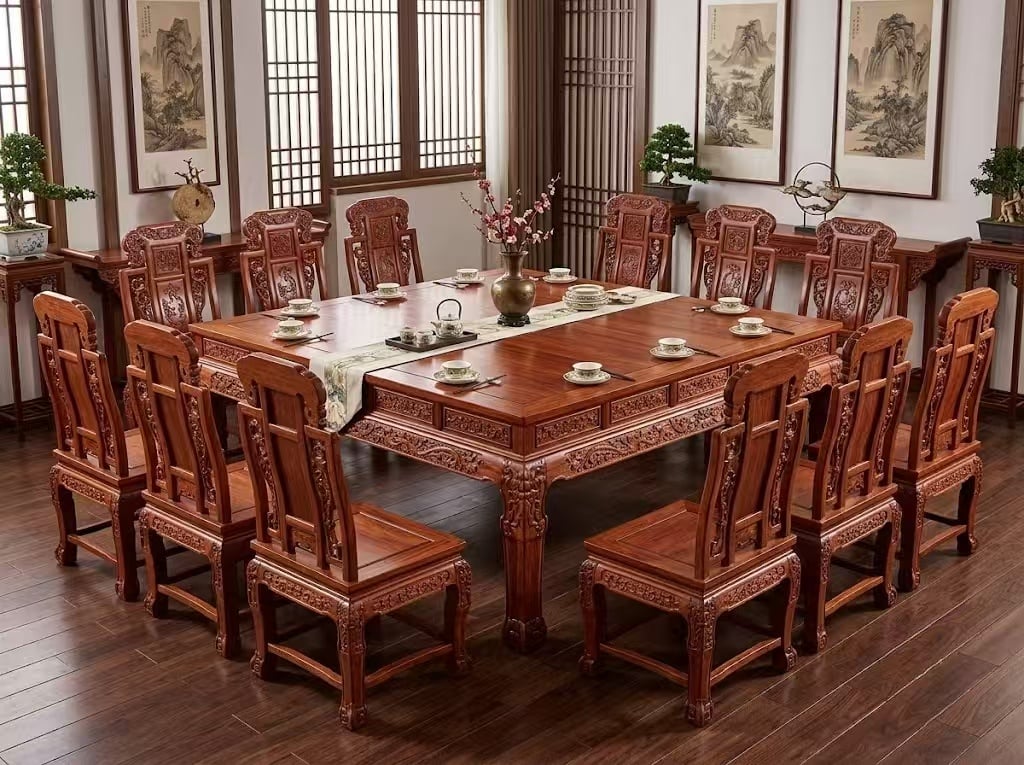
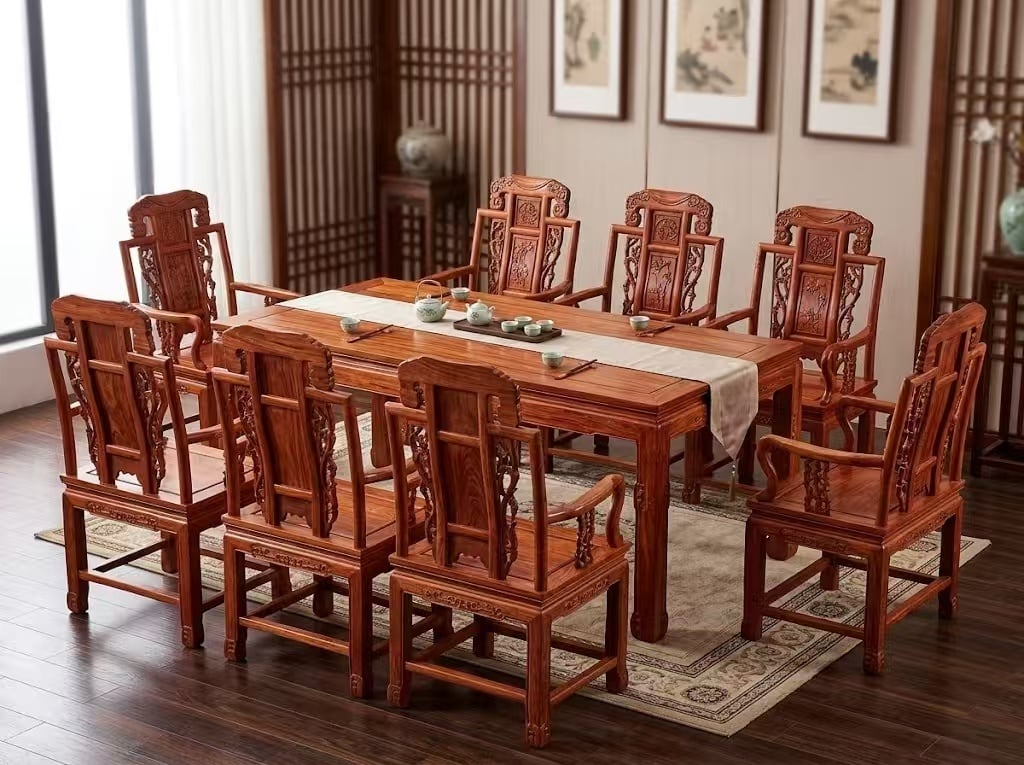
Six chairs fit an oval top in two standard patterns. The 2+2+2 arrangement places two chairs on each long side with host positions at the ends - the formal residential dining default that customers expect from carved rosewood. The 3+3 arrangement places three chairs per long side without end positions - the restaurant default, maximizing covers per table without end chairs consuming span.
For hospitality buyers, 3+3 yields six covers per table with clean service aisles on both sides. For residential retail, 2+2+2 photographs better in listings: end positions showcase the carved backrests that justify the category's price point. Both patterns load the oval top evenly, which matters for joinery longevity - concentrated loading stresses one side over years of use.
The Oval 6-Seat Set in the Catalog
The Oval Redwood Dining Table 6-Seat Set pairs an oval floating-panel top with six Ming-style chairs. The oval geometry removes corners, easing circulation in rooms where rectangular tables create traffic pinch points at the corners - a practical advantage in both apartments and restaurant floors where servers circulate continuously.
Ming-style chairs bring clean lines and restrained lattice carving that photograph well for retail listings and suit contemporary interiors as readily as classical ones. The set is built on the same 36-day kiln-dried Siamese rosewood, through-tenon joinery, and 8-9 coat raw lacquer system as every catalog model - nothing in the mid-size format is downgraded engineering.
Hospitality Floor Planning With Six-Cover Tables
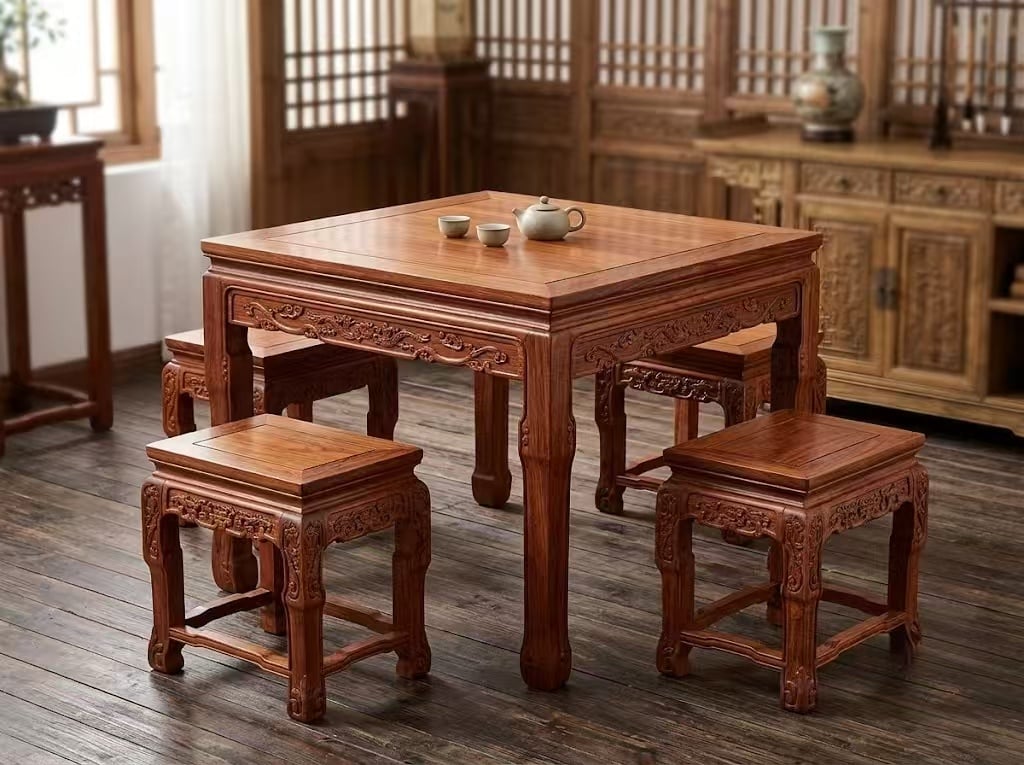
Restaurant floors are planned around covers per square meter, and the 6-cover table is the planning unit that balances density against comfort. Space six-cover tables at 140 to 150 centimeters center-to-center so that back-to-back occupied chairs still leave a service lane, and keep main service aisles at 90 centimeters minimum for trays and trolleys. A practical hybrid floor mixes 6-cover oval tables in the main room with 4-cover compact square units along the window line - one material story, two seating densities, and the flexibility to combine tables for larger parties.
For private dining rooms, a single 6-cover oval with 2+2+2 placement reads as intimate rather than sparse, which is why the configuration sells into clubs and boutique hotels as readily as into family homes.
Climate Stability: Why 36-Day Drying Matters at Home
Family dining rooms swing between heating-season dryness and summer humidity - the hardest indoor climate regime for solid wood. Three features protect the 6-chair set through those cycles: 36-day kiln drying below 14 percent moisture, floating-panel construction that lets the top move seasonally without cracking, and breathable lacquer that moderates moisture exchange.
The kiln cycle itself runs three phases - initial high-temperature moisture removal, intermediate equalization across the timber cross-section, and final stress-relief conditioning - each phase verified by documented moisture readings that ship with the pre-shipment file. Buyers in dry North American and European interiors and humid Southeast Asian and Australian coastal climates receive the same engineering.
Finish and Surface Compliance for Daily Dining
A family dining table sees daily meals, hot dishes, and repeated cleaning for years. The 8-9 coat raw lacquer system is engineered for exactly that: it meets EU REACH, US CARB formaldehyde limits, and FDA 21 CFR 175.300 for repeated food contact. For retail programs, the food-contact compliance file is a listing-level differentiator against synthetic-finished competitors - customers and restaurateurs both care what touches food.
Unlike polyurethane barriers, raw lacquer is breathable: it allows moisture vapor transmission while protecting the surface, which is why the finish does not blister or peel as trapped-moisture finishes do in humid climates. Over the first two to three years the finish develops a deeper patina as natural oils migrate through it - a hallmark of authentic classical furniture.
Carving Programs for Six-Chair Sets
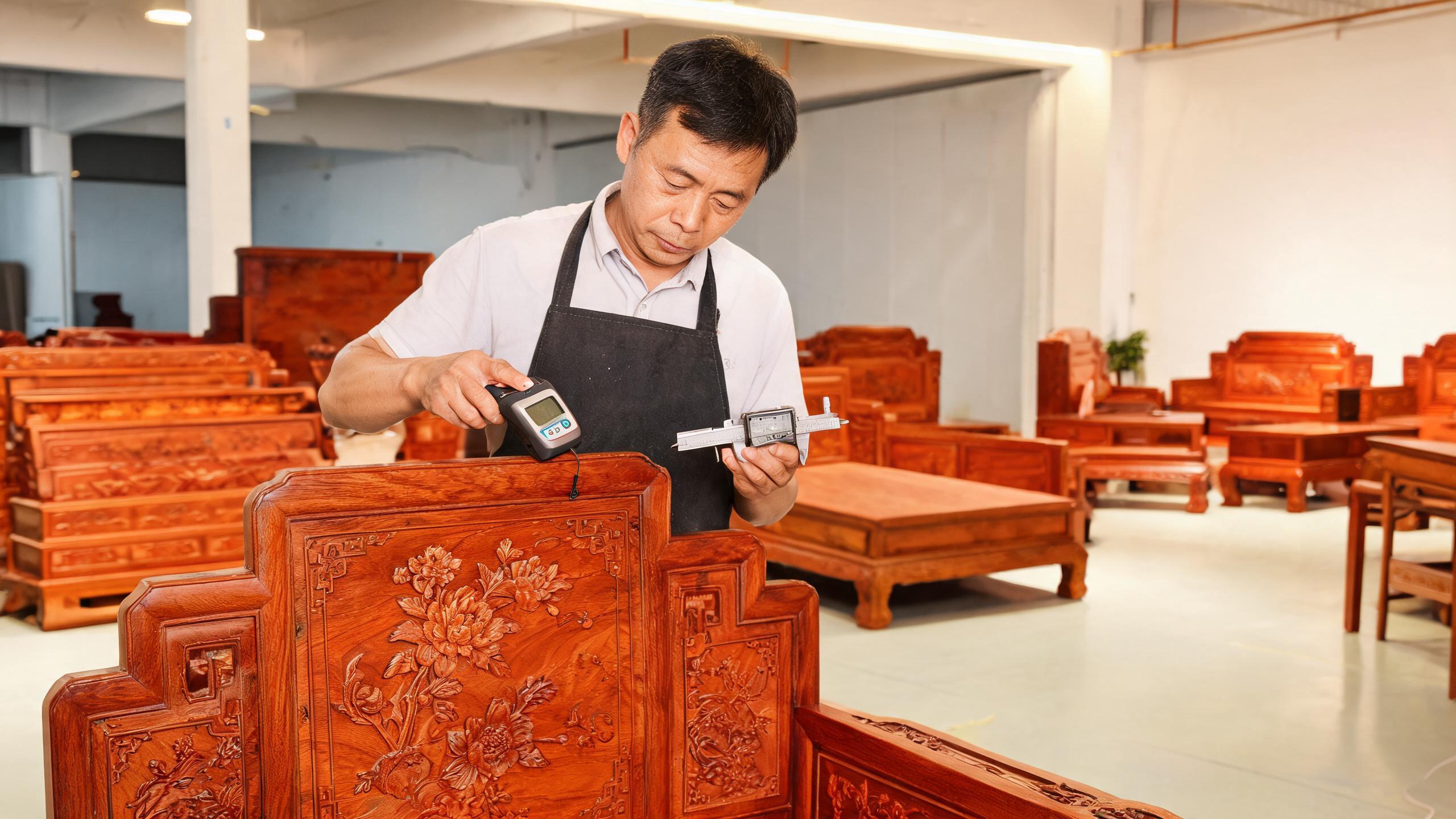
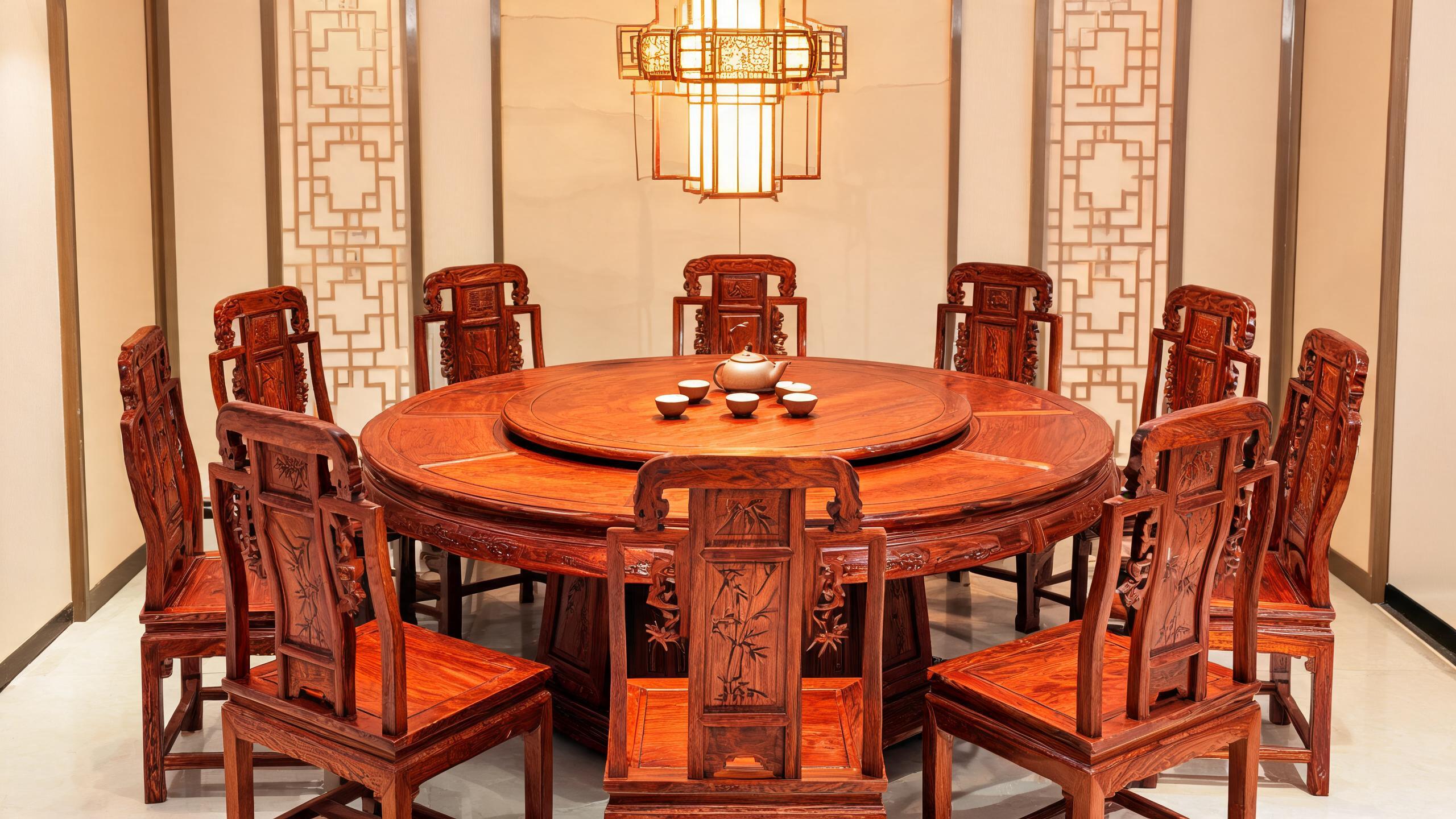
Motif options across the chair program: dragon, phoenix and peony, cloud and Ruyi, lattice in hexagonal, diamond, and ice-ray patterns, and bamboo. The same carving team executes all six chairs; each backrest panel takes 30 to 40 hours of hand work in three-step relief. Close-up carving photos are issued at the carving inspection checkpoint, and carving samples on wood panels can be mailed for container orders.
For retail listings, the motif is the photograph: dragon and phoenix read as prosperity motifs in East Asian communities, lattice reads as clean and contemporary in Western interiors, and bamboo bridges both. Choosing the motif is choosing the market.
Regional Demand Patterns for Six-Seaters
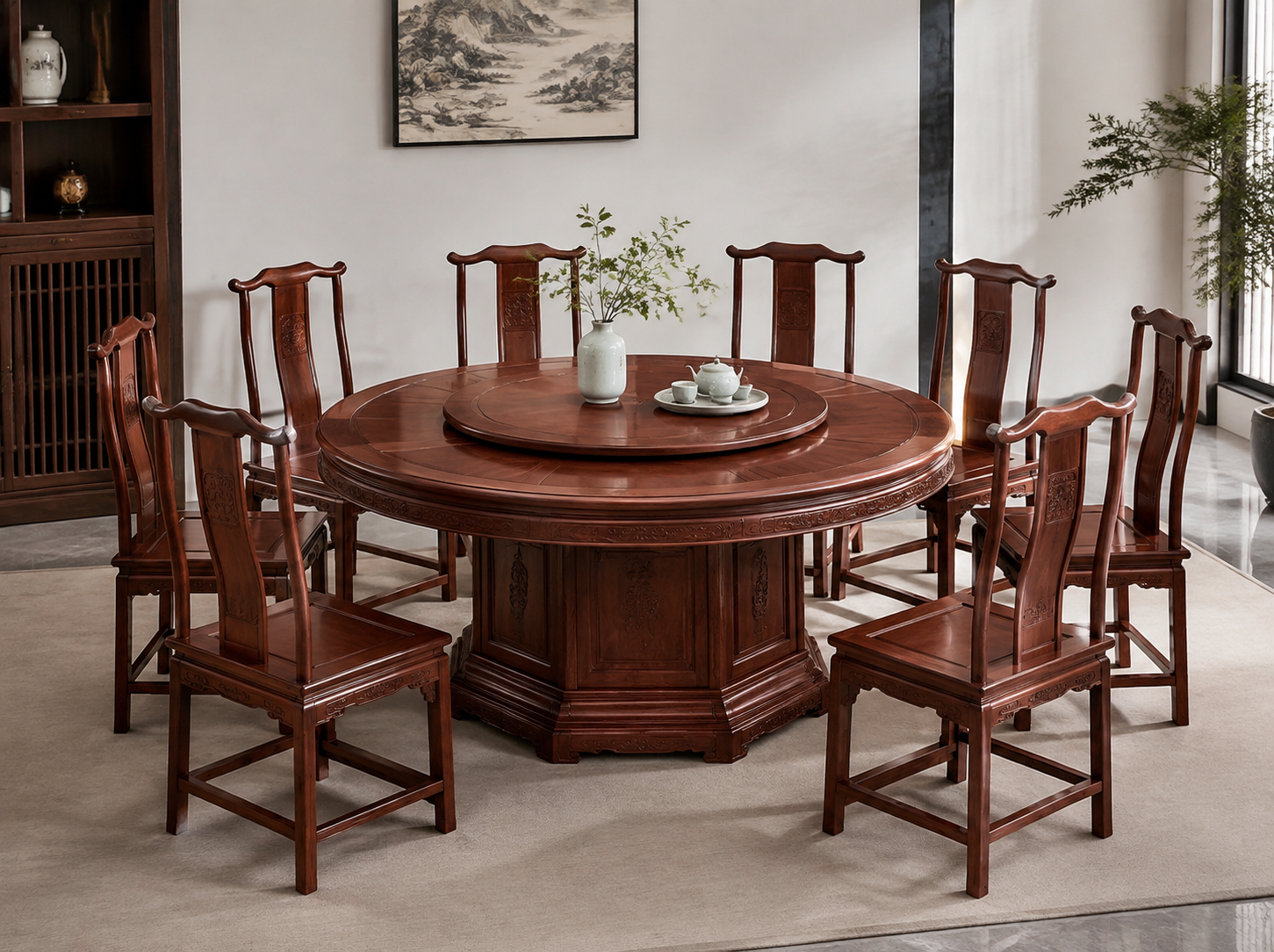
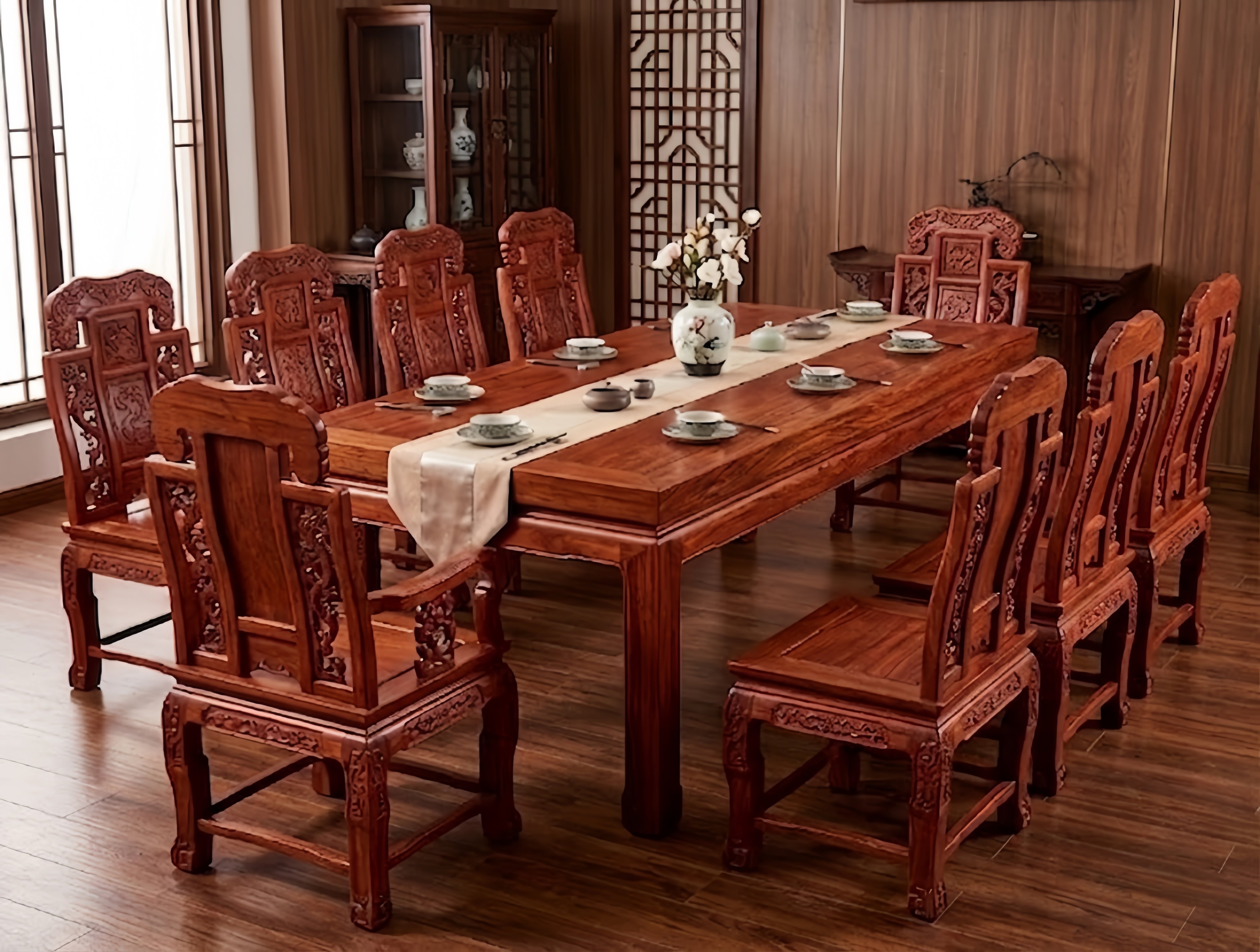
Six-chair sets sell differently by region, and the pattern is stable enough to plan containers around. In North America, the 6-seat set is the standard family format - it matches the dining room of the typical suburban home and carries the strongest retail velocity. In Southeast Asia, six covers is the private-room unit for restaurant groups, often ordered alongside 10- and 12-seat banqueting sets for the main halls. In Europe, where dining rooms run smaller, the 6-seat oval plays as the premium family format, chosen for apartments and townhouses where a rectangular 8-seater would overwhelm the room. In Australia, coastal hospitality projects use 6-cover tables as the standard dining-room unit.
For a first mixed container, these patterns argue for a volume core of 6-seat sets with regionally weighted accents - more banqueting sets for Southeast Asian buyers, more compact sets for European channels.
Wholesale Economics of 6-Chair Configurations
At quotation, the container loading plan shows how 6-chair sets load against other configurations in a 40-foot container holding 6 to 10 sets. Six-chair sets sit mid-pack in crate volume - denser than 12-chair banqueting sets, roomier than 4-seat compact sets - making them the flexible filler in mixed containers. For a first order, a common mix is 6-chair sets as the volume core with one or two banqueting sets as flagship listings.
Pricing follows standard terms: 30 percent T/T deposit, balance before shipment, L/C accepted above USD 30,000. Trial single sets let new buyers verify quality before container volume.
Claims and Damage Protocol for Container Orders
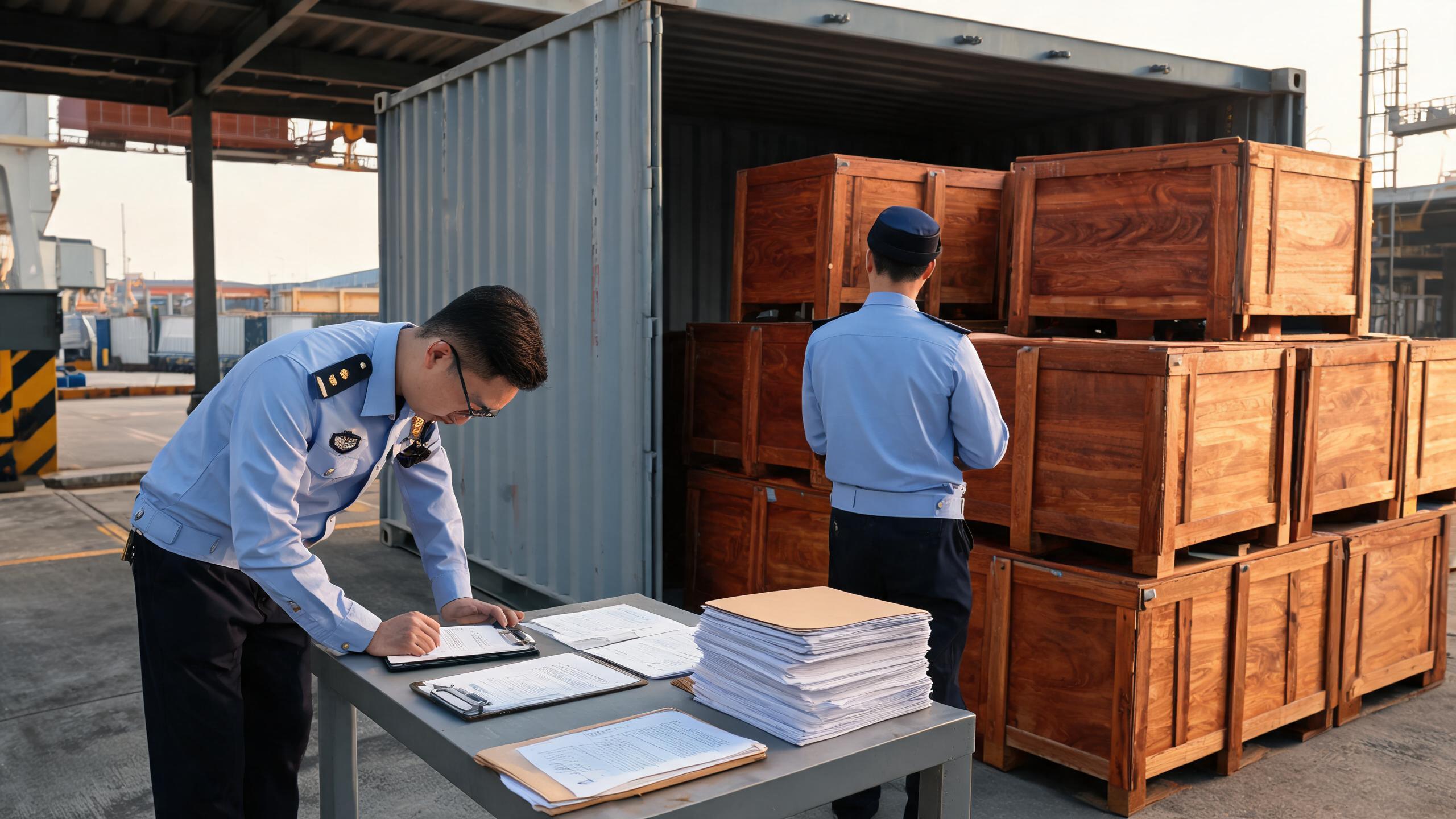
Even with engineered packaging, a container program needs a written claims protocol agreed before the first shipment. The sequence that works: photograph every crate at arrival before opening; photograph each piece as it is unpacked; notify the factory within the agreed claim window with the photos attached; retain the crate and bracing materials for survey if a carrier claim is possible. Loading photos issued before departure establish the baseline condition, which is what makes the claim resolvable rather than arguable.
Agree on the claim window in writing at order confirmation - thirty days from arrival is a workable standard for ocean freight - and name the inspection evidence that counts: the unpacking photographs, the survey report, and the loading photo set.
Quality Control and Export Documentation
Four documented checkpoints govern production: timber verification (moisture, heartwood ratio 80 percent or higher, density 0.90-1.00 g/cm³), carving inspection (accuracy and relief depth against drawings), assembly verification (joinery tightness and dimensions for each chair), and finish assessment (coverage, color, sheen). Third-party pre-shipment inspection is welcomed at buyer expense with full access to production records and kiln drying logs; weekly production photos keep the order visible throughout the build.
Siamese rosewood is CITES Appendix II listed, so each 6-chair shipment carries its own export permit - shipment-specific, non-transferable, 5-10 working days once contents are final. The full file adds FSC chain-of-custody, the ISPM-15 certificate for crates, REACH and CARB declarations, FDA 21 CFR 175.300 for the table top, the HS 9403.60 commercial invoice, and the packing list, all in English. Buyers needing to avoid CITES paperwork can specify Machilus Nanmu, which carries FSC documentation without a CITES permit.
Ordering Timeline and Delivery
Standard production runs 45 to 60 working days from deposit; custom OEM versions run 60 to 75 working days plus the 15-day design approval cycle. The 36-day kiln drying is embedded and cannot be accelerated. Ocean transit runs 14 to 30 days from Xiamen to major destination ports. Loading is supervised at the factory warehouse with loading photos issued before departure.
Frequently Asked Questions
What room size fits a 6-chair rosewood dining table?
3.6 by 4.2 meters is the comfortable standard with 90-100 cm clearance; 3.2 by 3.6 m works with reduced clearance and 2+2+2 placement; 4.2 by 4.8 m adds sideboard space along one wall.
How are 6 chairs arranged around the table?
2+2+2 - two per long side plus host ends - for formal residential dining, or 3+3 - three per long side - for hospitality maximizing covers per table with clean service aisles.
Is the oval top available in other shapes?
Yes, through OEM customization - round, rectangular, or square tops with the same chair program and finish system, inside the 15-day design approval cycle with 3D mockups.
Are 6-chair sets good first imports?
Yes - six chairs is the volume sweet spot: enough to justify container economics, small enough to test a market without overstock risk, and mid-pack in crate volume for mixed containers.
Do the chairs match the table finish exactly?
Each set is finished in one continuous batch in humidity-controlled rooms and verified against the approved sample under controlled lighting at the finish assessment checkpoint.
What motifs are available for the chair program?
Dragon, phoenix and peony, cloud and Ruyi, lattice in hexagonal, diamond, and ice-ray patterns, and bamboo - executed by one carving team across all six chairs at 30-40 hours per backrest.
Will the set crack in a heated winter home?
No - 36-day kiln drying below 14 percent moisture plus floating-panel construction and breathable lacquer accommodate heating-season dryness without cracking.
What documents accompany a 6-chair shipment?
CITES Appendix II permit, FSC chain-of-custody, ISPM-15 certificate, REACH and CARB declarations, FDA 21 CFR 175.300 compliance, HS 9403.60 invoice, and packing list - all in English.
How long does production take?
45-60 working days standard, 60-75 custom, including the non-accelerable 36-day kiln cycle; CITES permits run concurrently at 5-10 working days.
Can I see the set before shipment?
Yes - weekly production photos, close-up carving photos at the carving checkpoint, and third-party pre-shipment inspection welcomed at buyer expense with access to production records.
How should a restaurant floor space 6-cover tables?
140 to 150 centimeters center-to-center between tables with 90 centimeter minimum service aisles; mixing 6-cover ovals with 4-cover compact units along window lines gives one material story at two seating densities.
What is the claims process if a piece arrives damaged?
Photograph crates before opening and each piece as unpacked, notify within the agreed claim window with photos, and retain crate materials for survey - the pre-departure loading photos establish the baseline that makes claims resolvable.