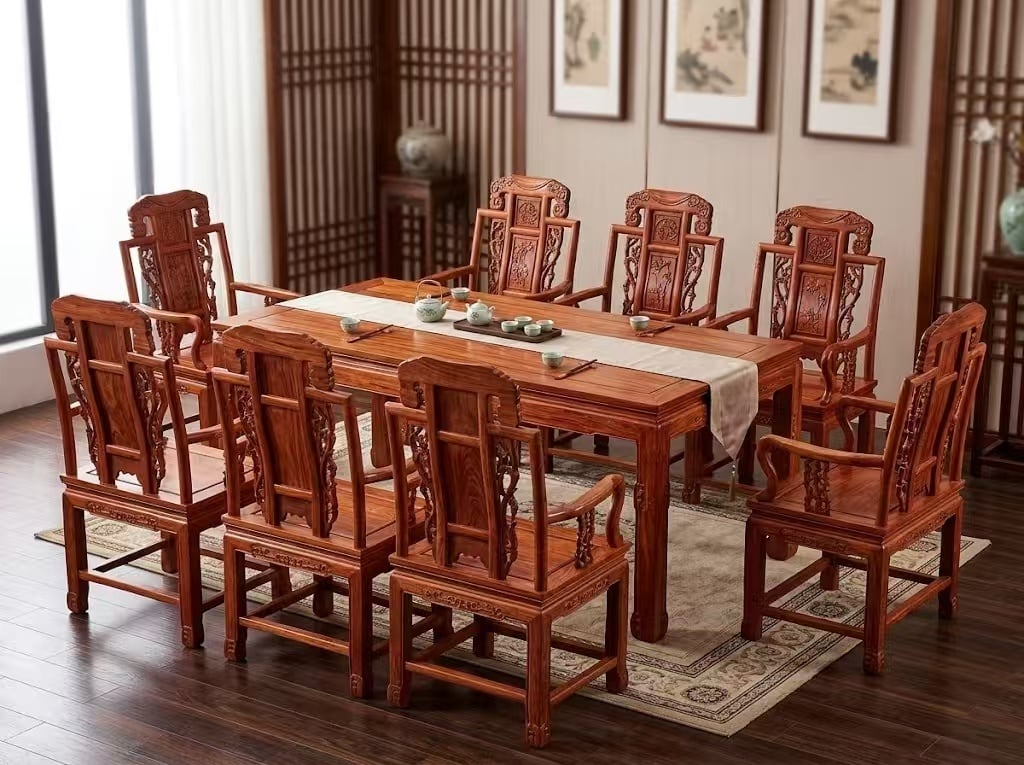
The Complete rosewood dining table 4 seater Sourcing Framework
Importing a full rosewood dining set from China is a decision chain, not a single purchase. Each set is a complete timber, joinery, finishing, compliance, and logistics system that must arrive intact, clear customs in the destination country, and hold up in the buyer's climate for decades. This framework walks through that chain in procurement order - from seat-count analysis and table geometry, through quality verification and CITES documentation, to container loading and landed cost - exactly as an experienced import manager would run it.
Yunxiao Rosewood Furniture Co., Ltd, founded in 2008 in Xianyou County, Fujian Province, manufactures solid Siamese rosewood dining sets from a 12,000-square-meter factory in one of China's oldest hardwood craft regions. Seven catalog models span 4-seat compact sets to 12-seat banqueting sets in round, rectangular, oval, and square table formats. Every set is assembled with mortise-and-tenon joinery and no primary-frame metal fasteners, built from 36-day kiln-dried timber below 14 percent moisture, and finished in hand-rubbed raw lacquer meeting EU REACH, US CARB, and FDA 21 CFR 175.300 for food-contact surfaces.
Use this page as a working checklist from first inquiry to container loading. Each section ends with the concrete deliverable you should request from the factory at that stage, so nothing is left to assumption.
What a Complete Set Actually Contains
Buyers new to classical Chinese dining furniture often underestimate its scope. A production-grade rosewood dining set is not a table with chairs pulled from a warehouse; it is a matched program in which every chair backrest motif, apron carving, and finish batch is executed to the same design intent, by the same carving team, in the same finishing cycle.
| Set Component | What It Includes | What to Verify |
|---|---|---|
| Table assembly | Solid top with floating panel, carved or plain apron, four legs with through-tenon joints | Panel gap allowance, joint flushness, top flatness under raking light |
| Chair program | Matching carved chairs or stools in counts from 4 to 12 | Motif consistency across chairs, seat height uniformity, joint tightness |
| Finish system | 8-9 coats hand-rubbed raw lacquer over 20-30 days, humidity-cured | Coat count records, FDA 21 CFR 175.300 food-contact compliance file |
| Documentation | CITES Appendix II export permit, FSC chain-of-custody, ISPM-15 crate certificate | Permit matches shipment contents exactly; request samples at quotation |
Because each set is a program rather than a product line, change requests after carving begins are costly. Finalize seat count, motif, and dimensions at drawing approval, not after production has started.
Seat-Count Analysis: Matching Sets to Your Market
The fastest way to match a catalog to a market is seat-count math. A 4-seat compact set serves apartment retail and small restaurants; a 6-seat oval or rectangular set is the workhorse of family dining retail; 8-seat round tables anchor mid-scale hospitality; 10- and 12-seat banqueting sets serve private dining rooms, clubs, and banquet halls.
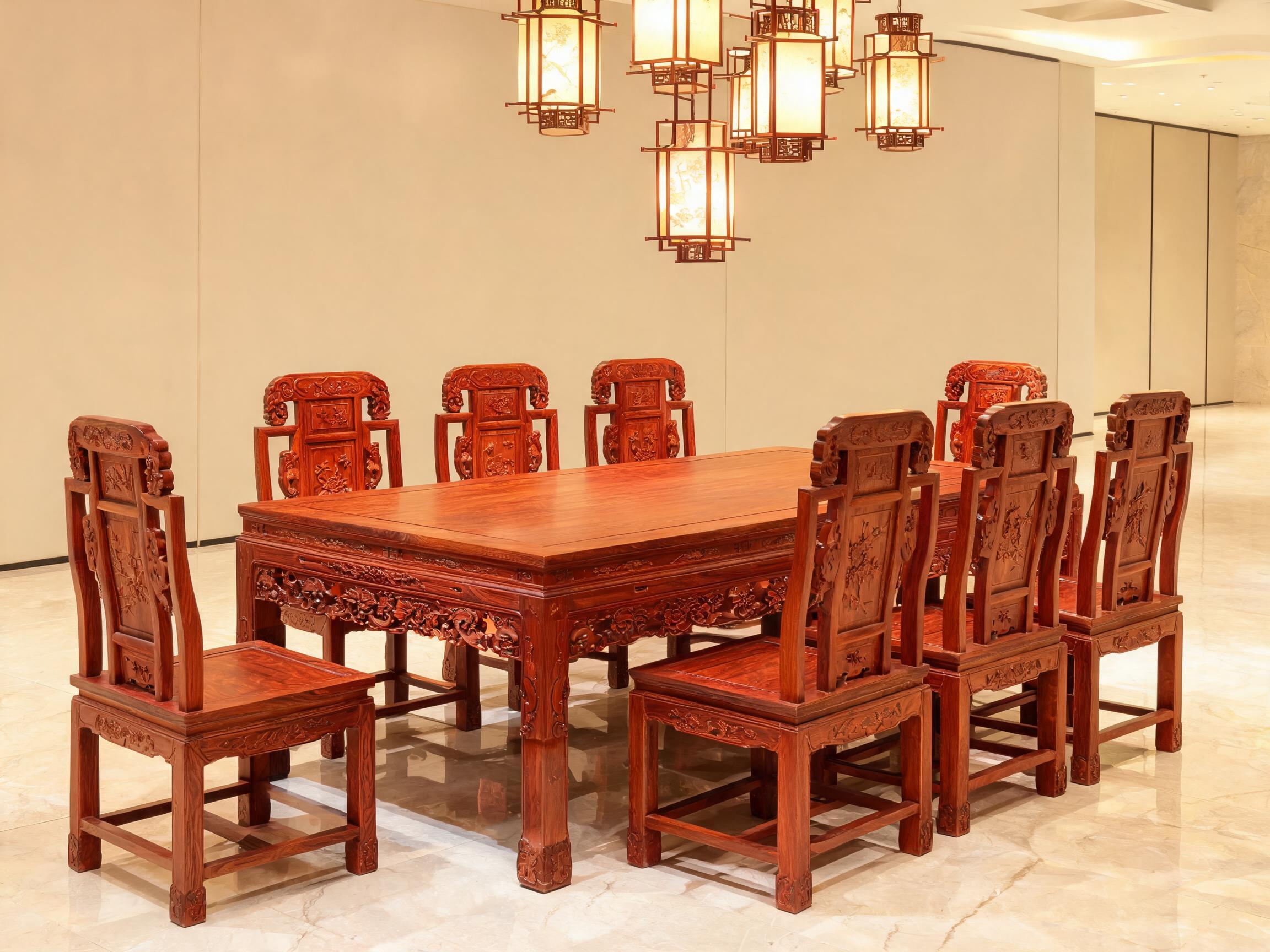
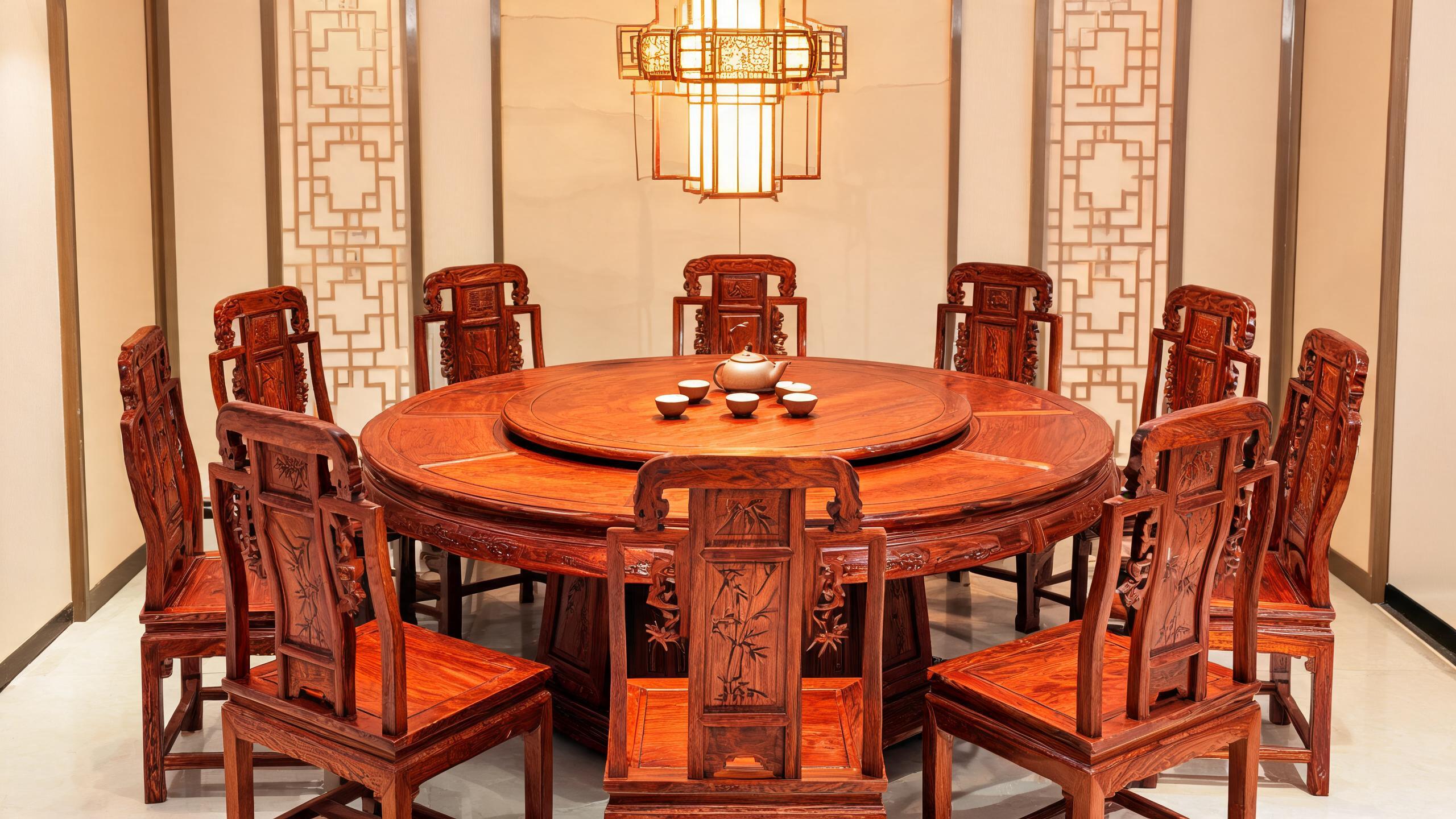
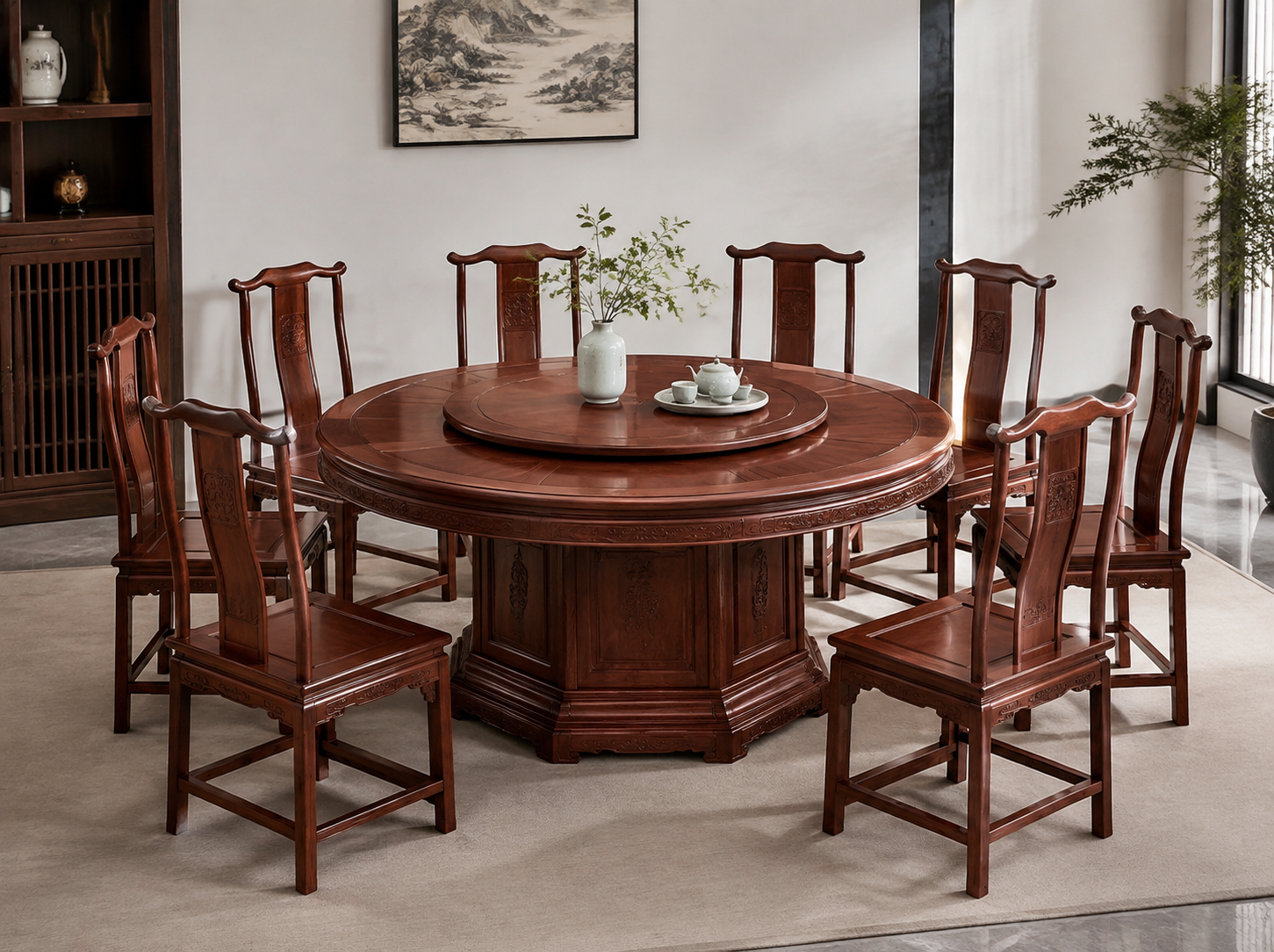
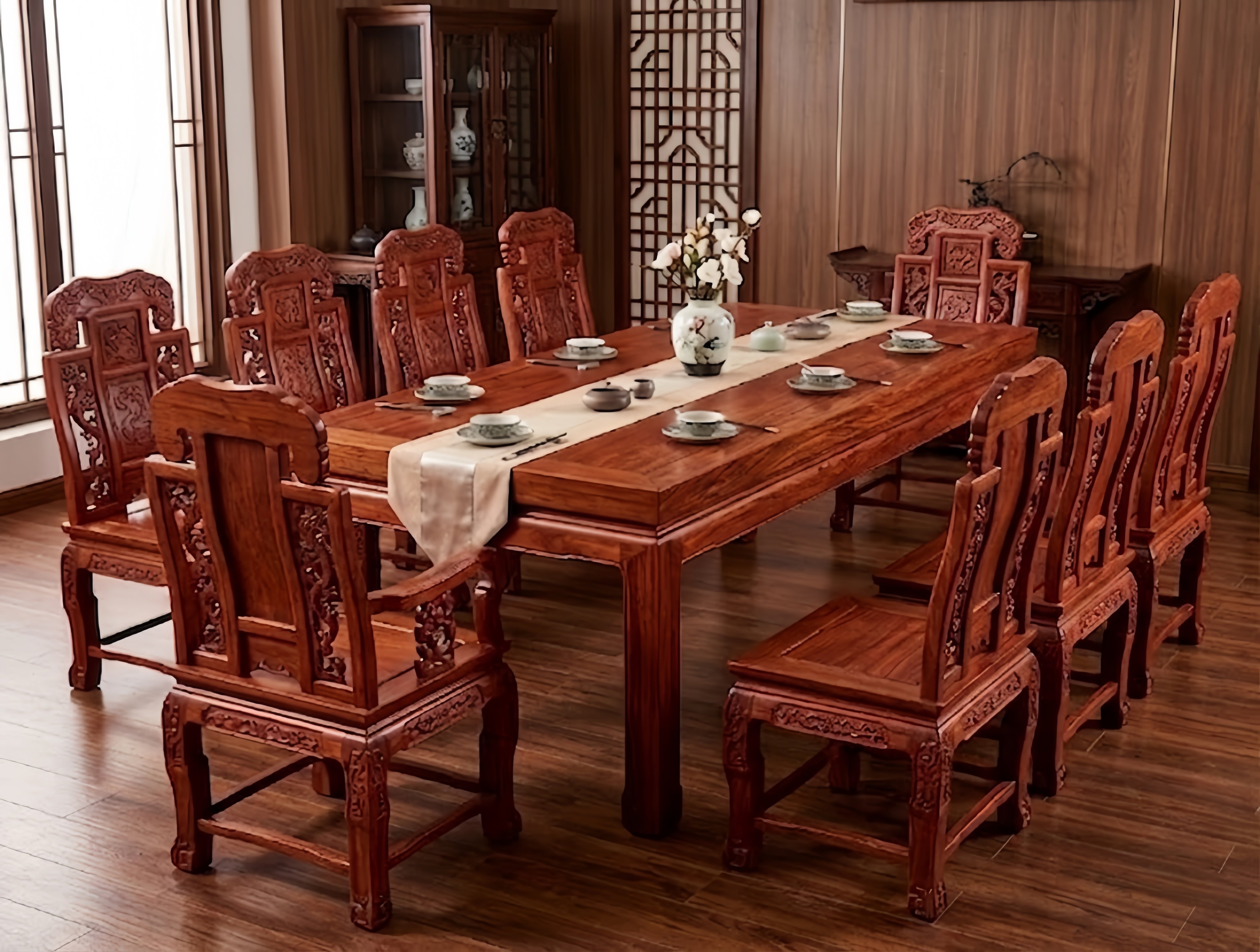
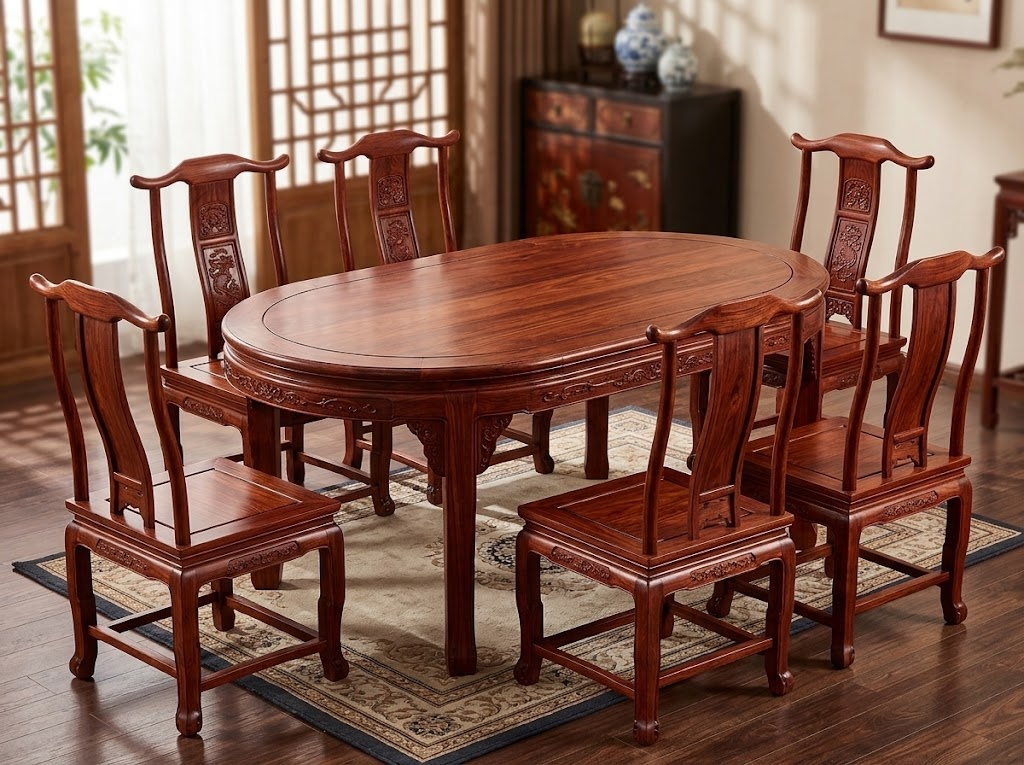
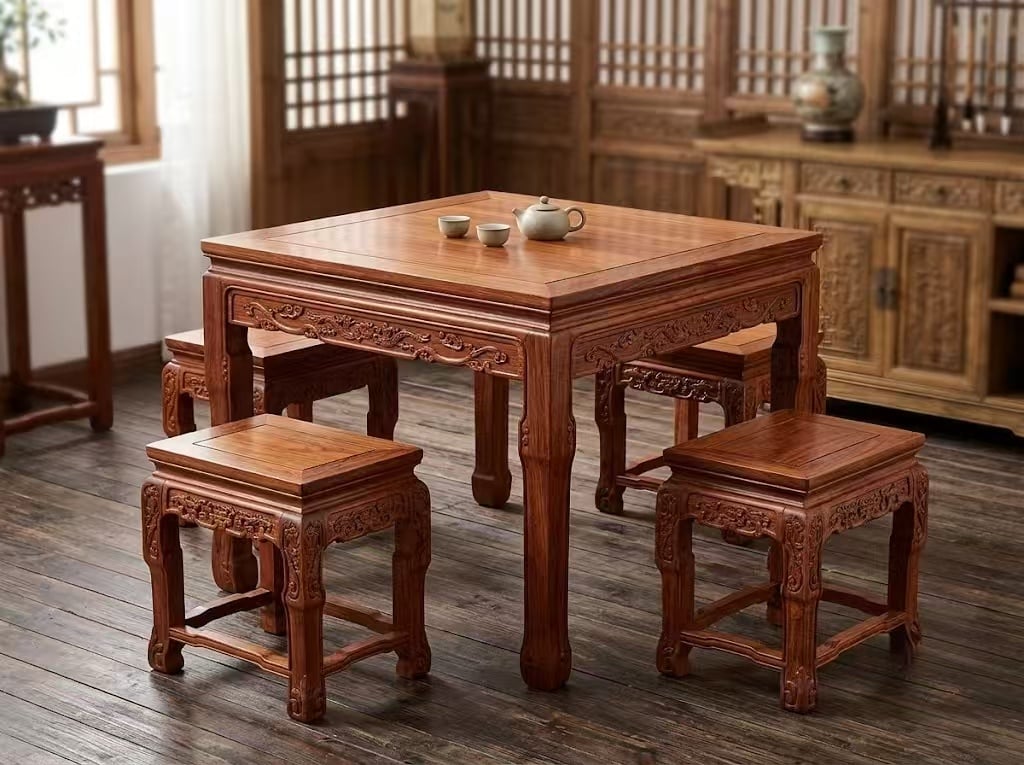
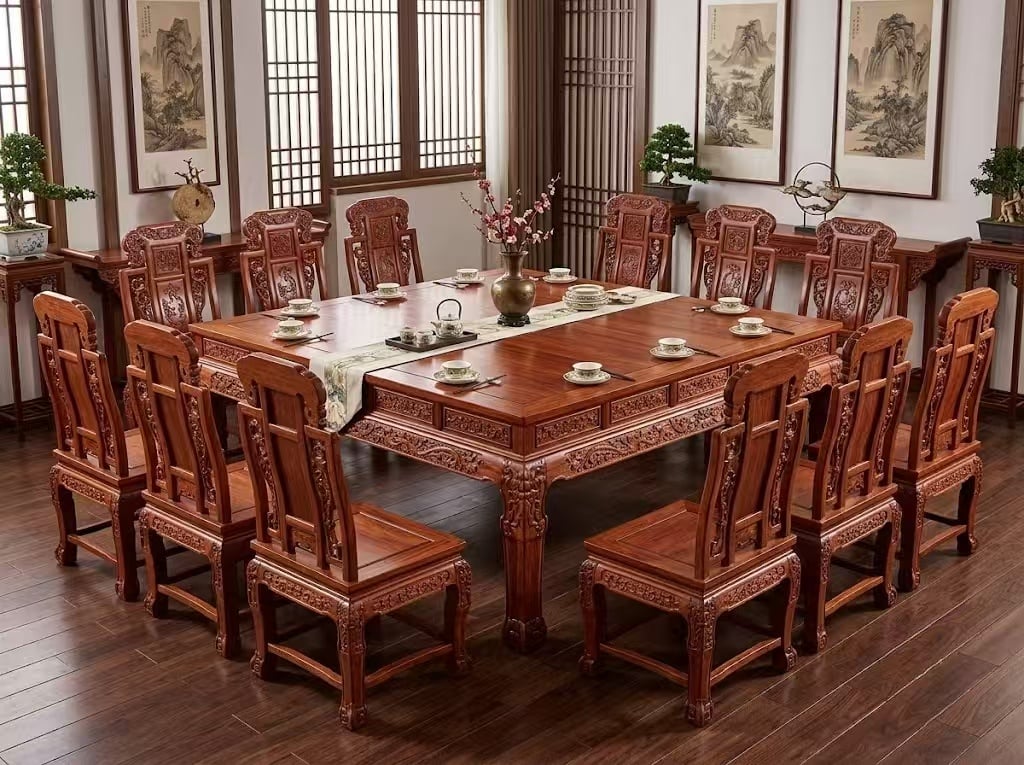
Yunxiao's catalog covers this full ladder natively: the Square Redwood Dining Table 4-Seat Compact Set with Carved Stools for space-constrained retail; the Oval 6-Seat Set with Ming Style Chairs and the Rectangular 8-Seat Set with Bamboo Carved Chairs for family dining programs; the Ming Style Round 8-Seat Set for hospitality; and the Square 12-Seat Banqueting Set with Carved Chairs for private dining and club installations.
For wholesale programs, ordering across the ladder lets one container serve multiple retail price points: compact sets for entry listings, mid-size sets for core volume, banqueting sets for flagship or project business. During quotation the factory provides a container loading plan that calculates how the mix loads into a 40-foot container holding 6 to 10 sets.
Table Geometry and Room Fit Calculations
Table shape determines circulation. As a planning rule, allow 90 to 100 centimeters of clearance around every table edge for chair pull-out and service. Round tables of 8 seats work best in rooms at least 4.5 by 4.5 meters; rectangular 10-seat tables assume rooms around 4 by 6 meters; 12-seat square banqueting tables are typically installed in dedicated private dining rooms with a full meter of perimeter circulation.
The catalog spans all four geometries, so buyers can standardize on one manufacturer across an entire project: oval tops soften strictly rectilinear rooms, rectangular tops maximize seating along a wall, round tops create banquet intimacy, and square tops carry grand formal dining. For hospitality fit-outs, mixing geometries by room type keeps a consistent material story while varying the spatial rhythm - round tables in the main room, rectangular tables in private areas.
Chair Ergonomics and Carving Consistency
Chairs determine whether a dining set succeeds in commercial use. Verify seat height uniformity across the set (typically 45 to 48 centimeters), backrest angle consistency, and armrest clearance under the table apron so chairs slide fully under when not in use. On carved aprons, that clearance is set at the drawing stage; it cannot be corrected after production.
Carving consistency is the visible quality signature. In three-step relief carving, each backrest panel receives 30 to 40 hours of hand work by a Xianyou master artisan. For multi-chair sets, the same carving team executes every instance of a motif so relief depth and line quality match across the set. Request close-up carving photos at the carving inspection checkpoint, and for container orders, carving samples on wood panels can be mailed before production begins.
Timber: Siamese Rosewood and Legal Alternatives
All catalog dining sets are offered in solid Siamese rosewood (Dalbergia cochinchinensis), CITES Appendix II listed, with heartwood ratio of 80 percent or higher selected for carving clarity and density sorted to 0.90-1.00 g/cm³ for consistent structural response. Heartwood ratio matters for color consistency; density sorting matters for how uniformly the set responds to humidity changes in destination climates.
Buyers who need to avoid CITES documentation can specify legally certified Machilus Nanmu or Grade-A aged redwood; both still receive the 36-day kiln drying and mortise-and-tenon construction, and both carry FSC chain-of-custody documentation. Material choice affects price, lead time, and the export file, so specify it at first inquiry rather than mid-order.
The 36-Day Kiln Drying Protocol in Detail
Moisture content is the single most critical factor in solid wood furniture durability, and it deserves its own section in any sourcing decision. Furniture built in humid subtropical Fujian and shipped to dry North American or European interiors, or to air-conditioned tropical hotels, faces humidity differentials that crack inadequately dried wood within months.
Yunxiao's 36-day constant-humidity kiln drying runs three phases. The initial high-temperature phase removes free moisture from the cell lumens - rushing this phase causes surface checking, so temperature ramps are controlled against moisture readings. The intermediate equalization phase lets the moisture gradient balance across the timber cross-section, so the outside and inside of each board reach equilibrium instead of fighting each other. The final conditioning phase relieves drying stresses that would otherwise cause warping after machining.
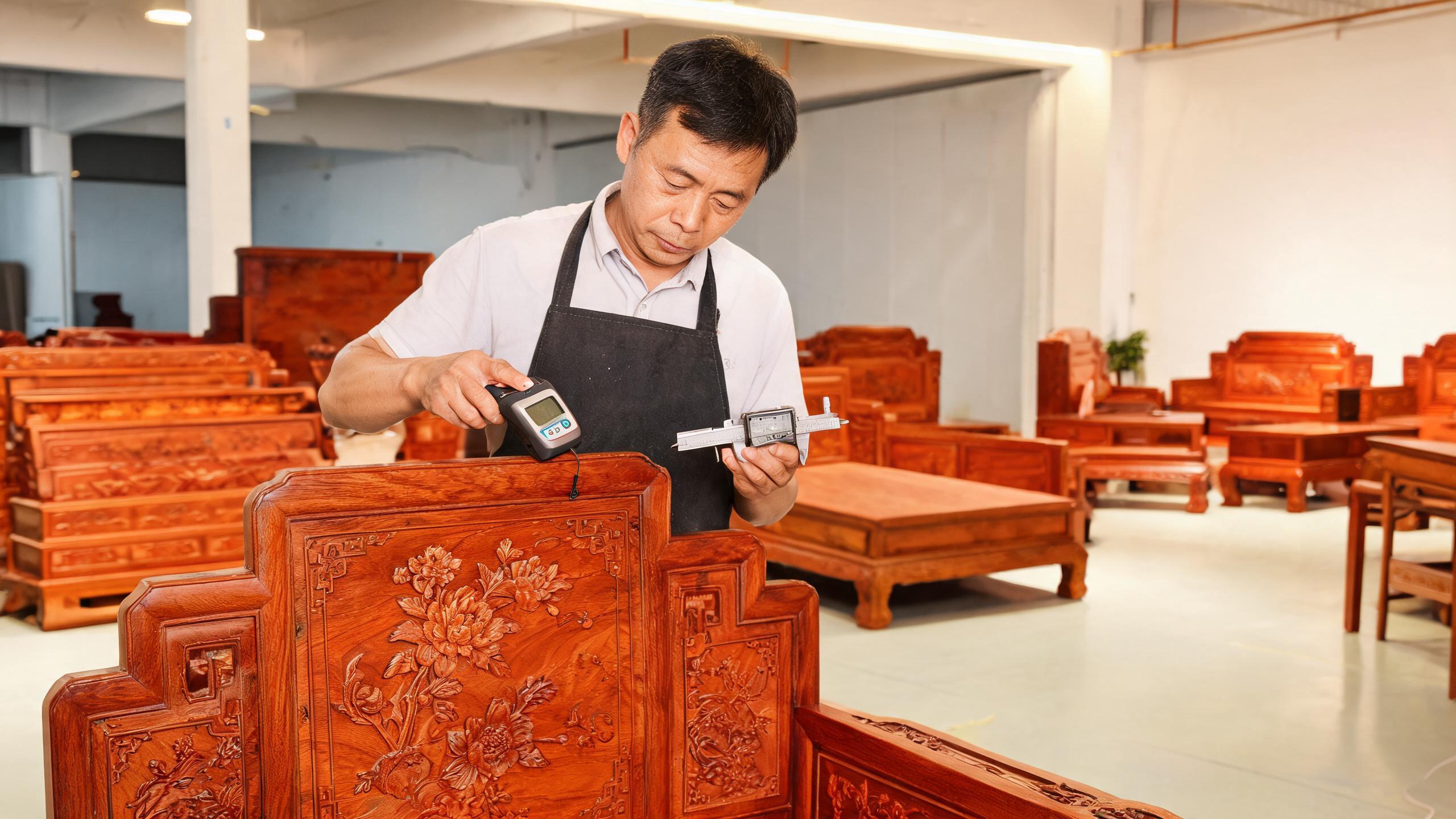
The target is below 14 percent moisture content, verified by documented readings that buyers can request as part of the pre-shipment file. The cycle is embedded in the 45 to 60 working day production timeline and cannot be accelerated without compromising structural integrity - any factory promising dramatically faster drying on thick rosewood sections is cutting a corner that will show up as cracks in the buyer's climate, not in the factory's showroom.
Joinery: The Structural Grammar Behind Longevity
Mortise-and-tenon joinery is both a structural system and an authentication marker in classical furniture. The primary leg-to-apron joint is a through-tenon with wedge: the tenon passes completely through the apron and is split at its tip; a bamboo wedge is driven into the split, expanding the tenon inside the mortise so it cannot pull apart under tension and actually tightens with load.
Supporting joints follow the same grammar: half-lap mortise-and-tenon joints on stretchers prevent racking; dovetail joints in drawers resist pull-out; bamboo dowel pins secure tenons because bamboo's moisture expansion matches rosewood's, preventing the differential movement that loosens metal-fastened joints. Floating-panel construction on tabletops, wardrobe doors, and bed panels lets wood move seasonally without cracking - the small gap between panel edge and groove wall is intentional engineering, not a defect.
The verification point for buyers: metal screws in primary structural joints are a red flag. If a third-party inspection report shows metal fasteners in primary frames, the piece is not built to traditional standard regardless of how classical it looks.
Quality Verification and the CITES Permit Workflow
Yunxiao's quality control covers four documented checkpoints. Timber verification: moisture readings from the 36-day kiln cycle, heartwood ratio verification, density sorting confirmation. Carving inspection: accuracy against approved drawings, relief depth consistency, surface quality before assembly. Assembly verification: joinery tightness, dimensional accuracy, structural integrity. Finish assessment: lacquer coverage, color consistency against the approved sample, sheen under controlled lighting.
Third-party pre-shipment inspection is welcomed at buyer expense, with full access to production records and kiln drying logs. Time inspection after finish assessment and before ISPM-15 crating - once furniture is crated, remediation becomes expensive for everyone.
Because Siamese rosewood is CITES Appendix II listed, every international shipment requires its own export permit. The permit is shipment-specific and non-transferable: it names the actual contents of that container, so it cannot be issued until quantities and dimensions are final. Processing takes 5 to 10 working days once contents are finalized. Sequence it correctly: finalize quantities, trigger the permit application, then book vessel space. Booking a vessel before the permit is issued risks demurrage if the permit is delayed. The internal export team prepares the permit, the FSC chain-of-custody certificate, the ISPM-15 heat treatment certificate, REACH and CARB compliance declarations, the commercial invoice with HS code 9403.60, and the packing list - all in English.
Container Loading and Mixed-Set Planning
A 40-foot container holds 6 to 10 furniture sets depending on the mix. Banqueting tables with 12 chairs consume far more crate volume than 4-seat compact sets; chair volume dominates the math more than table volume. Plan the mix against your sales forecast: compact sets sell at accessible price points with faster turns; banqueting sets carry higher margins but slower turns and need project buyers.
Request the container loading plan at quotation - it calculates total crate volume and recommends the optimal mix. Loading is supervised at the factory warehouse in Xianyou, with loading photos issued to the buyer before departure so the baseline condition is documented from day one.
Risk Register: Where Rosewood Dining Imports Fail
After enough container cycles, the failure modes repeat. This register lists the ones that cost buyers the most, with the specific control that prevents each.
| Failure Mode | Root Cause | Preventive Control |
|---|---|---|
| Shipment held at port | CITES permit delayed or mismatched to contents | Finalize quantities before permit application; use a broker familiar with Appendix II timber |
| Cracking after one heating season | Shortcut kiln drying above 14 percent moisture | Require documented moisture readings in the pre-shipment file |
| Motif drift across chairs | Multiple carving teams on one order | Single-team carving per order; relief-depth check at carving inspection |
| Finish tone mismatch | Separate finishing batches | One continuous finishing batch per set, checked against approved sample |
| Carved panel damage in transit | Inadequate crate bracing | Foam-braced crates, backrests isolated, loading photos before departure |
| Demurrage from late documents | Paperwork chased after sailing | Full document set issued before vessel departure, all in English |
None of these controls is exotic - each is a request you make at quotation and verify before deposit. The register exists because buyers who skip one of them usually meet it again as a claim.
Sampling Strategy and Aftercare Guidance
Between first contact and first container there should be a verification step. Yunxiao supports three tiers. Trial single sets: a full set produced to catalog specification, letting you inspect joinery, carving depth, finish color, and dimensional accuracy in your own warehouse before ordering volume. Refundable sample sets: for qualified partners evaluating new designs, converting evaluation cost into a credit against the following order. Finish and carving samples on wood blocks: mailed during design approval, verifying color and relief depth under your own lighting - the single most useful pre-production artifact because photographs shift color and hide texture.
Plan the sample order two to three months before your target container booking: sample production uses the same 45 to 60 working day line, and the evaluation window - including showing samples to your retail customers - deserves real time. Buyers who compress the sampling step are the ones who discover motif or finish objections at container volume.
A rosewood dining set that clears customs correctly still needs honest care guidance in the retail listing. Three rules cover most risks: keep the room humidity stable - solid wood tolerates dry or humid but punishes rapid swings, so advise against placing sets directly over radiators or against air-conditioning outlets; use the surface for dining, not for hot cookware - trivets under pots protect the lacquer; and dust with a dry or barely damp cloth rather than solvent cleaners, which attack the cured film. The patina question deserves pre-emption too: the finish deepens over the first two to three years as natural oils migrate through the breathable lacquer. Retail customers who expect factory-fresh gloss forever read that as a defect; customers told in advance read it as evidence of authenticity. One paragraph of aftercare text in the listing prevents a season of returns conversations.
Import Duty, Landed Cost, and the Full Timeline
Landed cost is more than the FOB price. For US-bound shipments, classify under HS 9403.60 and confirm the duty rate with your customs broker; note that Section 301 tariffs on China-origin goods may apply depending on trade policy in force at booking - verify rather than assume. For EU imports, VAT applies at importation, and EUDR due-diligence obligations require legality evidence that the FSC chain-of-custody supports.
Build the landed-cost model at quotation stage: FOB price plus ocean freight, insurance, duty, and destination charges. A set that looks inexpensive FOB Xiamen can arrive expensive if duty and destination handling are misjudged. Ocean transit runs 14 to 30 days from Xiamen to major ports in North America, Europe, Australia, and Southeast Asia.
A realistic import calendar: quotation and specification worksheet within 48 hours; design approval for custom orders 15 working days with 3D mockups; production 45 to 60 working days standard or 60 to 75 custom; CITES permit processing concurrent at 5 to 10 working days; ocean transit 14 to 30 days. Payment terms are 30 percent T/T deposit to initiate production with balance before shipment; L/C is accepted above USD 30,000. Trial single sets are available for new buyers, and refundable sample sets for qualified partners - two mechanisms that let you verify quality before committing to container volume. Weekly production photos keep the order visible throughout, and finished furniture can be held in climate-controlled storage for up to six months pending delivery instructions.
Frequently Asked Questions
What does a complete rosewood dining set include?
A table assembly with floating-panel top and through-tenon legs, a matching chair program from 4 to 12 chairs executed by one carving team, the 8-9 coat raw lacquer finish system, and the full export documentation file. Each set is a matched program, not separate catalog pieces.
How many seats should my first order cover?
Match the seat ladder to your channel: 4-seat for apartment retail, 6-seat for family dining retail, 8-seat round for hospitality, 10-12 seat for private dining and clubs. Wholesale programs often order across the ladder so one container serves multiple price points.
Is Siamese rosewood legal to import?
Yes, with an Appendix II permit. Trade is regulated, not prohibited. Yunxiao is a CITES-registered exporter and prepares a shipment-specific permit for every order; permits are non-transferable between shipments.
How do I verify carving quality before shipping?
Request close-up carving photos at the carving inspection checkpoint, and for container orders, carving samples on wood panels mailed before production. Third-party pre-shipment inspection is welcomed at buyer expense, timed before crating.
What finish compliance applies to dining tables?
The raw lacquer system meets EU REACH, US CARB formaldehyde limits, and FDA 21 CFR 175.300 for repeated food contact on dining surfaces. A compliance file accompanies each shipment.
Can table dimensions be customized?
Yes. OEM and ODM customization covers table dimensions, chair counts, carving motifs, and finish colors within a 15-working-day design approval cycle with 3D mockups and one revision round.
What is the production lead time?
45 to 60 working days from deposit for standard catalog sets, 60 to 75 for custom orders. The 36-day kiln drying cycle is embedded in this timeline and cannot be accelerated. CITES permit processing runs concurrently at 5-10 working days.
How do the sets handle different climates?
36-day kiln drying below 14 percent moisture, floating-panel construction that allows seasonal movement, and breathable raw lacquer prevent cracking and warping in dry North American and European interiors or humid tropical climates.
What documents come with each shipment?
CITES Appendix II export permit, FSC chain-of-custody certificate, ISPM-15 heat treatment certificate, REACH and CARB compliance declarations, FDA 21 CFR 175.300 compliance, commercial invoice with HS code 9403.60, and packing list - all in English.
What are typical payment terms?
30 percent T/T deposit initiates production, balance before shipment; L/C accepted above USD 30,000. Trial single sets are available for new buyers, and refundable samples for qualified partners.
How should I sequence sampling and the first container?
Order a trial set or refundable sample two to three months before the target container booking, evaluate it in your own market, then release the container order - the sample uses the same production line, so it predicts the volume honestly.
What aftercare guidance should my listings include?
Stable room humidity, trivets under hot cookware, dry or barely damp dusting, and a plain-language note that the lacquer deepens into patina over two to three years - setting that expectation prevents returns and reinforces authenticity.