What rose wood sofa set price Means in Modern Wholesale Sourcing
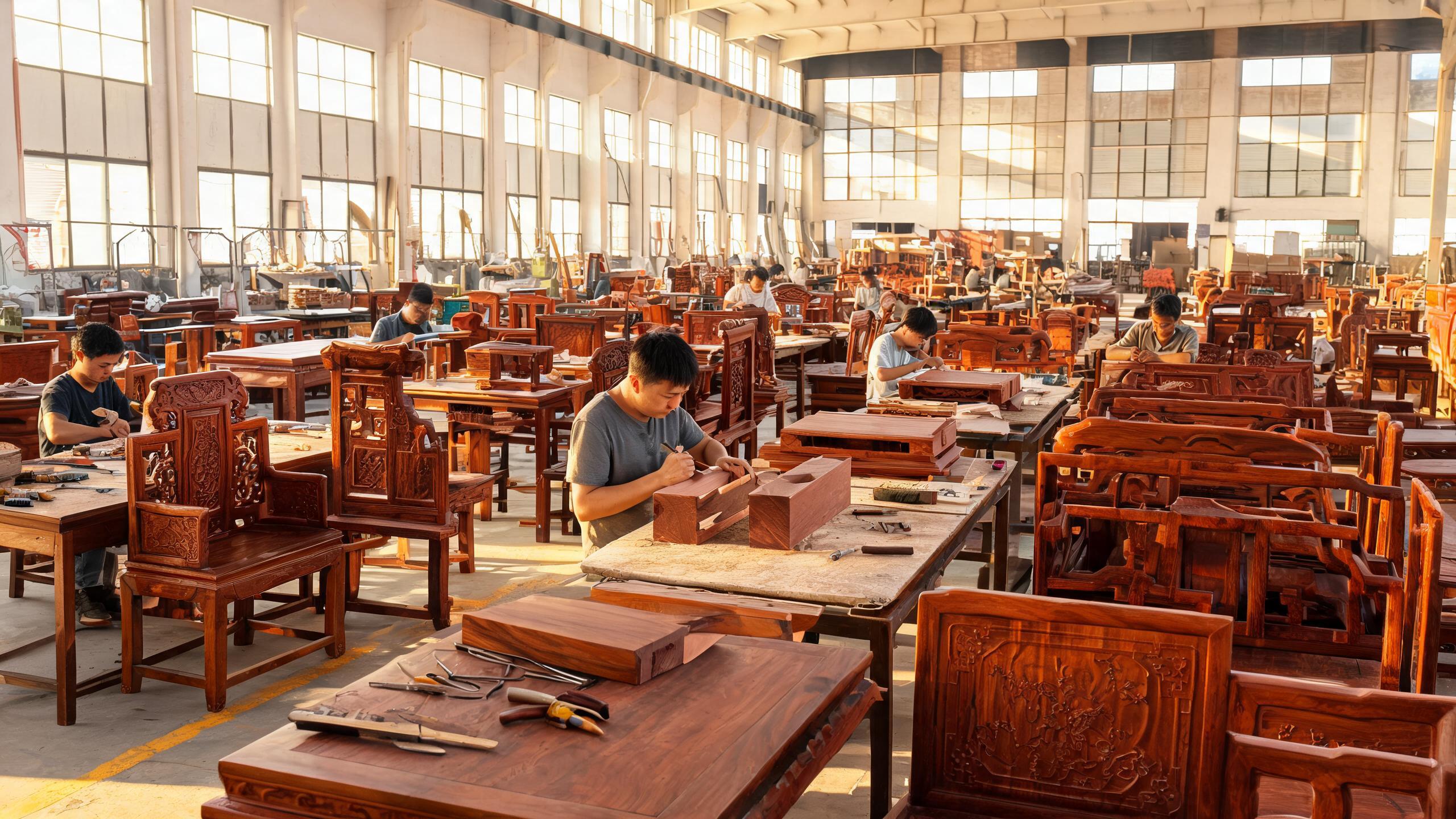
Asian rosewood furniture has moved far beyond the antique shop. Today the category covers newly manufactured, hand-carved hardwood furniture produced for wholesalers, hospitality groups, and interior design firms that want classical Asian craftsmanship at container scale. Yunxiao Rosewood Furniture Co., Ltd has been part of this shift since 2008, producing classical solid rosewood sofa sets, dining sets, and bedroom suites from a 12,000-square-meter factory in Xianyou County, Fujian Province, the traditional hometown of Chinese hardwood craft.
For a B2B buyer, the category raises practical questions that this guide answers directly: which styles exist and who buys them, which wood species are involved and how they are graded, how carving quality is judged, what export compliance each destination market demands, and how a first container order is actually assembled. Every fact below comes from Yunxiao's real production and export practice serving buyers across Southeast Asia, Australia, North America, and Europe.
Style Genealogy: Ming, Qing, and Contemporary Classical Lines
Classical Asian rosewood furniture divides into recognizable style families, and each attracts a different buyer. Understanding the vocabulary helps buyers specify precisely and price fairly, because style family determines carving density, timber volume, and the retail story a set can carry.
| Style Line | Visual Signature | Typical B2B Buyer |
|---|---|---|
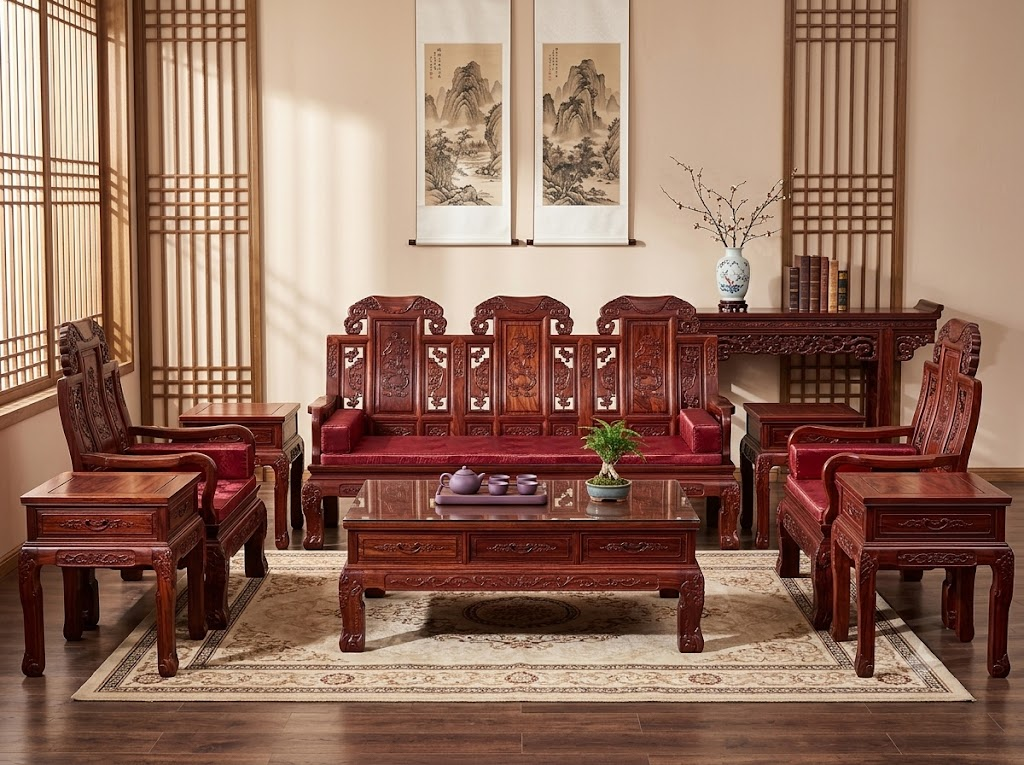
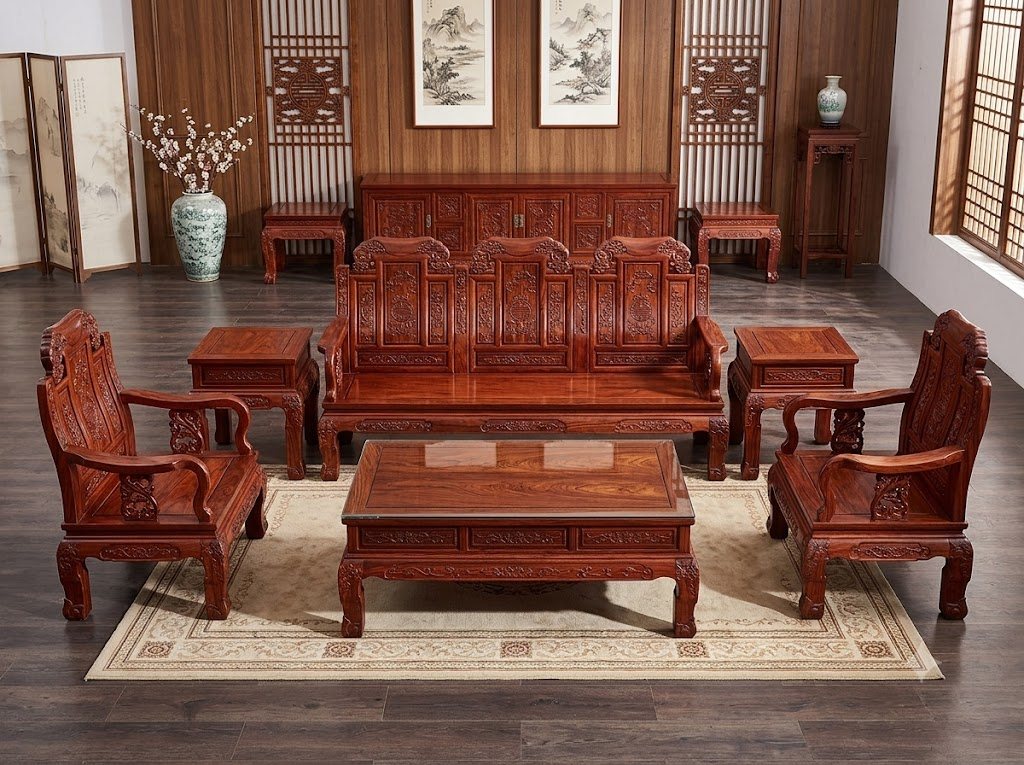
| Ming style | Clean lines, rounded members, restrained carving, lattice panels | Design-led retailers, boutique hotels, contemporary programs |
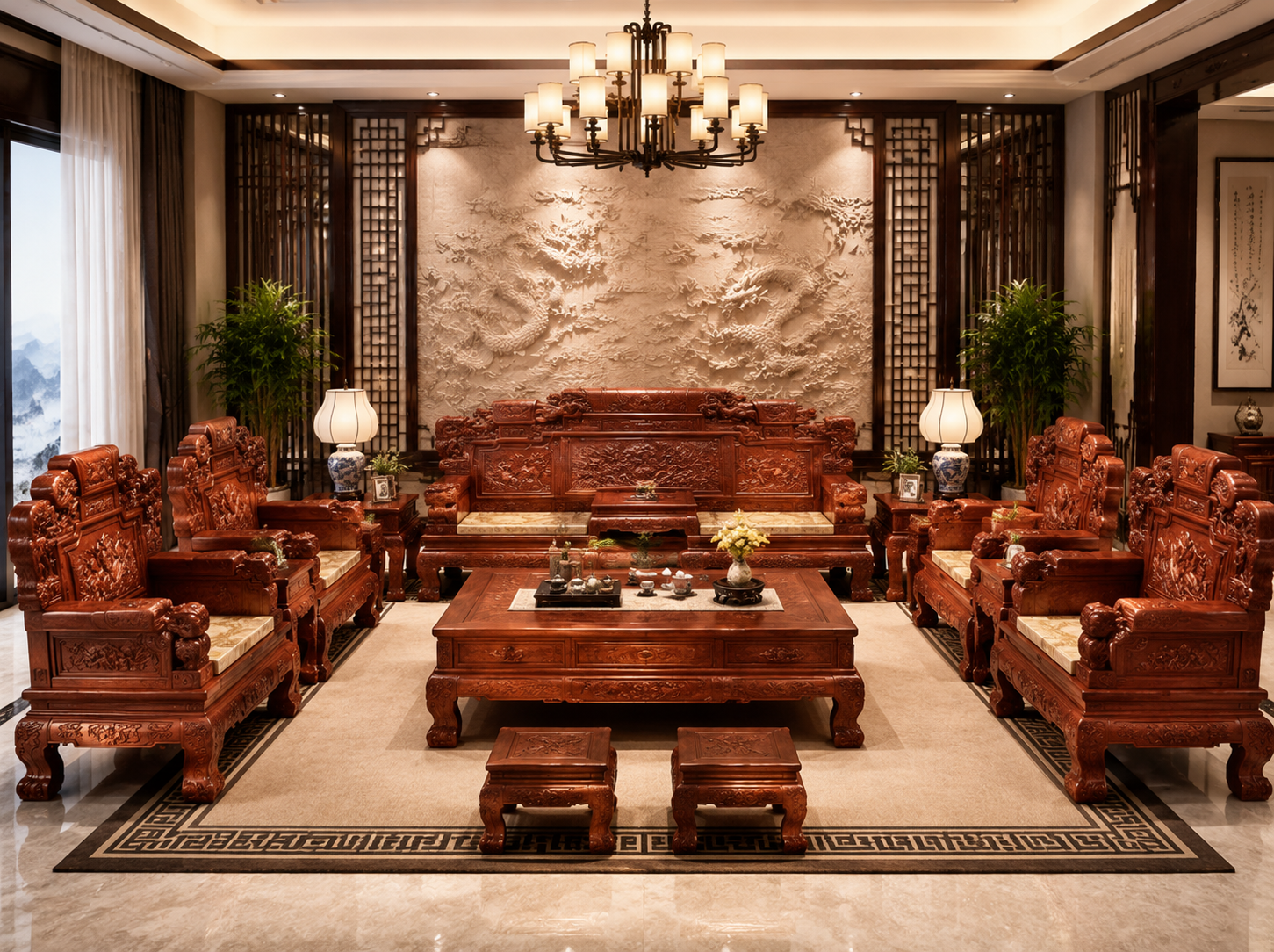
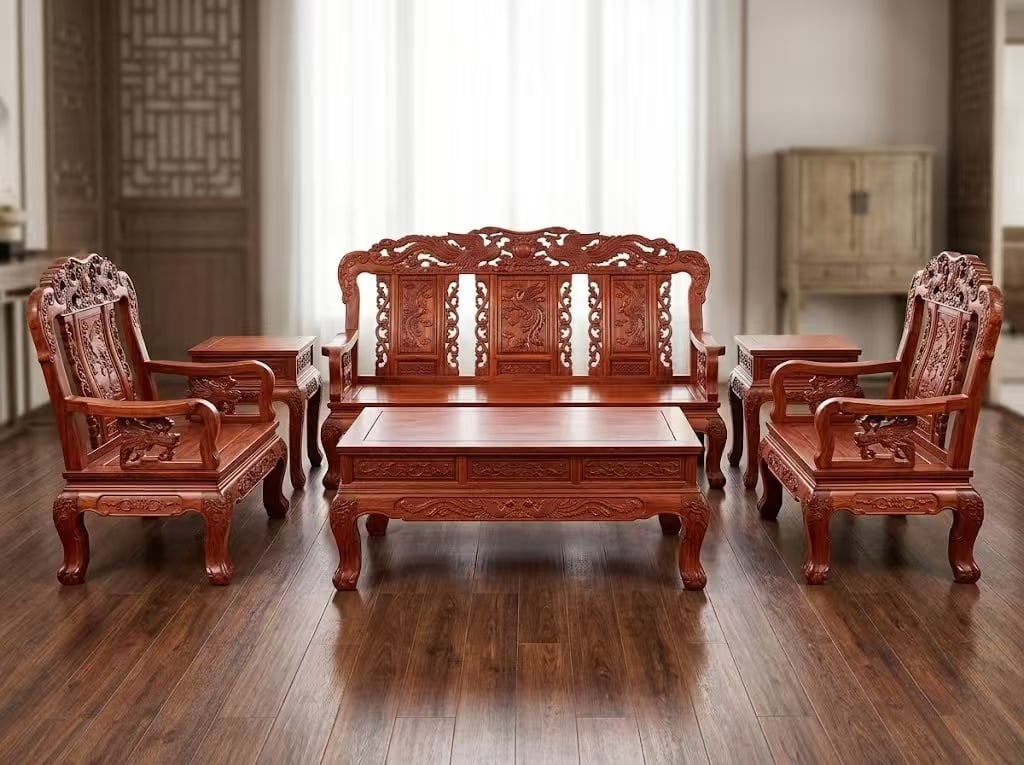
| Qing court style | Heavier proportions, dense relief carving, dragon and phoenix motifs | Banquet venues, reception halls, luxury projects |
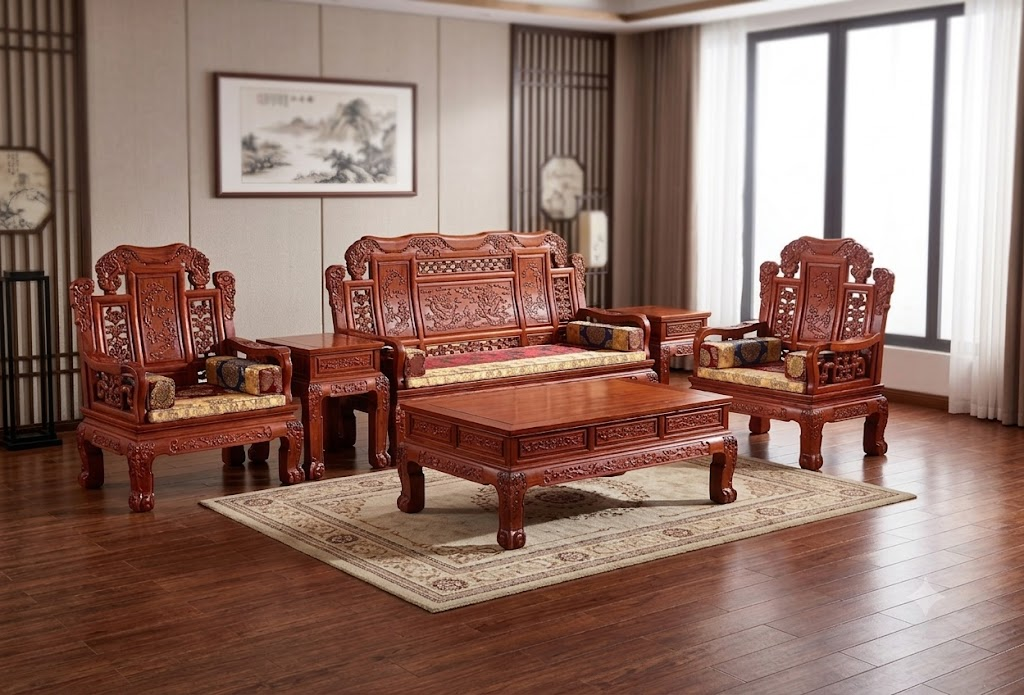
| Contemporary classical | Classical joinery with simplified motifs and modern dimensions | North American and Australian wholesalers mixing eras |
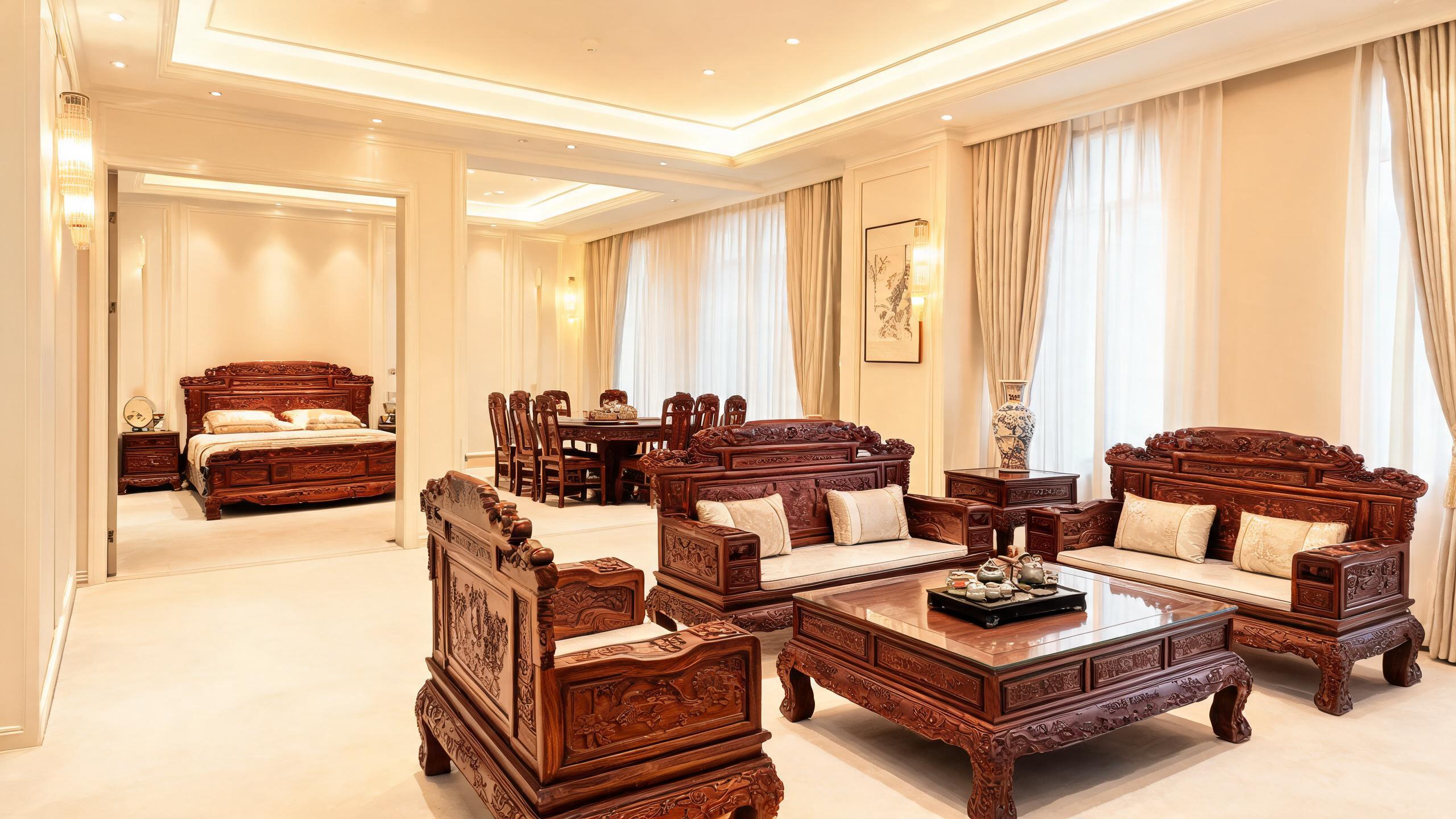
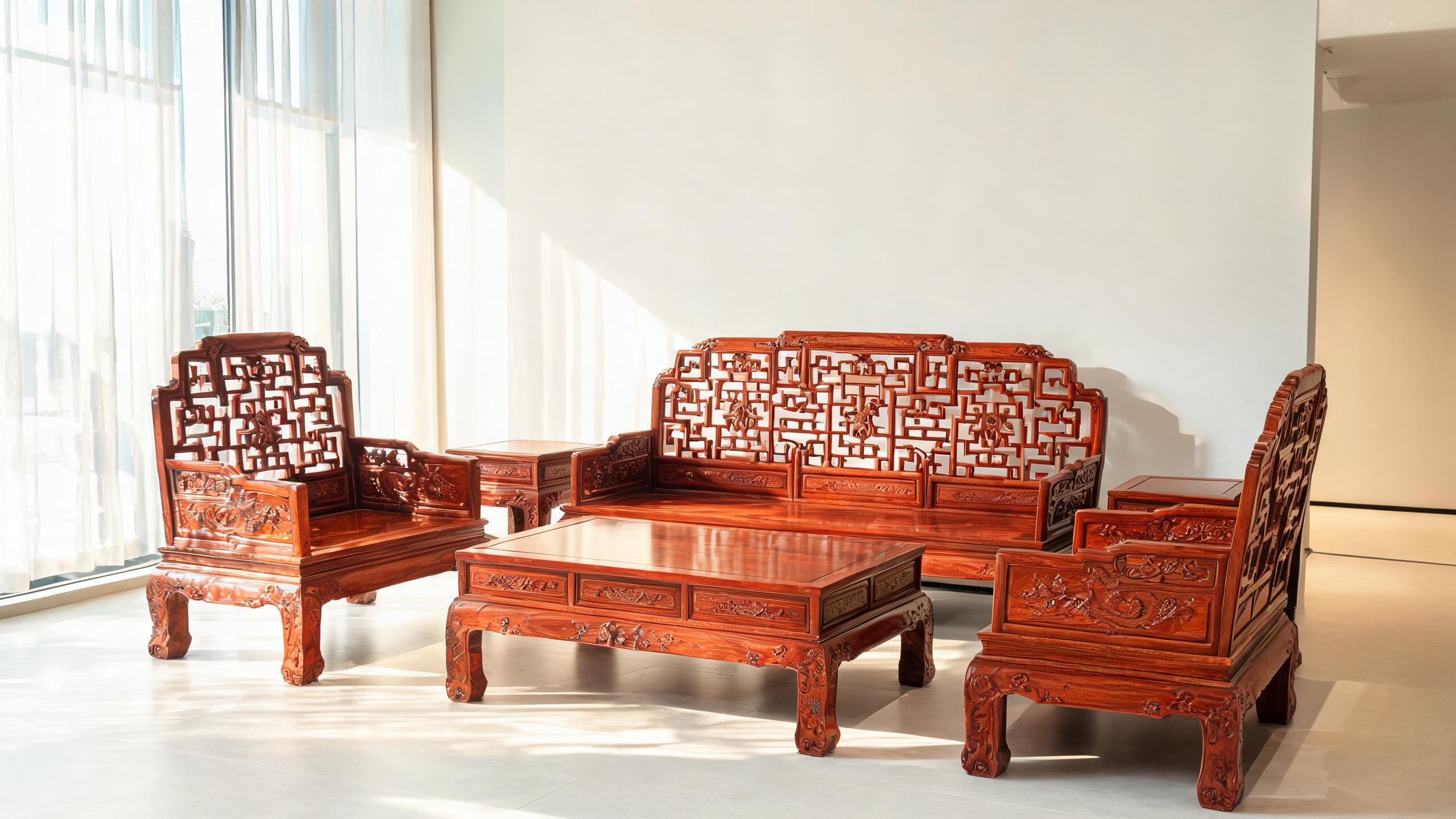
Yunxiao's catalog spans all three lines, from the Ming Style Siamese Rosewood Living Room Sofa 7-Piece Set to the Imperial Dragon Carved Redwood Sofa 10-Seat Set in full Qing court idiom, so a wholesale program can source a coherent family of pieces from one factory without mixing joinery or finish standards.
The Wood Behind the Category: Dalbergia Cochinchinensis and Alternatives
The heart of authentic Asian rosewood furniture is Siamese rosewood, Dalbergia cochinchinensis, a dense tropical hardwood listed on CITES Appendix II. Its deep reddish-brown heartwood holds carving detail exceptionally well and carries natural insect and decay resistance. Yunxiao grades each timber allocation to a heartwood ratio of 80 percent or higher and sorts density into 0.90 to 1.00 g/cm3 bands so every piece in a set responds to humidity the same way.
Buyers who want to avoid CITES documentation for certain markets can specify Machilus Nanmu, a legally certified alternative with lighter color and finer grain, or Grade-A aged redwood sourced with FSC chain-of-custody documentation. All three species receive the same 36-day constant-humidity kiln drying and mortise-and-tenon construction, so the choice is commercial and aesthetic rather than structural. Species selection affects price, lead time, and paperwork, and it should be fixed at quotation, not discovered at customs.
How Genuine Rosewood Is Graded Before It Reaches the Workshop
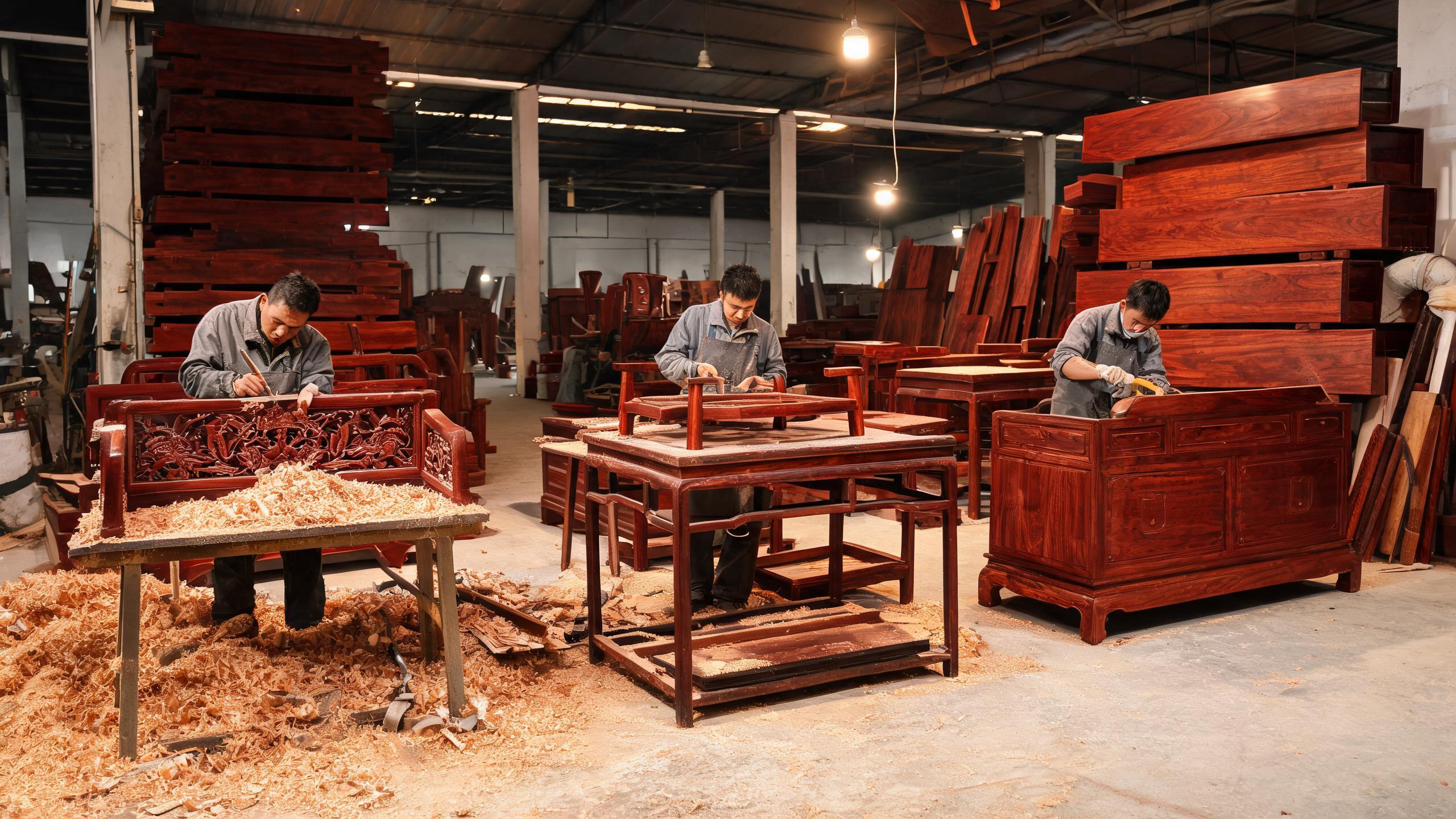
Grading decisions made at the timber yard determine everything downstream: carving clarity, color consistency across a set, and long-term stability. Yunxiao's intake process checks three variables on every allocation. First, heartwood ratio: sapwood is rejected for visible surfaces, and only timber reaching the 80 percent heartwood threshold enters carving stock. Second, density banding: timber is sorted into 0.90 to 1.00 g/cm3 bands so that every component in a set shares the same structural response. Third, moisture verification: incoming timber enters the 36-day kiln program targeting below 14 percent moisture before any cutting begins.
For buyers, the practical implication is batch matching. A ten-seat sofa set carved from a single density-matched allocation keeps grain tone and movement behavior consistent across all ten pieces, which is why Yunxiao allocates one timber batch per set rather than mixing stock. When comparing suppliers, ask how timber is graded and whether one set comes from one allocation; vague answers usually mean mixed stock and uneven aging.
Carving Motifs and What They Signal to End Customers
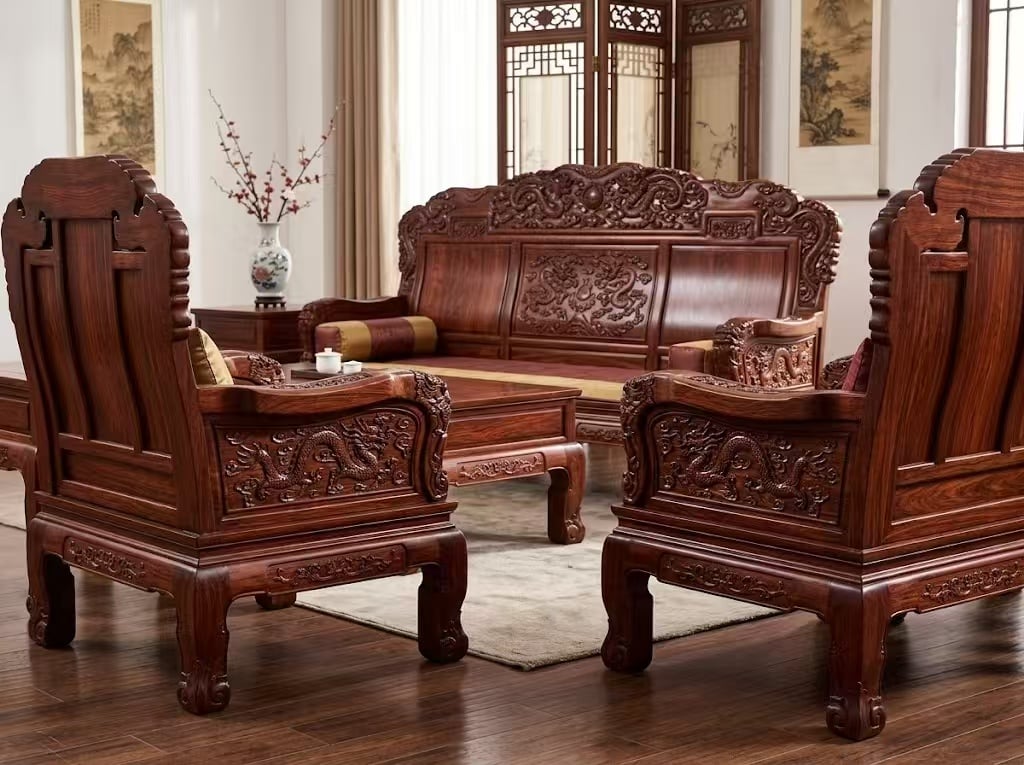
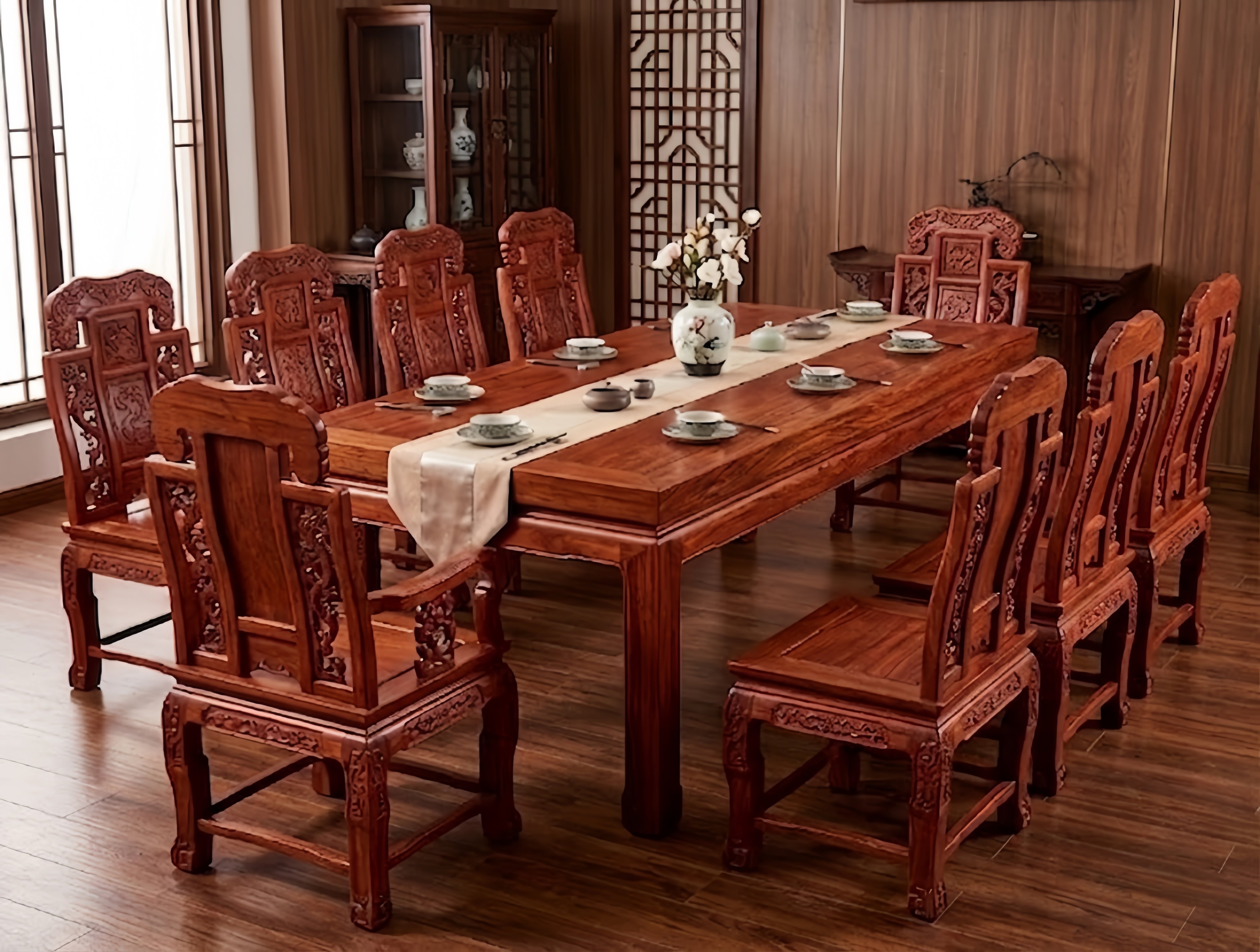
Carving is the visual signature retail customers respond to, and each motif carries meaning that matters in merchandising. The five-claw dragon signals authority and celebration, which is why it anchors the armrests of the Imperial Dragon 10-seat set. The phoenix pairs with auspicious renewal and defines the Auspicious Phoenix 6-piece reception set. Cloud scrolls suggest fortune rising, lattice panels read as scholarly refinement, the ruyi head promises wish-fulfillment on backrests, and bamboo frames integrity on carved dining chairs.
Carving labor is real labor: a single five-claw dragon armrest consumes approximately 40 hours of master-artisan work. Buyers specifying dense relief across large surfaces should budget production time accordingly, and Yunxiao quotes carving hours transparently during specification so the trade-off between motif density and lead time stays visible. Mixing a heavily carved hero piece with restrained secondary seating is a common way to hold the visual identity while controlling total labor cost.
Set Configurations: From 3-Piece Living Rooms to 10-Seat Grand Suites
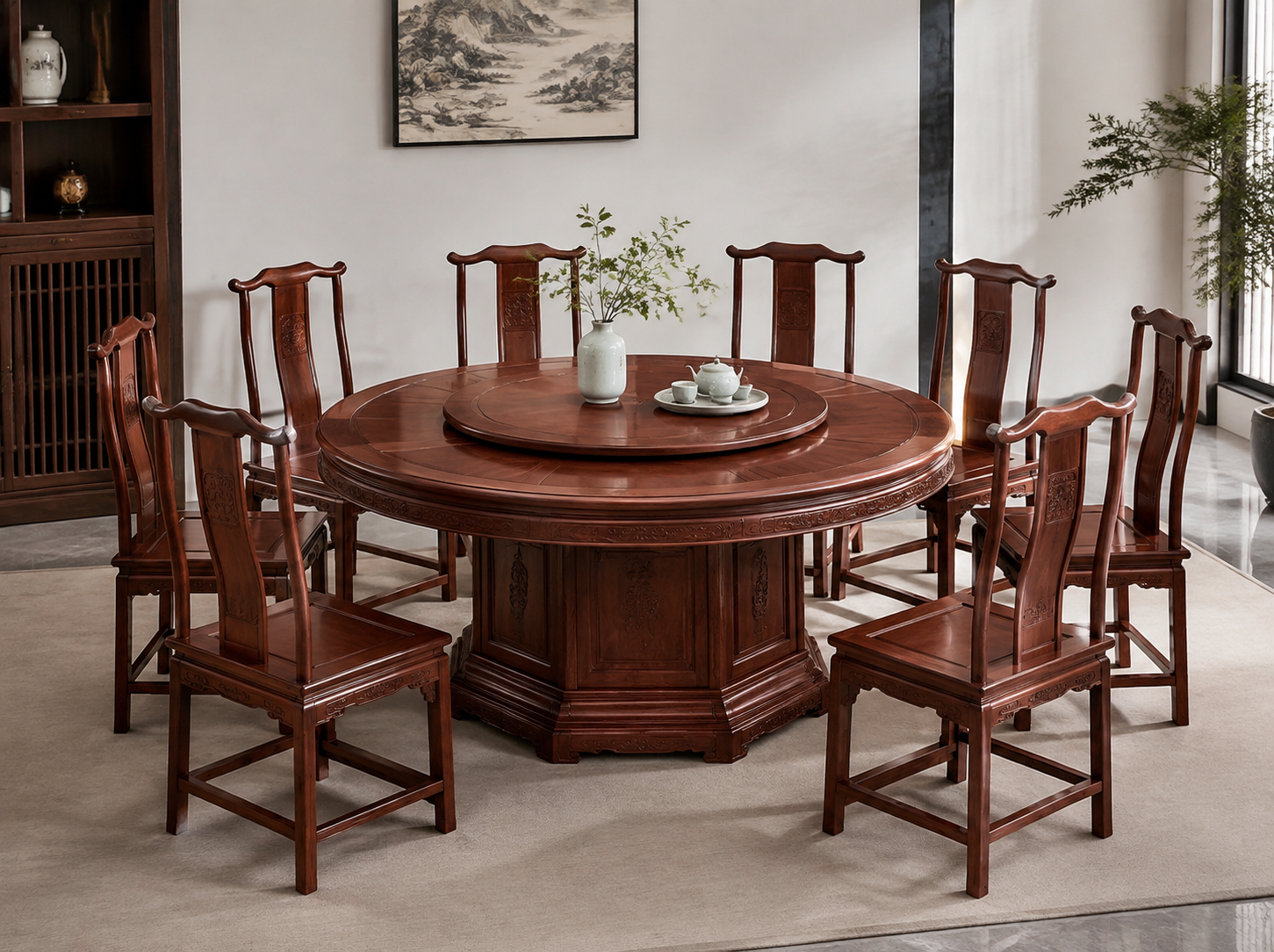
Asian rosewood furniture sells as coordinated sets, and configuration drives both price and container planning. The catalog covers a deliberate ladder: a 3-piece sofa set with carved armrests for compact living rooms; a Qing style 5-piece set built around a 185 cm central sofa with two armchairs, a coffee table, and an end table; a 6-piece phoenix reception set; Ming style 7-piece and 9-piece grand living room sets; and the 10-seat imperial configuration combining a three-seat central sofa, two side sofas, two armchairs, and three tables. Dining programs run from a 4-seat compact set through 6, 8, 10, and 12-seat banqueting sets, and bedroom suites come in coordinated 3, 4, 5, and 6-piece groups.
This ladder exists for a commercial reason: wholesalers rarely need every size, but they need a run of adjacent sizes so retail customers can trade up within one collection. Because all configurations come from one factory with shared joinery and finish standards, a mixed container keeps a consistent look across categories. When requesting quotations, specify the configuration ladder your market supports rather than a single size, and ask for the container loading plan that shows how the ladder packs.
Placing Classical Rosewood in Western Retail and Hospitality Interiors
The fastest-growing demand for rose wood sofa set price comes from projects, not collectors: resort lobbies in Bali and Phuket, banquet halls in Kuala Lumpur and Singapore, Chinese-Australian community clubs, and North American design boutiques running classical accent programs. In these settings classical rosewood works as anchor pieces: a carved sofa group defining a reception area, a 12-seat banqueting set as the centerpiece of a dining floor, a canopy bedroom suite carrying an entire suite-level story.
Yunxiao supports placement work with free layout drawings for projects and remote installation guidance after delivery, which matters because large carved sets must be positioned with clearance for doors, maintenance access, and climate. Buyers planning hospitality projects should request layout drawings during quotation, not after delivery, and should confirm corridor and elevator dimensions at destination before finalizing grand-scale configurations. A ten-seat imperial set is an investment in presence, and presence requires planning.
Export Compliance for Asian Rosewood by Destination Market
Compliance is where uninformed purchases fail, because each destination enforces its own requirements and Yunxiao prepares the full stack per shipment. The essentials by market:
- North America: US Lacey Act declaration support, CARB formaldehyde limits, and FDA food-contact expectations on dining surfaces; satisfied by CITES Appendix II permits, CARB and REACH declarations, and FDA 21 CFR 175.300 finish compliance.
- Australia: strict ISPM-15 and biosecurity inspection; satisfied by heat-treated crates, VCI moisture barriers, and desiccant packing.
- Southeast Asia: CITES permits plus tropical climate stability; satisfied by shipment-specific Appendix II permits and sub-14-percent moisture timber.
- Europe: EUTR due diligence and REACH chemical safety; satisfied by FSC chain-of-custody documentation and REACH declarations.
Buyers should confirm their customs broker has processed CITES Appendix II timber before ordering, and request document samples during quotation rather than after production starts. Missing paperwork, not production quality, is the most common reason rosewood shipments are held at port.
Understanding Pricing Structure Across the Category
Prices within the category vary by a wide margin, and the variation is structural rather than arbitrary. Four variables dominate: wood species and grade, set size and piece count, carving density, and finish specification. A 3-piece set in Machilus Nanmu with restrained carving sits at the accessible end; a 10-seat Siamese rosewood set with 40-hour dragon armrests and nine-coat lacquer sits at the top. Container freight, packing method, and documentation add a smaller, largely fixed layer.
Because pricing is specification-driven, Yunxiao quotes per project: buyers who send seat counts, species preference, carving density, and destination market receive itemized FOB Xiamen quotations with production timeline and document samples within 48 hours. Comparing suppliers without fixing these variables first produces meaningless numbers. Fix the specification, then compare quotes; that sequence is the difference between negotiation and guessing.
Building a First Order: Samples, Trial Sets, and Container Logic
New buyers do not need to start with a full container. The standard onboarding path is: request specifications and document samples, order a trial single set to verify quality in person, then consolidate into container orders. A 40-foot container accommodates 6 to 10 complete furniture sets depending on the mix, and Yunxiao provides a container loading plan with each quotation showing crate volumes and the optimal product combination.
For established partners, partial shipments are available so a wholesaler can phase inventory against sell-through rather than warehousing an entire season at once. Refundable sample sets support design evaluation, and long-term programs move to batch production with dedicated carving and assembly teams for consistent grain, color, and joinery across repeat orders. Payment follows the standard structure: 30 percent T/T deposit to start production, balance before shipment, with L/C available above USD 30,000.
Care, Patina, and Lifetime Value for End Clients
End clients buy classical rosewood as a lifetime asset, and honest care guidance protects the retailer's reputation. Daily care is dry dusting and avoidance of direct heat sources. The hand-rubbed raw lacquer finish is breathable, so the wood keeps interacting with indoor humidity and develops a deeper patina over the years without blistering or peeling, and the metal-free mortise-and-tenon joinery means there is nothing to retighten. Retailers should pass a simple care card with each set; Yunxiao's remote installation guidance covers placement clearances that prevent impact damage during room use. Handled this way, a carved set bought today outlives its first owner, which is exactly the story premium programs sell.
Frequently Asked Questions
How can I verify the furniture is genuine rosewood?
Each shipment carries FSC chain-of-custody documentation and CITES Appendix II export permits naming the species, Dalbergia cochinchinensis. Timber density and heartwood grading records are available on request, and third-party material verification is welcome.
Is Asian rosewood furniture legal to import?
Yes, when documented correctly. Siamese rosewood is CITES Appendix II listed, meaning trade is legal with shipment-specific export permits. Yunxiao is a CITES-registered exporter and prepares permits for every international shipment.
What is the difference between Ming and Qing style?
Ming style favors clean lines, rounded members, and restrained carving; Qing court style uses heavier proportions and dense relief carving with dragon and phoenix motifs. Both use the same joinery and finishing standards.
Will rosewood furniture crack in dry climates?
Properly dried rosewood does not. Timber is kiln-dried for 36 days to below 14 percent moisture, and floating-panel construction on tables, doors, and bed panels absorbs seasonal movement without cracking.
What is the minimum order?
Trial single sets are available for new buyers. Wholesale partners typically order container loads; a 40-foot container holds 6 to 10 complete sets depending on the mix.
How long does production take?
Standard catalog products take 45 to 60 working days after deposit. Custom OEM and ODM orders take 60 to 75 working days, including the 15-day design approval cycle.
Can I customize sizes and carvings?
Yes. OEM and ODM customization covers dimensions, carving patterns, wood species, and finish color, with 3D mockups delivered within 15 working days and physical samples mailed for approval.
What documents come with a shipment?
CITES Appendix II permits, FSC chain-of-custody certificate, ISPM-15 heat treatment certificate, REACH and CARB declarations, commercial invoice with HS code 9403.60, and an itemized packing list, all in English.
How should end customers care for rosewood furniture?
Dust with a dry cloth, avoid direct heat sources, and let the hand-rubbed raw lacquer develop patina naturally. The breathable finish allows the wood to adjust to indoor humidity without peeling.
Which markets does Yunxiao export to?
Southeast Asia, Australia, North America, and Europe, with direct sailing routes from Xiamen to Los Angeles, Long Beach, Sydney, Melbourne, Singapore, and Rotterdam.